









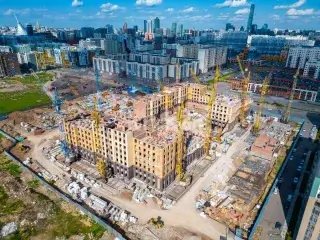



China’s Housing Slump Starts to Ease

China home prices fall at a slower pace
China’s property market delivered one of its clearest signs of stabilization in months in March 2026, as home prices continued to decline in February but at a slower pace than before. That is the central takeaway from Bloomberg’s latest report, and the broader picture is supported by China’s official economic data released on March 16. The housing downturn has not ended, but the change in momentum is increasingly being interpreted as evidence that the worst phase of the property slump may be starting to pass.
For the Chinese economy, the timing matters. Housing has remained one of the main weak points even as manufacturing, exports and high-tech activity became more resilient. A slower pace of price declines gives policymakers a chance to argue that their recent support measures, including city-level adjustments and efforts to manage supply, are beginning to have some effect.
Why slower price declines matter for China’s economy
The importance of the latest data is not that the market has recovered, but that the deterioration no longer appears to be accelerating. After several years of deep correction, even a milder decline in prices can influence buyer sentiment, developer expectations and local government confidence. That is why Bloomberg framed the February figures as a possible indication that the market is approaching a bottom. The signal is especially notable because the property sector remained one of the biggest drags on growth through much of 2025.
China’s official January-February macro data highlight that contrast clearly. Industrial output rose 6.3% year on year, retail sales grew 2.8%, and fixed-asset investment increased 1.8% after falling in 2025. But real estate development investment still dropped 11.1%, the floor space of newly built commercial buildings sold fell 13.5%, and the value of those sales declined 20.2%. In other words, housing remains weak, but it may no longer be worsening at the same pace across every indicator.
China’s property market is still under pressure
Even with softer price declines, it would be premature to describe the market as fully recovering. China’s housing sector still faces structural pressures, including weak buyer confidence, strained developer financing and large inventories of unsold homes in many cities. Recent analysis continues to show that the market is fragile and that nationwide new-home sales remain far below earlier levels. Bloomberg reported earlier this month that the value of China’s new-home sales last year was still more than 50% below the 2021 peak.
Another complication is that price stabilization does not automatically translate into stronger activity. In China’s housing market, transaction volumes, developer investment, construction starts and household expectations are just as important as headline price indices. For now, those indicators still point to an industry undergoing a painful and incomplete adjustment. Official data continue to show falling real estate investment and weaker sales even as broader macro indicators improve.
How Beijing is trying to support the housing market
In recent months, Chinese authorities have preferred a series of targeted and localized measures over one large nationwide rescue package. Bloomberg reported in early March that Beijing planned to rely on city-specific policies to control new supply, reduce inventory and revive the existing housing stock. That approach suggests policymakers are no longer aiming for a rapid return to the old growth model based on aggressive construction, but instead are trying to manage the correction more carefully and limit its damage to the wider economy.
That strategy makes sense given the widening divergence across Chinese cities. Housing pressure is not the same in top-tier urban centers as it is in weaker regional markets, which means a single nationwide policy is less effective than before. February’s softer decline may therefore indicate that more tailored intervention is having a better effect than broad easing alone. At the same time, it also implies that any eventual recovery is likely to be uneven and gradual rather than rapid and synchronized.
Why global investors are watching China housing again
For global investors, China’s housing market is not just a domestic story. The property sector has long been a major source of internal demand, credit creation and local fiscal revenue, and its downturn has affected commodities, construction materials, banks and household confidence. That is why even a modest slowdown in price declines can matter well beyond China. It feeds the idea that the economy may be entering a more stable phase after several turbulent years, especially as industrial production, exports and retail spending improved in the first two months of 2026.
Still, markets are unlikely to treat the crisis as resolved anytime soon. A decline of 11.1% in real estate investment and a 20.2% drop in the value of new commercial building sales still represent a very weak base. The latest figures therefore do not confirm a recovery so much as they change the discussion: instead of focusing on the risk of renewed collapse, investors are increasingly considering the possibility of a slow and uneven stabilization.
As experts at International Investment note, the latest China housing data matter because they suggest the market is moving from a phase of sharp deterioration into a phase of prolonged stabilization. That is not yet a real rebound, but for China’s economy and for global investors, the mere slowdown in the pace of decline is already meaningful: systemic downside risks remain, yet the probability that the cycle is nearing its bottom has increased.