







 Covivio Hotels Revenue Grows 4.7% as European Markets Split
 Lithuanian Apartment Prices Accelerate Across Major Cities
 Georgia's Tourism Revenue Hits Record High
 Norway's Sovereign Fund Commits €1.5bn to European Warehouses
 Market Rout of October 2026: Can Branded Hotels Protect Capital?
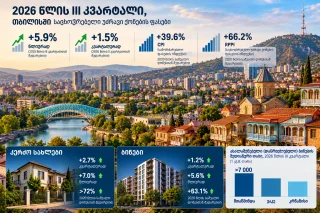 Residential Property Prices in Tbilisi Rise by 5.9% Year-on-Year
Croatia Ends Summer With a Record August

Croatia recorded 17.5 million tourist arrivals and 90.5 million overnight stays from January through August 2026, with both figures rising 1% year on year. August set a new record for arrivals, but private accommodation showed a more restrained picture: arrivals increased during July and August while overnight stays remained unchanged from a year earlier.
Croatia tourism grows 1% in 2026
Croatia recorded 17.5 million tourist arrivals and 90.5 million overnight stays in the first eight months of 2026. Both figures were 1% higher than in the same period of 2025.
The Adriatic accounted for 86.7 million overnight stays, up 0.5% year on year. Continental Croatia, including Zagreb, recorded 3.8 million nights, an increase of 1%.
The eVisitor system covers tourism traffic in commercial and non-commercial accommodation as well as nautical charter activity. Arrivals should not be interpreted as unique visitors because the same traveller can be registered again after changing accommodation.
The Croatian National Tourist Board reported 25.4 million overnight stays in Istria, more than 17 million in Split-Dalmatia County and 15.2 million in Kvarner. Rovinj, Dubrovnik, Poreč, Split, Umag and Medulin were among the destinations with the highest traffic.
The figures point to continued demand at a high level rather than a sharp acceleration. Both national arrivals and overnight stays increased by only 1% over the first eight months.
August sets a new record
August produced the clearest record of the summer season. For the first time, Croatia registered more than 5 million tourist arrivals during the month.
Arrivals increased by 2% year on year, while overnight stays reached 31.4 million, an increase of only 0.5%. The difference means that the number of nights per registered arrival fell compared with a year earlier.
July and August together generated about 9.8 million arrivals and 60.9 million overnight stays. MyRent’s analysis of the official season data shows arrivals increasing 2% and nights 1% during the two months. In household accommodation, arrivals rose 1.5%, while overnight stays remained at their 2025 level.
For owners of apartments and holiday homes, that distinction is more relevant than the national arrival record. Additional trips do not necessarily generate an equivalent increase in nights sold.
Official data show moderate summer growth
The Croatian Bureau of Statistics publishes a separate dataset covering commercial accommodation, so its totals are lower than the broader eVisitor figures.
Commercial establishments recorded 4.476 million arrivals in July 2026, an increase of 2.7% year on year. Overnight stays reached 25.264 million, up 1.2%.
Foreign travellers accounted for 4.065 million arrivals and 23.412 million nights. Domestic visitors generated 411,000 arrivals and 1.852 million nights. The average stay was 5.6 nights per arrival.
During the first seven months of 2026, commercial accommodation recorded 11.726 million arrivals and 51.241 million nights, representing increases of 1.4% and 0.8% respectively.
The two statistical series are therefore complementary rather than contradictory. They cover different parts of Croatia’s accommodation market.
Private accommodation dominates available capacity
Apartments, holiday homes and other small accommodation properties remain a central part of Croatia’s tourism infrastructure.
The official season figures cited by MyRent put household accommodation at 52% of total accommodation capacity and 37% of arrivals. Hotels account for 14% of capacity and 35% of arrivals, while campsites represent 20% and 17% respectively.
Croatia’s official commercial-accommodation statistics also illustrate the scale of non-hotel supply. In June, the category of holiday and other short-stay accommodation provided 563,000 permanent beds, equivalent to 57.1% of all permanent commercial beds available that month. It included 212,000 rooms and apartments.
The category generated 6.3 million overnight stays in June, or 47.1% of the commercial total. That was 5.6% below the previous year, while arrivals fell 6.4% to 1.4 million.
This statistical category is broader than privately owned holiday rentals. It also includes hostels and several other types of short-stay accommodation, so the figures should not be treated as a direct measure of private hosts alone.
Germany remains Croatia’s largest source market
Germany generated 16.9 million overnight stays in Croatia during the first eight months. Domestic travellers accounted for 11.7 million and Slovenia for 9.6 million. Austria and Poland each produced 6.3 million nights, followed by the Czech Republic with 4.5 million, Hungary with 3.7 million, Italy with 3.5 million and the UK with 3.2 million.
This structure leaves the Adriatic tourism market closely tied to demand from Central Europe. Changes in household budgets, driving costs and holiday duration in those countries can have a direct effect on demand for apartments and holiday homes.
Tourism Minister Tonči Glavina has attributed the gap between faster growth in arrivals and slower growth in overnight stays to changing travel patterns, including shorter trips and more cautious spending. That is the ministry’s interpretation rather than a single cause established by the statistics.
Tourism-related fiscalised turnover rises 17.6%
Financial indicators grew much faster than physical tourism volumes.
Croatia recorded €7.41 billion in fiscalised turnover during the first eight months of 2026, 17.6% more than a year earlier. The number of fiscalised receipts increased by 5.7% to 328 million.
The Croatian government presents those figures as an indicator of tourism-related economic activity. The €7.41 billion total should not be interpreted as revenue earned only by hotels and short-term rental operators.
A separate measure comes from Croatia’s balance-of-payments statistics. Revenue from foreign tourists reached €945.2 million in the first quarter of 2026, €79.7 million or 9.2% more than a year earlier. Croatia recorded 1.2 million arrivals and 3 million overnight stays during the quarter.
Foreign-tourist receipts and fiscalised turnover are calculated using different methodologies and should not be added together or treated as interchangeable measures.
Croatia prepares a new short-term rental registration system
The regulatory environment is also changing for owners of tourism properties.
Croatia is preparing to implement European rules on the collection and exchange of data for short-term accommodation. A separate registration number for advertising properties on online platforms is not yet required in 2026.
The Ministry of Tourism and Sport says the requirement is expected to enter into force in early 2027, with the exact date to be determined after adoption of a new hospitality law.
The registration number will apply to both individuals and companies offering rooms, apartments, studio apartments and holiday homes through short-term rental platforms. The ministry plans to issue the numbers digitally and free of charge. They will then have to be displayed on the relevant platforms.
Existing eVisitor requirements remain in force. Accommodation providers must register guests within 24 hours of arrival and deregister them within 24 hours of departure. Separate provisions also apply to owners of holiday homes, apartments and flats.
A national record does not guarantee higher rental income
Croatia’s first eight months of 2026 confirm resilient tourism demand, but national records do not describe the performance of every accommodation property.
The difference between arrivals and overnight stays is particularly important. August arrivals increased by 2%, while nights rose only 0.5%. In household accommodation, arrivals increased 1.5% across July and August but overnight stays did not increase at all.
For tourism-property investors, national visitor numbers are therefore only one part of the calculation. The economics of an individual apartment or holiday home depend on occupancy, nightly rates, average length of stay, operating costs, location and the ability to attract guests outside the busiest summer weeks.
As International Investment experts report, the 2026 results do not support treating the entire Croatian short-term rental market as equally strong. Overnight stays increased only 1% during the first eight months, while household accommodation recorded no growth in nights during July and August. Investors should focus on real occupancy in a specific location, achievable nightly rates, season length, operating expenses and registration requirements rather than relying on national arrival records as a proxy for property returns.
FAQ: Croatia tourism in 2026
How many tourist arrivals has Croatia recorded?
The eVisitor system registered 17.5 million tourist arrivals from January through August 2026, 1% more than during the same period in 2025.
How many overnight stays were recorded?
Croatia registered 90.5 million overnight stays during the first eight months, an increase of 1%. The Adriatic accounted for 86.7 million nights.
How strong was August 2026?
August became the first August on record with more than 5 million tourist arrivals. Arrivals increased 2% year on year, while overnight stays rose 0.5% to 31.4 million.
How is private accommodation performing?
Household accommodation recorded 1.5% more arrivals in July and August, but overnight stays remained unchanged from the same period of 2025.
Which countries generate the most overnight stays in Croatia?
Germany is the largest source market, with 16.9 million nights in the first eight months. It is followed by Croatia, Slovenia, Austria and Poland.
Which Croatian regions receive the most tourism?
Istria led with 25.4 million overnight stays from January through August, followed by Split-Dalmatia County with more than 17 million and Kvarner with 15.2 million.
Do short-term rental hosts need a new registration number in 2026?
No. Croatia plans to introduce the new registration-number requirement for properties advertised through short-term rental platforms in 2027.