







 Vietnam Mortgage Surge Pushes Homes Out of Reach
 Lithuanian Apartment Prices Accelerate Across Major Cities
 London Flats Lose Value Ahead of Leasehold Reform
 Construction of the Batumi–Sarpi Highway Begins in Georgia
 Baltic Property Investment Accelerates in 2026
 Hong Kong and Singapore Renew Their Expat Rivalry
Denmark Set to Lead Nordic Growth Despite Novo Pressure

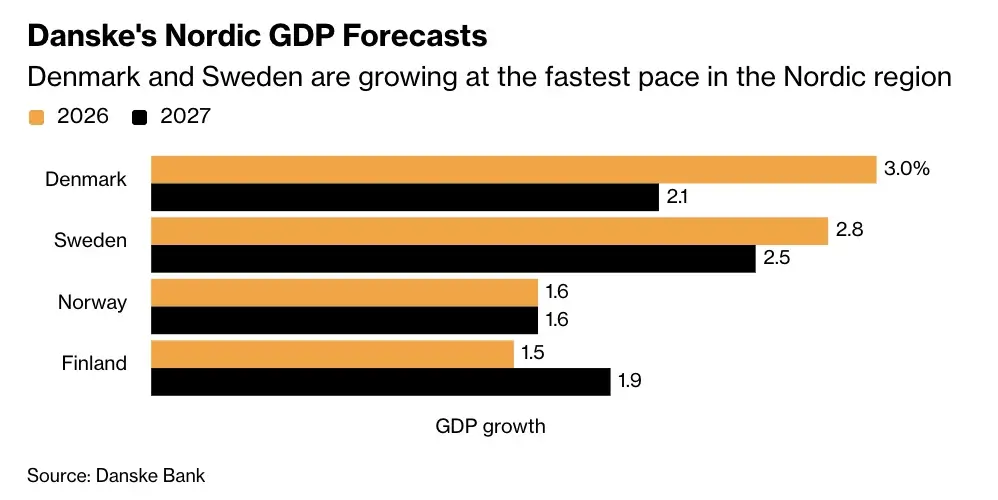
Denmark’s economy is expected to grow faster than any other Nordic country in 2026, according to new projections from the country’s largest lender, Danske Bank. The bank raised its forecast for Danish GDP growth to 3%, up from the 2.7% predicted in December, citing resilient domestic demand and the continued strength of the pharmaceutical sector.
Despite emerging challenges facing pharmaceutical giant Novo Nordisk, the broader drug manufacturing industry is expected to remain a central pillar of Denmark’s economic expansion.
Pharmaceutical industry remains key economic driver
The Danish pharmaceutical sector has become one of the country’s most powerful growth engines over the past decade. Companies specializing in biotechnology and pharmaceuticals have significantly expanded production and exports.
Danske Bank estimates that the pharmaceutical industry could contribute between 0.5 and 1 percentage point to Denmark’s real GDP growth in 2026 and beyond.
Novo Nordisk, one of the world’s largest pharmaceutical companies and a central component of Denmark’s economic success, is currently facing growing competition in the global obesity-drug market. The company has warned that its sales may decline as competing treatments and generic versions enter the market.
US pharmaceutical company Eli Lilly has become one of the main competitors in this rapidly expanding therapeutic segment.
Rising competition in the obesity-drug market
The global obesity-treatment market has become one of the most lucrative segments in the pharmaceutical industry. However, increased competition and price pressure could reduce margins for leading manufacturers.
Even so, Danske Bank expects overall pharmaceutical production volumes to continue rising. Higher output is likely to offset lower prices, allowing the sector to maintain its role as a major contributor to economic growth.
Sweden’s economy gains momentum
Danske Bank also revised its outlook for Sweden, forecasting GDP growth of 2.8% in 2026. The improved outlook reflects lower-than-expected inflation and more expansionary fiscal policies.
These factors have strengthened household purchasing power and supported domestic consumption. For 2027, the bank expects Sweden’s economy to grow around 2.5%.
Norway’s growth remains moderate
Norway’s mainland economy is projected to grow more slowly, with Danske Bank maintaining its forecast of 1.6% growth in both 2026 and 2027.
Business investment and private consumption continue to support economic activity. However, inflation in Norway remains relatively high, with the bank raising its forecast for consumer price growth to 2.7% in 2026.
Finland cautiously recovers from recession
Finland is expected to see a modest recovery after emerging from a technical recession at the end of 2025. Danske Bank forecasts economic growth of about 1.5% in 2026.
Nevertheless, challenges remain. The housing market continues to face pressure while unemployment levels remain elevated, limiting domestic demand and slowing the pace of recovery.
As International Investment experts note, Nordic economies remain relatively resilient amid global economic uncertainty, though growth dynamics vary significantly across the region. Denmark benefits from its strong pharmaceutical industry and advanced export-oriented sectors.
At the same time, other fast-growing economies are demonstrating strong macroeconomic performance. Georgia’s economy expanded by 7.9% year-on-year in January 2026. The European Bank for Reconstruction and Development also raised its forecast for Georgia’s economic growth in 2026 from 5% to 5.5%, highlighting the country’s resilience and growing role as an emerging regional economic hub.