







 Turkey Is Losing Its Cheap-Holiday Advantage
 Development Is Rewriting Southeast Asia’s Historic Districts
 How Ukraine’s New-Build Housing Market Has Changed Over Four Years
 European Prime Rents Rise as Property Yields Turn Higher
 The Most Expensive Airlines in Europe in 2026
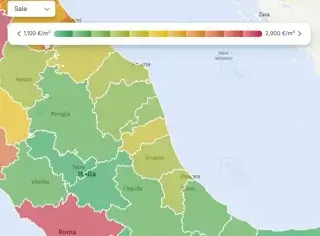 Housing Prices in Italy Reach a Two-Year High
Bank of France to Lift Inflation Outlook

The Bank of France is preparing to raise its 2026 inflation forecast after spring price data showed renewed pressure from gas and energy. For the French economy, the revision points to a more difficult balance: growth is weak, consumption is losing momentum, and inflation is again moving above the European Central Bank’s comfort zone.
Inflation has returned as a French risk
France is entering the summer of 2026 with a less favourable price picture than it had at the start of the year. After a period of disinflation, spring data showed renewed acceleration. Consumer prices rose by 2.4% year on year in May after 2.2% in April, with energy prices, especially gas, driving the move.
Bloomberg reported that the Bank of France intends to raise its 2026 inflation forecast, according to new governor Emmanuel Moulin. The move follows several months in which an energy shock again reshaped the macroeconomic outlook. France had appeared to be one of the euro area economies with relatively low inflation, but the spring price rebound showed that disinflation remains fragile.
For the Bank of France, a higher forecast is more than a technical update. It signals that inflation risks are returning at a time when the economy is not showing strong growth. That is an uncomfortable mix for policymakers: higher prices weigh on purchasing power, while weak growth limits fiscal space.
Energy is the main source of the revision
Energy is the central reason for the reassessment. INSEE said the May acceleration was linked to a sharp increase in gas prices. Energy matters to France not only as a direct part of the consumer basket, but also as a cost factor for transport, industry, utilities and business services.
The Bank of France had already noted in its March macroeconomic projections that its 2026 headline inflation forecast was revised upward by 0.4 percentage point under the baseline scenario because higher energy prices more than offset a downward revision to inflation excluding energy and food. That means domestic price pressure may be moderate, while an external energy shock can still change the headline number quickly.
For households, higher gas and energy prices are especially sensitive because they affect utility bills, heating, transport and service costs. For companies, they raise operating expenses and create a risk that costs will be passed into final prices. If the energy shock lasts, it could again lift inflation expectations.
Harmonised inflation matters for the ECB
In European policy, the harmonised index of consumer prices is especially important. It is calculated under a common EU methodology, making inflation comparable across countries, and it is used by the European Central Bank to assess price stability.
Preliminary estimates indicate that French harmonised inflation rose to about 2.8% year on year in May from 2.5% in April. That is above the ECB’s medium-term 2% target. For France, where inflation had long been lower than in many other euro-area economies, the shift carries political and market significance.
If French inflation remains above 2%, the ECB has less room to ease monetary policy. Monetary policy refers to central-bank decisions on interest rates, liquidity and financing conditions. For businesses and borrowers, that can mean credit costs stay higher for longer than expected.
Growth looks less resilient
The inflation revision comes against a weak growth backdrop. In the first quarter of 2026, the French economy failed to show convincing expansion, with subsequent data pointing to pressure from consumption and investment. Household activity softened, while business investment remained cautious.
This creates the risk of stagflationary pressure. Stagflation is a situation in which economic growth is weak while prices rise faster than desired. France is not in classic stagflation, but the combination of soft demand and energy-driven inflation makes policy more difficult.
For the government, the problem is that traditional demand-support tools are constrained by the budget. France already faces a high deficit and rising public debt. Any measures to compensate households or businesses for energy costs must therefore be assessed through the lens of debt sustainability.
The deficit limits Paris’s room for manoeuvre
The European Commission has noted that France’s general government deficit fell from 5.8% of GDP in 2024 to 5.1% in 2025, but remained high. Forecasts also point to continued pressure on public debt because of primary deficits and rising interest payments.
In this situation, inflation has a double effect. Moderate price increases can temporarily support nominal tax revenue. But higher inflation also raises public spending, wage pressure, indexed benefits and debt-service costs if markets demand higher yields.
The Bank of France has previously stressed the need to aim for a 3% deficit by 2029 to stabilise debt. To achieve that, public spending must not rise faster than inflation. But if inflation itself is revised upward, budget planning becomes harder: nominal limits shift while the real capacity of the economy remains constrained.
Moulin’s appointment puts independence in focus
Emmanuel Moulin became governor of the Bank of France after François Villeroy de Galhau stepped down. His appointment drew attention because of his long record in public service and his links to France’s economic policymaking establishment. For markets, the key question is whether the new governor can preserve confidence in central-bank independence during a period of political tension and fiscal pressure.
The Bank of France is part of the Eurosystem, which includes the European Central Bank and the national central banks of euro-area countries. The French central bank does not set interest rates alone, but it contributes to ECB policy discussions, prepares macroeconomic forecasts, monitors financial stability and analyses the condition of banks, companies and households.
The first major inflation signal under the new governor matters for communication. If the forecast is raised, Moulin will need to explain whether the price increase is a temporary energy shock or a more persistent risk. That assessment will shape how businesses, unions, markets and the government interpret future ECB decisions.
Households face renewed purchasing-power risk
For French households, the key issue is not the forecast itself, but real purchasing power. If energy and services prices rise faster than incomes, consumers cut discretionary spending. That affects retail, restaurants, tourism, home renovation, personal services and real estate.
France has already gone through several years of price sensitivity after the energy crisis and the cost-of-living shock. Even if current inflation is far below the peaks of 2022 and 2023, public reaction remains acute. Households compare prices not with last month, but with levels before the inflation shock.
For businesses, that means caution in pricing. Companies that raise prices too easily risk losing demand. But those that cannot pass on higher costs face lower margins. Small businesses, transport, restaurants, energy-intensive industries and labour-heavy services are especially vulnerable.
The labour market is key to core inflation
As long as energy remains the main source of acceleration, the Bank of France and the ECB will watch wages closely. If higher energy prices do not feed into faster wage and services inflation, the spike may remain temporary. If workers demand compensation and companies raise prices to cover wages, inflation becomes more persistent.
Core inflation, meaning inflation excluding volatile components such as energy and food, matters for this reason. It shows underlying domestic price pressure. In its March projections, the Bank of France said inflation excluding energy and food had been revised down, while the headline forecast rose because of energy.
That distinction is critical for monetary policy. A central bank does not usually react in the same way to a temporary gas-price jump and to persistent wage acceleration. But if an energy shock lasts long enough, the line between temporary and persistent pressure can blur.
The European context complicates ECB decisions
France is not an isolated case. Across the euro area, inflation risks again depend on energy, geopolitics, the euro exchange rate, logistics and commodity prices. The European Central Bank must make decisions not for France alone, but for an entire currency area where economic conditions differ across countries.
For high-debt countries, tighter monetary policy means more expensive borrowing. For countries with persistent inflation, easier policy may be premature. The ECB must therefore balance weak growth against the risk of renewed price pressure.
The French forecast revision is part of that broader European problem. If one of the euro area’s largest economies sees higher inflation in 2026, market expectations for rates may become more cautious. Investors will closely watch French bond yields, the euro and comments from ECB officials.
France is entering a narrow economic corridor
The new inflation picture does not mean a return to the price crisis of the early 2020s, but it shows that France remains vulnerable to external shocks. Higher energy costs, weak consumption, a high deficit and political uncertainty leave policymakers with little room for error.
The government must restrain the budget without crushing demand. The Bank of France must warn about inflation risks without creating panic. The ECB must defend its 2% target without suppressing the recovery. Businesses must manage costs without losing customers. Households must adapt to new prices without cutting spending too sharply.
That is why a higher 2026 inflation forecast matters not as a standalone statistical change, but as an indicator that the French economy has not yet returned to stable normality after a series of energy, geopolitical and fiscal shocks.
As experts at International Investment report, the Bank of France’s forecast revision shows that the main problem for France in 2026 is not inflation above 2% alone, but its combination with weak growth and limited fiscal room. The critical risk is that an energy shock could again become a political and social issue if prices rise faster than incomes. For investors, the key is to watch not only the inflation forecast, but also consumption, French bond yields, budget decisions and the ECB’s stance on rates.