







 Turkey Is Losing Its Cheap-Holiday Advantage
 Development Is Rewriting Southeast Asia’s Historic Districts
 How Ukraine’s New-Build Housing Market Has Changed Over Four Years
 European Prime Rents Rise as Property Yields Turn Higher
 The Most Expensive Airlines in Europe in 2026
 Housing Prices in Italy Reach a Two-Year High
EU Allows Temporary Suspension of EES System at Borders
POLITICO
The new Entry/Exit System (EES) is facing capacity problems at European airports and other border crossing points. As a result, biometric checks may be suspended during periods of heavy passenger traffic to avoid hours-long queues and missed flights, POLITICO reports.
The exception is in place until September
The European Commission has allowed the temporary suspension of biometric data collection when excessive queues occur. The measure is in effect until September 6 and applies to all entry points into the Schengen Area. During periods of high traffic, the option is already being used at airports in Paris and Amsterdam. Air France-KLM said the measure helps maintain a smooth flow of passengers. Similar arrangements are in place in Frankfurt, Brussels and Milan.
At Brussels Airport, a special derogation was introduced as early as the end of March after 600 passengers missed their flights within a 21-hour period. The Belgian Federal Police confirmed that border control authorities may use the derogation when necessary.
The exception applies to all entry points, including railway terminals. For example, British traveler Rene Colandog said that in July, before taking a Eurostar train from London St Pancras to Brussels, he only had to present his passport — no fingerprints or facial scan were taken.
Initially, this option was not intended to be a standard way of operating the system. However, the European Commission authorized the temporary suspension of biometric registration in exceptional circumstances during the summer season. The measure remains in place until September 6.
Eight EU countries and Switzerland are now calling for the arrangement to be extended beyond September 6.
Reasons for the disruption to biometric checks
The main problem is the additional time required to complete the new procedure. During the tourist season, the number of passengers at border crossing points rises sharply, while EES requires officers to carry out more procedures for each traveler.
The situation is further complicated by the early stage of the system's operation. Almost all travelers are going through registration for the first time, which makes the process take longer. Technical problems can also slow the procedure: if the equipment is not working, the required data must be entered manually.
In practice, this has already resulted in hours-long queues and missed flights. Lufthansa CEO Carsten Spohr said passengers had missed connecting flights because of the EES procedures. The airline managed to reach an agreement with German authorities and Frankfurt Airport to suspend biometric procedures because delays had become too long.
IATA has reported delays and missed connections in Portugal, Spain, Italy, Greece and Belgium. Ryanair has warned of queueing problems at airports in popular tourist destinations, including Alicante, Malaga and Palma.
Staffing levels are another issue. At Milan Malpensa Airport, border control currently consists of around 35 officers. According to Cristian Sternativo, another 10 to 15 employees are needed during peak periods to carry out all the checks required by the system without creating long queues. He described full operation of EES with the current staffing level as “unthinkable,” because the new procedure requires more time. Sternativo also believes that strict application of the full procedure during peak periods could lead to public order problems, as the existing infrastructure is not sufficient to accommodate all passengers.
EES implementation and initial results
The Entry/Exit System began its phased rollout in October 2025 and became fully operational on April 10, 2026. Its launch had been delayed for several years because border authorities needed to prepare for the additional workload.
EES applies to non-EU citizens entering the 29 countries of the Schengen Area. The system replaces passport stamps with electronic registration of border crossings and makes it possible to track overstays.
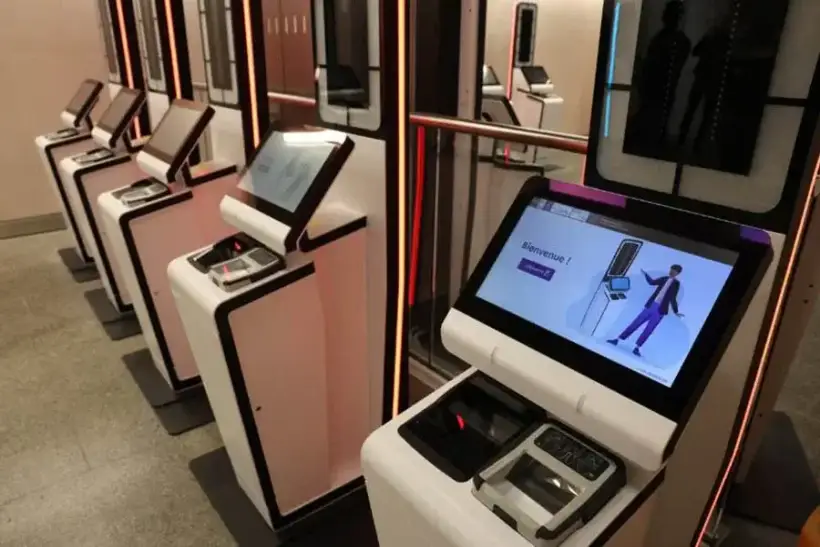
Upon entry, travelers use an EES kiosk to have their fingerprints taken and their photograph recorded. This data is stored for three years. Passengers then proceed either through electronic passport gates or to a border control officer. If the equipment is not working, the data must be entered manually.
European Commission spokesperson Guillaume Mercier said the advantages of the new system for the EU were evident. It increases the security of EU citizens and replaces paper stamps with a modern system of registration and checks. Biometric checks have already helped identify cases of identity fraud that would likely have gone undetected without EES.
Since its launch, the system has registered 110 million entries into and exits from the Schengen Area. Around 44,500 travelers were refused entry, mainly because they could not provide evidence of the purpose of their trip or their right to stay. A further 9,000 refusals were linked to overstaying the permitted period of stay. More than 1,000 people were prevented from crossing the border because they were suspected of posing a threat to internal security. Another 300 were stopped while attempting to enter using forged passports or other fraudulent documents.
Conclusion
Border authorities stress that the temporary suspension of fingerprint collection and facial scanning does not mean that border controls are being abandoned. “The traveler is always registered in the EES, and the required travel document data are entered into the system,” the Belgian Federal Police said. The agency emphasized that the security of border checks and compliance with European rules remain a priority.
The next major project is expected to be the European Travel Information and Authorization System (ETIAS). It will require citizens of 59 countries whose nationals currently do not need a visa for short-term travel to the Schengen Area to register in advance, undergo a security check and pay a small fee. ETIAS was originally scheduled to launch in 2021, then planned for 2026, and has since been postponed to 2027.
International Investment analysts note that the EU is continuing to move border controls into the digital sphere, although the rollout of new technologies is still accompanied by practical difficulties. The temporary suspension of biometric checks helps prevent disruptions during the peak summer travel period, but also highlights the current limitations of EES. Until EU countries have sufficient resources to operate the system smoothly during periods of peak demand, the full procedure at individual border crossing points will continue to depend on queue levels and the capacity of local border authorities.