











Berlin is turning labour shortages into a permanent global hiring strategy
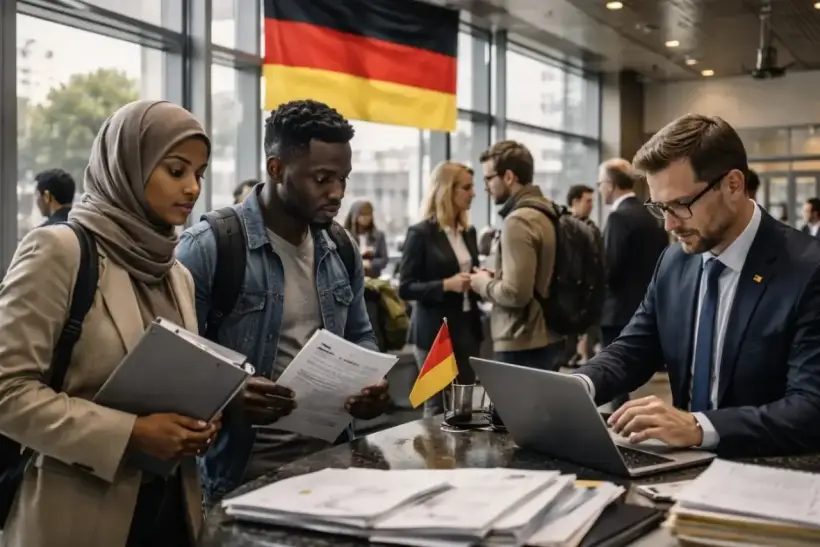
Germany is intensifying its push to recruit workers from abroad as labour shortages are increasingly treated not as a temporary bottleneck but as a structural constraint on the economy. In official communication from Berlin and federal agencies, the estimate that the country needs around 400,000 new workers and skilled professionals each year is now firmly embedded in the policy debate. That figure is tied to demographic decline, retirements and the shrinking domestic labour pool, which is why Germany is now combining labour-migration reform, digitalisation and new recruitment infrastructure into a broader external hiring strategy.
The ETIAS framing of Germany’s new global hiring plan fits that broader policy shift. But the official German picture shows that this is not one isolated reform. It is a layered strategy built around the revised Skilled Immigration Act, the planned Work-and-Stay Agency, digital visa channels, an expanded EU Blue Card and instruments such as the Opportunity Card. Together, these measures are designed to make Germany more competitive in the global market for labour.
Where the 400,000-worker figure comes from
The 400,000 number is not a brand-new April 2026 statistic, but it remains one of the most frequently cited estimates in Germany’s labour debate. In 2024, Germany’s Federal Interior Ministry explicitly said the country was short of 400,000 “great minds and even more hands” every year, warning that the gap was slowing the economy and making it essential to attract urgently needed talent from around the world. That language closely matches the direction of Germany’s current migration and labour-market policy.
Research from SWP Berlin, drawing on estimates by the Institute for Employment Research, says current labour volume in Germany can only be maintained with annual net immigration of about 400,000 workers until 2035. The same paper points to especially acute shortages in social services and education, healthcare and care work, construction, skilled trades and STEM occupations. That matters because the 400,000 figure in German policymaking is fundamentally tied to long-term demographic pressure rather than a single-year recruitment target.
Germany’s labour shortage remains significant even in a weak economy
Germany’s labour shortage has not disappeared with the softer economic cycle. In May 2025, the Federal Employment Agency said shortages still affected 163 occupations out of roughly 1,200 assessed, or about one in eight skilled occupational fields. The most acute bottlenecks remained in nursing and healthcare, construction, skilled trades, driving occupations and early childhood education. The agency also said there were on average about 439,000 registered vacancies in 2024 for skilled workers, specialists and experts in jobs subject to social security contributions, with almost half of those vacancies concentrated in bottleneck occupations.
That shows the problem is no longer just cyclical. Even as the ifo Institute reported some easing in February 2026, it still found that 22.7% of companies were struggling to find qualified workers. In other words, the shortage may have become less intense than at peak levels, but Berlin still sees a persistent structural gap that supports a long-term recruitment strategy focused on international workers.
Berlin is betting on the Work-and-Stay Agency
One of the central new pillars of that strategy is the Work-and-Stay Agency. In November 2025, the federal cabinet approved the core framework for the new structure, and Germany’s Labour Ministry said its purpose was to make immigration to Germany easier for skilled professionals from third countries and to support German employers in recruiting international talent. The agency is supposed to cover labour migration as well as immigration for training, study and qualification measures, while existing procedures are to be streamlined and digitalised.
The European Commission’s February 2026 overview of migrant employment in Germany describes the planned Work-and-Stay Agency as a digital platform that will centralise applications, documents and coordination between authorities. The Commission says the aim is to ease access both for migrant professionals and for employers, including small and family-run businesses. The platform is not meant to evaluate foreign qualifications by itself, but rather to reduce fragmentation and speed up an otherwise cumbersome migration process.
Germany’s hiring model is already changing through visa and residence reform
Germany’s current recruitment push does not start from scratch. Under the revised Skilled Immigration Act, the country has already widened legal pathways for non-EU professionals. The Make it in Germany portal says the law made it easier for skilled workers with vocational training and people with practical knowledge to immigrate, while also expanding existing tools such as the EU Blue Card and introducing the Opportunity Card for job search. The reforms were phased in from November 2023 onward.
Among the most important changes are lower salary thresholds for the EU Blue Card, a widened list of shortage occupations, access for IT specialists without a university degree if they can prove relevant experience, and the Opportunity Card, which allows third-country nationals to enter Germany to seek work. The law also eased some qualification-recognition routes and made it easier for foreign professionals to transition into employment and long-term residence.
The number of foreign workers in Germany has already risen sharply
The latest results suggest Germany is already attracting more labour migrants than before the 2020 reform cycle. In February 2026, the Federal Employment Agency said that by June 2025 the number of employees from third countries working in jobs subject to social insurance contributions and holding residence or settlement permits for employment had reached 420,000. In 2020, the number had been just above 200,000. More than half of those workers had come to Germany as EU Blue Card holders.
The same release said the number of Blue Card holders from non-EU countries had climbed to 164,000, up 114% from 2020. It also said the Federal Employment Agency had conducted 360,000 digital counselling sessions with international workers by the end of 2025, including 23,600 sessions focused specifically on the recognition of foreign vocational qualifications. That matters because Germany is not trying to build demand from zero. It is trying to turn an existing inflow of international interest into a faster and more coherent hiring system.
Why Germany is looking globally rather than relying on the EU labour pool
German policy and research increasingly assume that EU internal mobility alone will not solve the problem. SWP Berlin argues that labour shortages can no longer be offset by migration from within the EU, because all member states are facing similar demographic ageing. That is why attracting workers from third countries is now treated as strategically important for Germany’s long-term economic future.
That logic aligns with the Labour Ministry’s broader skilled-labour strategy, which says Germany is dealing simultaneously with digitalisation, decarbonisation and demographic change, and that securing labour supply is critical to innovation capacity and economic resilience. International recruitment is therefore no longer presented as a supplementary option, but as part of a long-term growth model.
What is still slowing Germany down
Even with more open rules, Germany acknowledges that administrative barriers remain a major obstacle. The European Commission says the planned Work-and-Stay Agency is needed precisely because visa and residence procedures for foreign workers have been too fragmented and complex. That echoes earlier German analyses that argued for a fully digital visa process and better coordination between consulates, immigration offices and labour-market institutions.
Germany’s labour market is also unevenly structured. The Federal Employment Agency notes that although average unemployment stood at roughly 2.7 million in 2024, businesses still often could not find the skilled workers they needed because supply and demand diverged by qualification, occupation and region. In that sense, Germany’s challenge is not simply the total number of available workers, but the shortage of specific skills that can most rapidly be supplemented through managed migration and targeted global recruitment.
As International Investment experts note, Germany’s current global hiring plan matters because Berlin is no longer treating foreign labour as a secondary source of staffing. It is increasingly embedding labour migration into the country’s core economic architecture. The real test, however, will not be the political symbolism of the 400,000 figure, but whether Germany can speed up visa handling, simplify recognition of qualifications and turn the Work-and-Stay Agency into a truly functioning single entry point for employers and candidates.
FAQ on Germany’s labour shortage and foreign hiring push
Does Germany really need 400,000 workers a year
Yes. That estimate is widely used in Germany’s labour and migration debate as a benchmark for the country’s annual labour need driven by demography and retirements. It appears in official government communication and in research based on IAB estimates.
Is this a new one-off plan to recruit 400,000 people
No. It is not a one-time campaign. The figure refers to a recurring annual labour need that Germany is trying to address through labour migration, visa reform and administrative digitalisation.
Which sectors are most affected by labour shortages in Germany
According to the Federal Employment Agency, the most acute shortages remain in healthcare and care work, construction, skilled trades, driving occupations and early childhood education. Broader analysis also points to IT, STEM and social-sector shortages.
What is the Work-and-Stay Agency
It is a new German digital structure designed to simplify immigration for skilled workers from third countries. It is supposed to centralise and accelerate applications, document handling and coordination across authorities.
Are Germany’s new labour-migration pathways already in use
Yes. Germany has already widened the EU Blue Card, introduced the Opportunity Card and eased several entry and residence rules under the revised Skilled Immigration Act. By June 2025, the number of third-country workers with employment-based residence rights had reached 420,000.