







 Vietnam Mortgage Surge Pushes Homes Out of Reach
 Lithuanian Apartment Prices Accelerate Across Major Cities
 London Flats Lose Value Ahead of Leasehold Reform
 Construction of the Batumi–Sarpi Highway Begins in Georgia
 Baltic Property Investment Accelerates in 2026
 Hong Kong and Singapore Renew Their Expat Rivalry
Iran war hits Germany property market
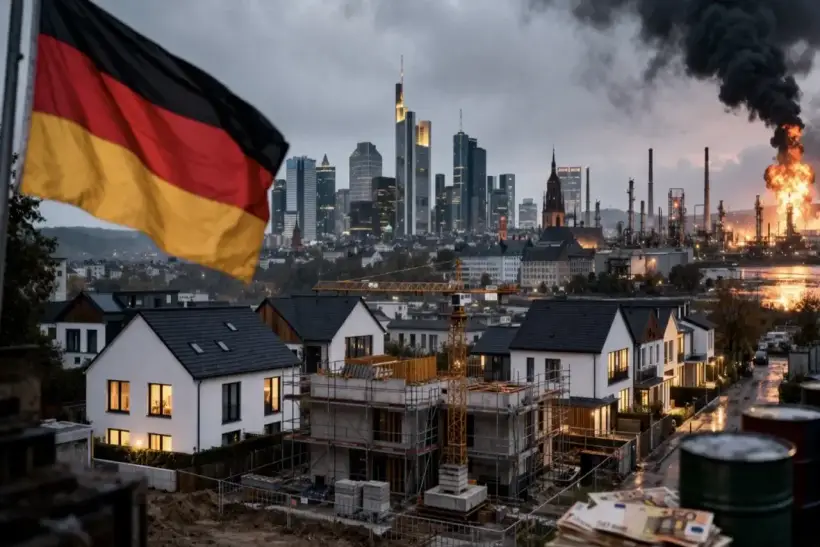
Germany’s housing market is again feeling an external energy shock
Germany’s housing market is once again being hit by geopolitics. The Local reports that the war in Iran is already driving up mortgage costs in Germany, making property purchases more expensive and increasing uncertainty for buyers, builders and the wider market. The transmission chain is straightforward: higher energy prices lift inflation expectations, bond yields move up, mortgages become more expensive, and project economics deteriorate across the housing sector.
That mechanism matters especially in Germany because the property market had only just begun to stabilise after the previous 2022–2023 shock. Market mortgage guides in mid-March 2026 put 10-year fixed mortgage rates in Germany at roughly 3.4% to 3.9%, with a central nominal reference point around 3.52%. That remains far above the ultra-low financing environment of 2021 and is highly relevant in a market where home purchases depend heavily on long-term borrowing.
Why German mortgage rates are rising with oil
The Local says German mortgage rates are closely tied to yields on 10-year German government bonds, which serve as a benchmark for home financing. It reports that after the US and Israel attacked Iran in late February, Bund yields rose by about 0.3 percentage point and reached their highest level since 2023, while roughly 30% of mortgage lenders in Germany had already increased rates. That is consistent with the broader market mechanism: if inflation risk rises, long-dated money becomes more expensive, and housing finance follows.
While I could not independently open the original Wirtschaftswoche reporting cited by The Local, the macro framework is supported by the ECB’s official rate structure. The ECB deposit facility currently stands at 2.00%, after a series of cuts in 2024 and 2025. That means the latest rise in mortgage rates is not being driven by a fresh ECB hike that has already happened, but by a repricing of longer-term inflation and market risks.
Homebuyers in Germany are again losing affordability
For buyers, even small rate shifts quickly translate into meaningful costs. The Local, citing Interhyp, says that a rise from 3.6% to 3.8% on an average loan of €340,000 means about €600 more per year in interest payments. It also gives an example of roughly €6,500 in additional interest costs over ten years on a €250,000 mortgage. Those figures are plausible for the German market, where loans are large and fixed-rate periods are long.
The pressure is strongest for buyers with little equity. The Local says borrowers financing a very large share of the purchase price are again facing mortgage rates that start with a four, while those with more capital can still secure better terms. That matters in Germany because transaction costs are already high: market guidance still suggests buyers should ideally bring at least 20% equity plus the full ancillary purchase costs.
The energy shock is hurting construction as well as finance
The problem does not stop at mortgage pricing. The Local notes that higher fuel and energy prices also push up construction costs directly. That fits the broader industry evidence. In the FIEC statistical report on Germany, 55% of construction companies said at the start of 2025 that energy and raw-material prices were a risk to their business. The same report says residential construction remains the sector’s biggest problem area after the deep downturn of 2023 and a further decline in residential orders in 2024.
Even before the latest Middle East shock, German housing construction was fragile. FIEC says building-construction orders fell 5.0% in 2024, while residential construction orders dropped 3.5% after a slump of almost 20% in 2023. That means any fresh increase in financing and material costs raises the risk that projects are delayed again and that new supply remains below the country’s housing needs.
Germany’s property market is revisiting a 2022 pattern
The Local explicitly draws a comparison with 2022, when Russia’s war in Ukraine sent energy prices and mortgage costs sharply higher and abruptly cooled Germany’s real-estate boom. The comparison is reasonable. Germany is once again dealing with an external energy shock that raises financing costs while also eroding household purchasing power. When families spend more on energy and transport, they have less room to save for a deposit or absorb higher debt-service costs.
That is especially sensitive for the wider economy because the new oil shock has hit during a fragile recovery. In early April, AP reported that German economic institutes had cut their 2026 growth forecast to 0.6%, while eurozone inflation accelerated to 2.5% in March amid the Iran war and higher energy costs. For real estate, that is a poor combination: weaker growth, more expensive energy and the risk of higher-for-longer borrowing costs.
What this means for buyers, sellers and developers
For buyers, the immediate result is a return to caution: larger equity buffers are needed, debt-service calculations become tighter, and some households will need to reduce their target budget. For sellers, that likely means a slower buyer pool and less room for aggressive price gains in rate-sensitive segments. For developers, the central issue again becomes the cost of capital and inputs rather than housing shortages alone.
As International Investment experts note, the impact of the Iran war on Germany’s property market is working through two channels at once: mortgage pricing and construction costs. If the oil shock proves short-lived, the market may face only another cautious phase. But if expensive energy persists and bond yields stay elevated, Germany risks another stretch of weak housing demand, delayed projects and worsening affordability for would-be buyers.
FAQ on Germany’s housing market
Why does the Iran war affect German property
Because it raises energy prices and inflation fears, which then affect bond yields, mortgage costs and construction expenses.
How much have mortgage rates moved in Germany
The Local says 10-year Bund yields rose by about 0.3 percentage point after the conflict escalated and that some German lenders already raised mortgage pricing. Mid-March market references put 10-year mortgage rates broadly around 3.4% to 3.9%.
Who is most exposed
Buyers with low equity and developers of new projects are most exposed because they are most sensitive to financing and input-cost increases.
Could this slow German housing construction again
Yes. Residential construction is already the weakest part of Germany’s construction market, and new energy and rate shocks increase the risk of delays and cancellations.
Is this already a new housing crisis
Not yet in full-crisis terms. It is more accurate to describe it as a renewed risk shock to a still-fragile recovery in Germany’s housing market.