









Empty Homes Tighten Greece’s Housing Market
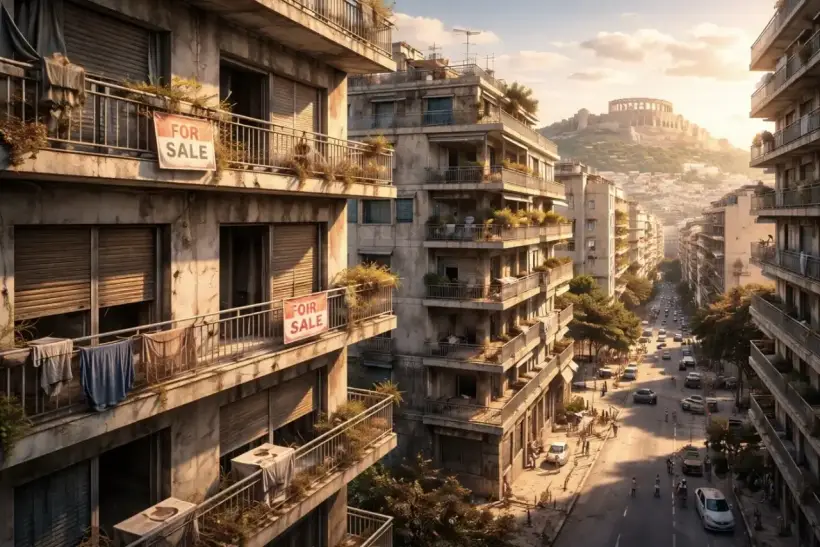
Housing shortages deepen in Athens and Thessaloniki
Greece’s housing shortage is worsening, especially in the country’s largest urban centers, including Greater Athens and Thessaloniki, where supply pressures are most severe. eKathimerini, citing Alpha Bank research, says the market is being constrained by three structural factors at once: a high share of vacant homes, the ageing housing stock and weak investment in new residential construction.
An ageing housing stock limits effective supply
One of the clearest constraints is the age of the country’s homes. According to the figures cited in the report, only 2.6% of Greece’s existing housing stock was built in the past 15 years, meaning after the start of the economic crisis. As a result, the average age of homes is now well above 30 years, and a large share of properties requires renovation before it can be sold or rented.
That has direct consequences for supply. A home may exist in the national housing stock on paper, yet still remain commercially unusable. Many older apartments and houses need substantial spending before they can re-enter the market, and owners are often unwilling or unable to make that investment quickly. This helps explain why a large stock of dwellings does not translate into readily available housing in practice.
Vacant housing remains one of Greece’s biggest distortions
Based on the 2021 building census, 35% of Greece’s homes are unoccupied, which the article describes as the third-highest rate in the European Union. Of that total, 12% are completely empty homes, while another 22.5% are holiday or secondary residences.
Although holiday homes increased by almost 10% compared with the 2011 census and empty homes declined by 11.6%, the overall volume of underused housing remains substantial. The article estimates that Greece has around 794,000 vacant homes nationwide. About a third of them, or roughly 262,000 units, are located in Greater Athens.
Why Athens faces scarcity despite a large housing stock
At first glance, a housing shortage alongside a large pool of vacant homes appears contradictory. The numbers suggest otherwise. In Greater Athens, vacant homes account for about 11.8% of the city’s total housing stock, which is estimated at roughly 2.2 million homes. That means a significant share of the capital’s residential inventory remains outside active market circulation.
This is why rising demand in Athens and other major urban markets is not being automatically matched by more listings. Supply is constrained not only by limited construction, but also by the fact that many existing homes are either not ready for use or are tied up by financial and legal obstacles.
Renovation costs keep many homes off the market
The survey cited by eKathimerini shows that 11% of respondents said they owned undeveloped or vacant housing. The share of such owners is higher in the rest of the country, at 14%, compared with 7% in Athens and 11% in Thessaloniki.
Among owners of vacant homes, 42% said the main reason for leaving the property unused was the high cost of reconstruction or renovation. Another 21% pointed to inheritance disputes and multiple ownership. These figures suggest that the barriers preventing housing from re-entering the market are not purely financial but also legal and administrative.
Weak construction investment worsens the imbalance
Low investment in new residential development remains the third major factor keeping supply tight. After Greece’s debt crisis, the construction sector went through a sharp contraction, and the share of homes built in the last 15 years remained very small. As a result, the housing markets of Athens and Thessaloniki still depend heavily on older stock that often fails to meet current requirements for renters, buyers and investors.
For the two largest cities, this means population pressure, shifting household structures and investor demand are meeting a limited pipeline of quality homes. In practical terms, that supports higher sale prices and rents even while the country continues to carry a large stock of unused housing.
As International Investment experts report, Greece’s housing market is showing a classic structural gap between nominal housing stock and real market supply. For investors and property owners, the main reserve for future growth lies not only in new construction, but also in bringing old vacant homes back into circulation through renovation, ownership consolidation and lower legal barriers.
FAQ
Why is Greece facing a housing shortage if so many homes exist
Because a large share of the housing stock is not available to the market. The article says 35% of homes are unoccupied, while many units require renovation or remain tied up due to ownership complications.
How many vacant homes are there in Greece
The total number of vacant homes is estimated at about 794,000 nationwide. Roughly 262,000 of them are located in Greater Athens.
Why are owners not renting out or selling vacant properties
The leading reason is renovation cost, cited by 42% of owners of vacant homes. Another 21% pointed to inheritance issues and multiple ownership.
How old is Greece’s housing stock
Only 2.6% of the country’s housing stock was built in the past 15 years, and the average age of homes is well above 30 years.
Why is the problem most visible in Athens and Thessaloniki
Because these are the markets with the strongest demand and the sharpest supply shortages, while a part of the older housing stock remains outside the market.