







 Vietnam Mortgage Surge Pushes Homes Out of Reach
 Lithuanian Apartment Prices Accelerate Across Major Cities
 London Flats Lose Value Ahead of Leasehold Reform
 Construction of the Batumi–Sarpi Highway Begins in Georgia
 Baltic Property Investment Accelerates in 2026
 Hong Kong and Singapore Renew Their Expat Rivalry
Greek Hotels Enter Season Under Pressure
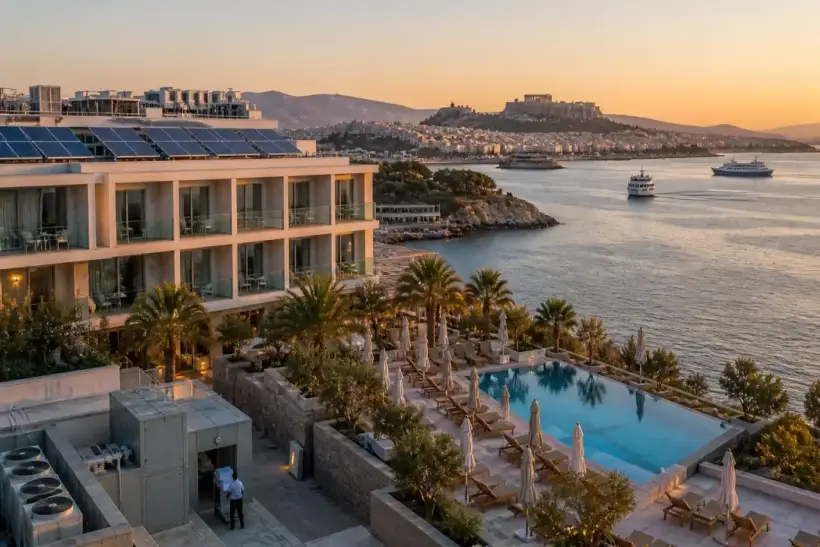
Costs reshape hotel performance
Greece’s hospitality sector is entering the high season with pressure not from a collapse in demand, but from weaker profitability. Travel Daily News reported on May 4 that first-quarter performance was affected by operating costs and shifting demand dynamics, forcing hotels to reassess pricing, occupancy and revenue expectations.
Operating costs include day-to-day expenses for labor, energy, maintenance, food, supplies and management. For Greek hotels, these costs are especially important because much of annual revenue is generated during a concentrated summer period, while labor and utility bills affect the business throughout the year.
Athens outperforms resort markets
Hotels in Athens, Attica and the Argosaronic Gulf posted a positive first quarter: average occupancy rose 2.4%, average daily rates increased 2% and revenue per available room climbed 4.5%. March was weaker than January and February, however, with hoteliers pointing to international uncertainty and the need for continuous forecast revisions.
Revenue per available room is a key hotel performance metric that shows how much revenue a property generates for each available room, whether occupied or not. It combines pricing power and occupancy into one measure.
Demand, not pricing, drives growth
Hotellab said in its April report that Greece is entering 2026 with a split market dynamic, where growth is being driven more by demand and occupancy than by higher prices. The report covers Athens, the Cyclades, Halkidiki, the Ionian Islands and Chania, using January–March actual data and projections for the rest of the year.
That points to limited room for broad price increases. After the strong recovery of 2022–2025, travelers are more sensitive to total trip costs, while competition among Mediterranean destinations remains high.
Energy and geopolitics weigh on tourism
IOBE, Greece’s Foundation for Economic and Industrial Research, warned on April 20 that tourism faces a more demanding environment in 2026 as rising costs, geopolitical tensions and energy pressures affect demand and spending. The institute expects tourism activity to remain broadly comparable with 2025 in real terms, while revenues may come under pressure from weaker visitor spending.
Greece is particularly exposed to higher transport costs because a large share of visitors arrive by air. That makes the country more vulnerable than some European destinations that are easier to reach by rail or road.
Europe’s hotel recovery remains uneven
The Greek outlook also fits a broader European pattern. STR and Tourism Economics forecast in February that revenue per available room across 31 European hotel markets would rise by 1.1% in 2026, with gains concentrated in selected markets and heavily influenced by events, pricing and local demand.
For Greece, the implication is clear: a powerful tourism brand no longer guarantees automatic profit growth. Hotels must protect occupancy without undermining rates, while controlling costs that are increasingly exposed to external shocks.
As experts at International Investment report, Greece remains attractive for hotel investors, but the growth model is becoming less straightforward. After the post-pandemic rebound, operators can no longer offset rising costs simply by lifting rates. The main risk in 2026 is high occupancy with weaker real profitability, especially for assets with poor energy efficiency, seasonal labor dependence and limited direct booking capacity.
FAQ
Why is Greece’s hotel market under pressure in 2026?
The main pressures are higher energy and labor costs, cautious traveler spending, geopolitical uncertainty and Greece’s reliance on air travel.
How did Athens hotels perform in Q1 2026?
Hotels in Athens, Attica and the Argosaronic Gulf reported higher occupancy, room rates and revenue per available room, although March showed a slowdown.
What is revenue per available room?
It is a hotel performance metric that measures revenue generated for every available room, including rooms that were not sold.
Why is pricing no longer the main growth driver?
Travelers are more price-sensitive, competition is stronger and hotels have less room to raise rates without affecting demand.