







 Fines for Illegal Rentals in Spain Reach €800,000
 Australia’s Spring Auctions Rise but Remain Well Below 2025
 Number of Foreigners Holding Turkish Residence Permits Exceeds 1.27 Million
 Demand from Russian Tourists for Holidays in Georgia Rises by 20–25%
 Montenegro Property Buying Costs in 2026
 Four in Ten Companies Would Not Choose Slovakia
Vacant Homes Deepen Athens Crisis
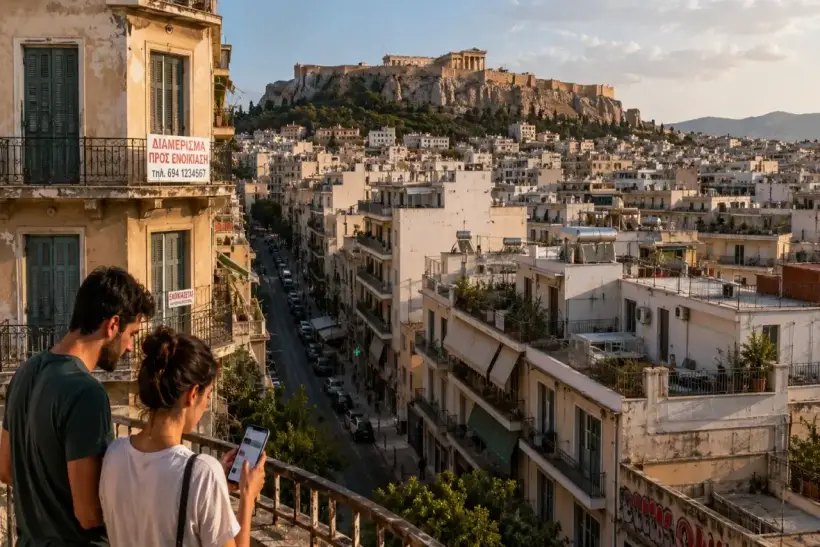
Greece’s housing crisis is increasingly about more than short-term rentals: data showing hundreds of thousands of vacant homes in Attica point to a deeper market failure involving underused housing stock, weak construction and a widening gap between incomes and prices.
Greece’s housing crisis moves beyond Airbnb
The Greek debate over housing affordability has long focused on short-term rentals, including Airbnb, but new estimates are shifting attention toward empty apartments. Travel and Tour World reported that more than 500,000 vacant homes are a key driver of Greece’s housing shortage, arguing that pressure on rents and prices cannot be explained by tourist platforms alone.
That view aligns with a broader policy debate now unfolding in Athens. Kathimerini reported that the International Monetary Fund has urged the Greek government to make more active use of unused homes, including a possible levy on vacant properties in high-demand areas and expanded renovation programs for older housing. The same report cited Greek statistical data showing that in 2021, 526,154 residential properties were vacant in Attica, while the Municipality of Athens had 117,137 vacant homes, equal to 26.8% of its housing stock.
Vacant housing is the market’s hidden reserve
The main challenge for Greek policymakers is that vacant housing is not a single category. Some units are genuinely available for rent or sale, some are used as second homes, some require renovation, and others are tied up in inheritance disputes, tax arrears, documentation problems or portfolios held by banks, public bodies and debt-management companies.
Athens Social Atlas, using the 2021 census, shows the structure of vacant dwellings in the Municipality of Athens: out of 437,188 conventional dwellings, 117,137 were vacant; 49,837 were listed as available for rent, 7,176 for sale, 34,842 as secondary residences, 869 as holiday homes and 24,215 as vacant for other reasons. That means the headline vacancy figure does not equal immediately available supply, but it does reveal the scale of underused urban housing.
For the market, this matters more than a narrow argument over individual platforms. Even if some short-term rentals return to the long-term market, the affordability crisis will not be solved without renovating old apartments, clearing legal bottlenecks, creating tax incentives and accurately recording how properties are actually used.
Prices are rising faster than supply
Greek housing prices remain under pressure. According to Kathimerini, citing Bank of Greece price indexes, nationwide home prices rose 7.8% in 2025. The International Monetary Fund links the increase to high demand, low utilization of existing homes, limited construction activity and local effects from housing-sharing through short-term rental platforms.
The Bank of Greece says its property-index system is based on data from credit institutions and real estate investment companies, and also tracks prices, rents, quality characteristics, construction costs, construction investment and housing credit. That matters because the crisis is not visible only in purchase prices; it also appears in rents, renovation costs, credit access and the weak replenishment of supply.
Short-term rentals remain a political target
Short-term rentals are still an important factor, especially in tourist-heavy parts of Athens. Associated Press reported that Greek authorities tightened rules for such properties, including measures targeting converted storage spaces, windowless basements and other units that fail basic living standards; a freeze on new short-term rental registrations was also introduced in popular Athens districts such as Kolonaki, Koukaki and Exarchia, with violations carrying a €20,000 fine.
But focusing only on tourist rentals simplifies the picture. In central Athens, short-term rentals have clearly intensified displacement, lifted apartment yields and changed neighborhood dynamics. Yet hundreds of thousands of vacant properties in Attica show another distortion at work: housing physically exists, but a large part of it does not function as accessible urban supply.
Tourism raises yields but cannot explain the whole shortage
Tourism remains one of Greece’s main economic engines and also a source of housing-market tension. AP noted that short-term rentals helped expand a tourism sector that directly accounted for 13% of gross domestic product in 2023, while also adding pressure to household expenses during the cost-of-living crisis.
That creates a difficult policy trade-off. Overly harsh restrictions on short-term rentals could hurt owners, small businesses and tourism. A soft approach leaves long-term tenants competing with higher-yield tourist use in neighborhoods where students, doctors, teachers, service workers and young families need housing. That is why the policy debate is moving toward a mix of measures: registration, quality standards, tax incentives, renovation programs and closer scrutiny of vacant homes.
Old housing needs capital, not just registration
Much of the vacant stock will not return to the market automatically. Older apartments in Athens often require major repairs, energy upgrades, new building systems, inheritance clarification or debt settlement. For an owner with limited income or multiple heirs, such a unit may be an asset only on paper: hard to rent, expensive to repair and difficult to sell without a discount.
That is why the IMF’s call to scale up renovation programs may be as important as the idea of taxing vacant homes. A levy could push some owners to put properties back into use, but without affordable renovation finance, simpler permitting and stronger landlord protections, the effect may be limited.
A new registry could reshape policy
Greece is preparing to launch a Real Estate Ownership Registry, where owners will be asked to declare how each property is actually used: owner occupation, long-term rental, short-term rental, vacancy or free-of-charge use. Kathimerini reported that the tool is intended to reduce the risk of making policy based on outdated 2021 census data.
For the market, this could be a turning point. At present, the state sees the problem with a delay: the census shows the structure of the housing stock, but not the current operational picture. A registry could show where vacant housing can realistically become rental supply and where the issue is renovation, legal clearance or tax treatment.
Athens becomes a test for Southern Europe
Greece’s situation resembles housing pressures in other Southern European tourism markets, including Spain, Portugal and Italy. Across the region, city rents are rising, tourism competes with permanent housing, older stock needs renovation, and owners are often reluctant to rent long term because of taxes, payment risks and doubts over legal protection.
Greece’s difference lies in the scale of unused stock and the legacy of the debt crisis. Years of recession left many owners with deferred repairs, unresolved inheritance issues and tax liabilities. As a result, solving the housing crisis cannot be reduced to platform regulation. It requires an urban housing recovery policy.
The market needs supply, not only bans
Greek housing policy is entering a more practical phase. After years of blaming short-term rentals, authorities and international institutions are increasingly focused on bringing underused housing back into circulation. This is less visible politically, but more important economically: find empty units, assess their condition, remove legal barriers, give owners incentives and create conditions for long-term rental supply.
As International Investment experts report, the critical conclusion for Greece is that fighting Airbnb alone will not solve the housing crisis. Short-term rentals have intensified pressure in specific areas, but hundreds of thousands of vacant homes point to a deeper problem: weak mobilization of existing housing stock. If the state relies only on fines and bans, the market will receive a political signal but little new supply. Real impact requires an accurate registry, renovation finance, tax incentives, long-term rental protections and targeted measures in districts where tourism displaces permanent residents.