







 Covivio Hotels Revenue Grows 4.7% as European Markets Split
 Lithuanian Apartment Prices Accelerate Across Major Cities
 Georgia's Tourism Revenue Hits Record High
 Norway's Sovereign Fund Commits €1.5bn to European Warehouses
 Market Rout of October 2026: Can Branded Hotels Protect Capital?
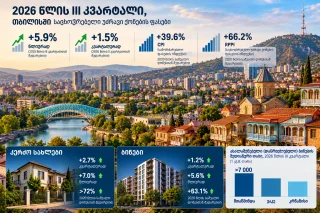 Residential Property Prices in Tbilisi Rise by 5.9% Year-on-Year
Greece Prepares 15% Home Tax for Third-Country Buyers

Greece is preparing to raise the property transfer tax on residential purchases by certain third-country buyers from 3% to 15%. Including the municipal levy, the effective charge would increase from 3.09% to 15.45%. The announced measure is limited to residential property purchased by individuals and excludes commercial premises, land and other types of real estate. The government says the change is intended to reduce pressure on housing from overseas demand. The planned start date has been set at July 1, 2027, although final legislation and transitional rules have yet to be published.
Greece Plans a Fivefold Increase in Property Transfer Tax
The standard Greek real estate transfer tax is currently 3% of the property's taxable value. A municipal levy equal to 3% of the tax itself takes the effective rate to 3.09%. The buyer is responsible for the payment before completion of the transfer.
The government announced in September that the headline rate would rise to 15% for qualifying residential purchases by third-country nationals. Including the municipal levy, the effective burden would reach 15.45%. The official presentation specifically excludes commercial premises, building plots and other non-residential property. The measure is expected to generate about €100 million in additional annual government revenue.
Early reports following Prime Minister Kyriakos Mitsotakis's Thessaloniki International Fair speech referred broadly to 2027. Finance Minister Kyriakos Pierrakakis subsequently set out a July 1, 2027 start date when presenting the housing package in greater detail. As of September 24, the final statute and its transitional provisions had not yet been published.
The Higher Rate Will Not Apply to Every Non-EU Buyer
Describing the proposal simply as a tax on all non-EU purchasers is too broad.
The government's detailed presentation excludes Greek citizens, qualifying members of the Greek diaspora, citizens of the European Union and European Economic Area, and people holding long-term resident status.
Existing rules also provide a transfer-tax exemption for qualifying first-home purchases. The basic exemption limit is €200,000 for an unmarried buyer and €250,000 for a married buyer, with additional allowances for children. The current framework extends eligibility beyond Greek and EU citizens to several other categories, including recognised refugees and certain long-term or second-generation residents. Greece's Independent Authority for Public Revenue confirms the current 3% transfer-tax framework and first-home exemption.
The final wording matters because the government presentation refers in one passage to nationality and residence status and elsewhere to individuals who are tax residents of third countries. Until the legislation is enacted, borderline cases should not be treated as settled.
Non-EU Investors Put €1.2 Billion Into Greek Property
Net foreign direct investment in Greek real estate reached €2.056 billion in 2025. Of that amount, €1.217 billion came from countries outside the European Union, down from €1.754 billion in 2024.
Turkey was the largest source among non-EU countries at €214 million, followed by Switzerland at €211 million and Hong Kong at €115 million. Israel and the United States each accounted for €88 million, the United Arab Emirates €67 million, the United Kingdom €63 million and China €50 million.
The Greek government estimates that buyers from third countries invested roughly €1.2 billion in real estate in 2025 and that about €800 million of that amount was directed toward residential property. It cites that demand as part of the rationale for the higher tax.
Greek Apartment Prices Rise Another 5.5%
The measure comes after several years of strong property appreciation. Greek apartment prices rose 5.5% year over year in the second quarter of 2026.
New apartments up to five years old increased 6.2%, while older apartments rose 5%. Prices advanced 5% in Athens and 4.7% in Thessaloniki. Other major cities recorded a 5.4% increase and the rest of the country 7.1%.
Growth has slowed but remains substantial. Apartment prices increased by an average 8.3% in 2025 and 9.1% in 2024. The Bank of Greece index is based on property valuations reported by credit institutions and included 971,800 valuations through the end of June 2026.
The government is therefore acting in a market where price growth has moderated from previous peaks but has not stopped.
Golden Visa Investment Thresholds Remain Unchanged
The transfer-tax announcement does not change the minimum real estate investment required under Greece's Golden Visa programme.
The standard minimum is €800,000 in Attica, including Athens, the Thessaloniki regional unit, Mykonos, Santorini and islands with populations above 3,100. The threshold is €400,000 in most other parts of Greece. For these standard property routes, the investment must be made in a single property and qualifying residential real estate is generally subject to a minimum size of 120 square metres.
A separate €250,000 route is available for certain special categories. One covers a single property converted from commercial to residential use; the 120-square-metre minimum does not apply, but the conversion must be completed before the Golden Visa application is filed. Another €250,000 route covers qualifying listed buildings that require restoration.
Golden Visa Property Purchases Could Become More Expensive
Golden Visa applicants are third-country nationals, so many residential property purchases made through the programme could fall within the higher transfer-tax regime if no specific exemption is included in the final legislation.
Arton Capital notes that the residence-programme investment thresholds themselves are not changing. The potential increase is in the transaction cost of acquiring the property, with the firm now referring to July 2027 as the expected timing.
The tax does not count toward the qualifying investment amount. An investor would still need to acquire property meeting the applicable €800,000, €400,000 or €250,000 threshold and pay transfer tax and other transaction expenses separately.
That distinction becomes increasingly important at the upper thresholds. A fivefold rise in the headline transfer-tax rate turns what was previously a relatively modest purchase cost into a material part of the total capital required.
Commercial Property and Land Remain Outside the Proposal
The government's presentation frames the measure as applying to residential property bought by natural persons. It does not say that the 15% rate will apply to purchases made by legal entities.
Commercial premises, building plots and other non-residential assets are also explicitly excluded from the announced increase.
That distinction could influence the composition of overseas investment. Some buyers may shift toward commercial assets or projects that create new housing through conversion, although the extent of any such change cannot be assessed before the final legal text is available.
Transitional rules are another unresolved issue. It is not yet clear how a transaction agreed before July 1, 2027 but completed afterward would be treated, or which stage of the transaction will determine the applicable tax rate.
Greece Tightens Rules After Years of Foreign Demand
The tax increase follows several earlier changes affecting international real estate investors.
Greece has already raised the main Golden Visa property thresholds to €800,000 and €400,000 depending on location, while retaining specific €250,000 routes. Qualifying Golden Visa properties are also subject to restrictions on short-term rental use.
The new transfer-tax measure is different because it changes the cost of completing a residential acquisition rather than the amount that must be invested to qualify for residence.
The same tax issue can also affect buyers who have no interest in the Golden Visa. If an individual falls within the new taxpayer category and buys residential property after the measure takes effect, the higher transfer rate would apply regardless of the purpose of the purchase.
International Investment experts report that a fivefold increase is large enough to change the economics of transactions in markets with significant third-country demand. The nationwide effect, however, will depend on the final statute. The treatment of long-term residents, deals already under way and other exemptions remains critical. Limiting the increase to residential property also creates the possibility that some capital will shift toward commercial assets or other structures rather than leave Greece altogether.
FAQ: Greece Property Transfer Tax
What is Greece's current property transfer tax?
The standard rate is 3% of the taxable property value. Including the municipal levy on the tax itself, the effective rate is 3.09%.
When is the tax expected to rise to 15%?
The latest detailed government presentation points to July 1, 2027. As of September 24, 2026, final legislation and transitional provisions had not yet been published.
What will the effective rate be after the municipal levy?
A 15% headline rate combined with the existing municipal levy produces an effective burden of 15.45%.
Will every non-EU citizen pay the higher rate?
No. The announced framework contains exemptions, including for European Economic Area citizens and long-term residents. The final statute will determine the exact scope.
Does the 15% rate apply to commercial real estate?
No. The announcement is limited to residential property. Commercial premises, building plots and other real estate categories are excluded from the proposed increase.
Are Greece's Golden Visa thresholds changing?
No. The current real estate thresholds remain €800,000 in designated high-demand areas, €400,000 in most other regions and €250,000 for specified special property categories.
Does transfer tax count toward the Golden Visa investment threshold?
No. The threshold refers to the qualifying property investment. Transfer tax and other transaction expenses are separate.
Why is Greece raising the tax?
The government says demand from third-country buyers has contributed to higher housing prices and reduced access for permanent residents. Non-EU investment in Greek real estate was about €1.2 billion in 2025, with the government estimating that roughly €800 million involved housing.