







 Covivio Hotels Revenue Grows 4.7% as European Markets Split
 Lithuanian Apartment Prices Accelerate Across Major Cities
 Georgia's Tourism Revenue Hits Record High
 Norway's Sovereign Fund Commits €1.5bn to European Warehouses
 Market Rout of October 2026: Can Branded Hotels Protect Capital?
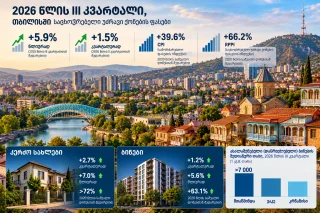 Residential Property Prices in Tbilisi Rise by 5.9% Year-on-Year
Athens Affordable Housing Shortage Deepens

Athens is facing a worsening shortage of affordable housing. Around four prospective tenants are competing for each rental property, while competition is far stronger for homes priced below €600 a month. In the northern suburbs, a listing in that price range receives an average of 21 expressions of interest. Apartment prices are still rising, while 26.4% of Greece's population lives in households spending at least 40% of disposable income on housing.
Rental Demand Far Exceeds Supply
The imbalance between available housing and prospective tenants is particularly visible in Athens.
Spitogatos data presented at an event marking the listing platform's 20th anniversary show an average of 2.41 expressions of interest from unique users and 23.38 unique searches for each rental listing.
Chief executive Dimitris Melachroinos estimated that the figures translate into roughly four prospective tenants for each available rental. The platform puts rental demand at about 380% of supply. In the sales market, demand is estimated to exceed supply by around 60%. Overall interest in buying and renting housing has increased 75.5% since 2020, according to eKathimerini.
The numbers measure activity on a private property platform rather than all tenancy agreements in Greece. They nevertheless provide an indication of the level of competition faced by households entering the open market.
The Shortage Is Most Severe Below €600
Headline supply figures conceal a much wider gap at the affordable end of the market.
Homes with asking rents of up to €600 a month and properties for sale below €250,000 generate particularly intense interest.
In the northern suburbs of Athens, a rental listing below €600 receives an average of 21.1 expressions of interest and around 282 searches. Demand falls sharply for homes renting above €1,500 a month.
Athens can therefore have vacant higher-priced properties while simultaneously suffering a severe shortage of homes within the budgets of lower- and middle-income households.
For a family able to spend €600 or €700 a month, a new apartment listed at €1,200 does not represent additional usable supply. That concentration of demand at the lower end makes affordability a separate problem from the total number of properties on the market.
Athens Apartment Prices Continue to Rise
Competition in the rental market is being reinforced by higher purchase prices.
Greek apartment values increased 5.5% year over year in the second quarter of 2026. Athens recorded a 5% rise, Thessaloniki 4.7%, other major cities 5.4% and other areas of Greece 7.1%.
New apartments up to five years old increased 6.2%, while older apartments rose 5%. Price growth is moderating: apartment values increased by an average 8.3% in 2025 and 9.1% in 2024.
The Bank of Greece calculates its index from property valuations submitted by credit institutions operating in the country. Its database contained 971,800 valuations through the end of June 2026, with apartments accounting for 65.3%.
Slower growth is not the same as falling prices. Homes continue to become more expensive, increasing the amount of capital required for households attempting to move from renting into ownership.
Greece Has the EU's Highest Housing-Cost Burden
The rise in housing costs is particularly significant because of the relationship between property expenses and household incomes.
In 2025, 26.4% of Greece's population lived in households where housing costs accounted for at least 40% of disposable income, the highest share in the European Union. Denmark ranked second at 23.4%, while the EU average was 7.7%.
Greece's rate had been 28.9% in 2024. In the same year, Greek households spent an average of about 36% of disposable income on housing, compared with 19% across the EU, again the bloc's highest share.
Eurostat includes rent or mortgage interest, utilities, routine maintenance and other recurring housing-related expenses in these measures. Affordability pressure therefore extends beyond headline rents.
A Large Housing Stock Does Not Guarantee Affordable Supply
A shortage of affordable homes does not mean Greece has too few dwellings in absolute terms. What matters is how many are available for long-term occupation, where they are located, their condition and their cost.
Some properties remain vacant or require renovation. Others are used as second homes or serve the tourism market. A dwelling that exists physically is not necessarily part of the long-term housing supply available to an Athens household.
Bank of Greece Governor Yannis Stournaras has linked the current imbalance partly to the legacy of Greece's debt crisis. Residential construction contracted sharply and has only partly recovered, while housing investment remains well below pre-crisis levels and the euro-area average.
Higher construction costs, regulatory complexity and permitting delays continue to restrict new supply. Demand, meanwhile, is supported by rising disposable income, foreign investment, tourism in urban centres and the appeal of property as a store of wealth.
Affordable Supply Is Under the Greatest Pressure
The composition of new supply matters as much as the number of listings.
An apartment entering the market at €1,200 or €1,500 a month increases total rental inventory but offers no relief to a household with a maximum budget of €600 or €700.
That is why the number of available properties can increase without materially easing the affordable-housing shortage. Owners of lower-priced rentals can choose from many prospective tenants and have little reason to compete through lower rents. Demand at the upper end is much thinner.
For investors, strong demand also has limits. Large numbers of inquiries do not mean households can absorb rent increases indefinitely. The shortage is severe precisely because the pool of homes priced in line with local incomes is small.
New Construction Cannot Close the Gap Quickly
The prolonged decline in housing construction during the previous decade created a supply shortfall that cannot be reversed within a few quarters.
Even when development activity increases, planning, financing and construction take time. Newly built homes are also frequently positioned at higher price points because of land, labour, material and financing costs.
More construction therefore does not automatically produce rentals below €600. Improving affordability also requires bringing existing vacant or underused homes back into long-term use.
Renovation can play an important role because an existing apartment in an established residential area can potentially return to the market faster than a new development can be completed. Its eventual affordability, however, depends on renovation costs and the rent required to make the investment viable.
Greece Expands Housing Support
The Greek government announced another package of housing measures in September.
Income thresholds for the rent-refund programme are being expanded, with the authorities expecting it to cover about 1 million renters, or roughly 85% of the group. Teachers, doctors and nurses working outside the largest metropolitan areas are due to receive a double rent refund.
Another €500 million from EU funding is earmarked for a programme to renovate older homes with moderate energy-efficiency improvements. The government is also preparing tax incentives for the construction of homes for long-term rental and extending restrictions on new short-term rental registrations in three municipal districts of Athens and Thessaloniki's first municipal district through 2027.
A €2 billion My Home III subsidised mortgage programme is expected to start in early 2027. The maximum eligible property value will rise from €250,000 to €300,000, the maximum loan from €190,000 to €230,000 and the maximum applicant age from 50 to 55, according to the Greek government.
Support for renters and buyers can reduce the burden on individual households, but it does not directly create additional homes. If purchasing power rises faster than supply, part of that support can also be reflected in prices.
Athens Lacks Housing at Affordable Prices
The latest figures point to an increasingly segmented market.
Higher-priced homes remain available with comparatively weaker demand, while rentals below €600 attract intense competition. At the same time, higher purchase prices make it harder for tenants to move into homeownership.
Households unable to buy remain in rental accommodation for longer, maintaining pressure on the same limited pool of affordable properties.
As International Investment experts report, Greece's central housing imbalance is not an absolute absence of dwellings but a shortage of homes priced in line with household incomes. Roughly four prospective tenants per rental already indicate substantial pressure, while competition below €600 is considerably more severe. Subsidies and cheaper mortgages can help individual households, but lasting improvement requires more supply through renovated vacant homes, a larger long-term rental stock and additional mid-market housing. Without that expansion, part of the extra purchasing power can be absorbed by higher prices.
FAQ: Athens Affordable Housing Shortage
How many people compete for each rental in Athens?
Spitogatos estimates that demand corresponds to roughly four prospective tenants for every available rental. The figure is based on platform activity rather than an official count of all tenancy agreements.
Which homes face the strongest demand?
Competition is particularly intense for rentals costing up to €600 a month and homes offered for sale below €250,000.
How strong is demand for cheaper rentals in northern Athens?
A listing below €600 receives an average of 21.1 expressions of interest and around 282 searches.
Are Athens apartment prices still rising?
Yes. Apartment prices in Athens increased 5% year over year in the second quarter of 2026, compared with 5.5% across Greece.
How many people in Greece face excessive housing costs?
In 2025, 26.4% of the population lived in households spending at least 40% of disposable income on housing, the highest rate in the EU.
Why is affordable housing scarce in Greece?
Factors include years of weak residential construction, the cost of renovating older housing, vacant properties, tourism-related use and strong domestic and foreign demand for real estate.
Will new construction solve the shortage?
Additional construction expands supply, but it does not necessarily create affordable homes. High development costs can push newly built properties into more expensive segments.
What housing measures is Greece introducing?
The package includes broader rent refunds, €500 million for renovating older homes, incentives for long-term rental housing, restrictions on new short-term rental registrations in selected districts and the My Home III subsidised mortgage programme.