







 Covivio Hotels Revenue Grows 4.7% as European Markets Split
 Lithuanian Apartment Prices Accelerate Across Major Cities
 Georgia's Tourism Revenue Hits Record High
 Norway's Sovereign Fund Commits €1.5bn to European Warehouses
 Market Rout of October 2026: Can Branded Hotels Protect Capital?
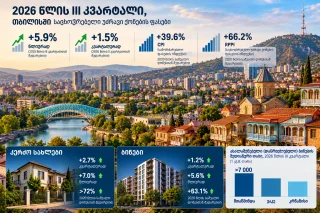 Residential Property Prices in Tbilisi Rise by 5.9% Year-on-Year
Greece Softens Property Tax Plan for Non-EU Buyers

Greece is preparing to raise the property transfer tax on some residential purchases by non-EU buyers from 3% to 15%, but the government has already narrowed the planned measure after strong opposition from the real estate industry. The higher rate is now expected to take effect on July 1, 2027 and apply only to residential property bought directly by individuals, while corporate purchases, expatriates and long-term residents are expected to be excluded.
The proposal was initially presented as a fivefold increase in transfer tax for buyers from outside the European Union. After objections from developers, brokers, chambers of commerce and industry associations, the Ministry of Economy and Finance began adding exemptions and postponed implementation. Kathimerini reports that the measure is now expected to have a much narrower scope than first indicated.
Property Transfer Tax Could Rise From 3% to 15%
Greece currently imposes a basic real estate transfer tax of 3% on the taxable value of a property. An additional municipal levy equal to 3% of the main transfer tax is also charged. The buyer is responsible for payment before the transaction is completed.
The Independent Authority for Public Revenue, AADE, states that the tax applies to purchases of Greek real estate and real rights where transfer tax is due. The declaration is generally processed through the digital myPROPERTY platform.
A 15% rate would increase the basic transfer tax fivefold for buyers covered by the new regime. On a home with a taxable value of €300,000, the main tax would rise from €9,000 to €45,000 before other transaction costs.
On a €500,000 property, the difference would be even larger, with the tax increasing from €15,000 to €75,000.
The scale of that increase has triggered particular concern in the holiday-home market, where foreign demand is an important source of sales.
Exemptions Narrow the Scope of the Measure
The original announcement appeared to cover a broad group of third-country buyers. The rules now being prepared are more limited.
The higher tax is expected to apply only to residential properties acquired directly by individuals. Purchases made through companies are currently expected to remain outside the new 15% regime.
Expatriates and long-term residents are also expected to be exempt. The proposed exemption would cover foreigners who spend at least six months a year in Greece.
That distinction is significant because Greece has spent years creating tax incentives designed to attract wealthy individuals, investors and foreign retirees.
The country offers an alternative taxation regime for individuals transferring their tax residence to Greece and making qualifying investments of at least €500,000.
A separate preferential framework applies to recipients of foreign pension income who move their tax residence to Greece. AADE updated the relevant implementation procedures in September.
Holiday Homes Face the Biggest Exposure
Real estate professionals are particularly concerned about the holiday-home segment. Its buyer base differs substantially from the housing markets of Athens and Thessaloniki and includes a larger share of purchasers from outside the European Union.
Elxis – At Home in Greece, a company specializing in Greek holiday homes sold to foreign buyers, said non-EU citizens accounted for around 20% of completed purchases between 2024 and 2026. They represented an even larger 44% of expressed demand, compared with 56% from EU buyers.
For these buyers, a 12-percentage-point increase in transfer tax would materially change the total cost of acquiring property.
The effect would be particularly visible on villas and second homes priced at several hundred thousand euros, where the additional tax could add tens of thousands of euros to a transaction before notary, registration and other expenses.
Industry participants warn that some demand could shift toward competing Mediterranean markets if the tax makes Greek property materially more expensive to acquire.
Government Links the Measure to Border-Area Purchases
One argument behind the proposal relates to property purchases by Turkish citizens in Thrace.
Kathimerini reports that government officials received concerns from residents in the region about an increase in such transactions and viewed the tax increase partly as a response.
Market participants, however, argue that the measure may not address the transactions that prompted the concern. Some property purchases in sensitive border areas are already structured through companies established in EU member states, including neighboring Bulgaria.
Direct property acquisitions by non-EU citizens in certain border regions can require additional approval involving the Ministry of National Defense. Transactions through EU corporate structures may be treated differently.
If corporate acquisitions remain exempt from the proposed 15% tax, the policy could leave a route around the higher levy for some buyers.
That has become one of the strongest objections raised by the real estate industry.
Industry Says the Tax Will Not Solve the Housing Shortage
Another point of criticism is the connection between the measure and Greece's housing affordability problem.
Foreign demand for holiday villas, coastal developments and second homes does not necessarily compete with Greek households looking for primary residences in Athens, Thessaloniki and other major employment centers.
The distinction is particularly relevant on islands, Crete, the Peloponnese and smaller coastal markets where foreign demand is concentrated in properties designed for seasonal or second-home use.
In major cities, the affordability problem has different causes. Athens continues to face a shortage of affordable long-term housing even while parts of the residential stock remain vacant or underused.
Market representatives therefore dispute the assumption that increasing the tax on non-EU buyers will automatically return affordable homes to local households.
Greek Apartment Prices Rise Another 5.5%
The debate comes as Greek residential prices continue to rise, although the pace has moderated.
Bank of Greece data show that apartment prices increased 5.5% year on year nationwide in the second quarter of 2026. Prices for apartments up to five years old rose 6.2%, while older properties gained 5%.
Athens recorded a 5% annual increase and Thessaloniki 4.7%. Prices in other major cities rose 5.4%, while areas outside the largest urban centers, including many tourism-driven markets, recorded the strongest increase at 7.1%.
For comparison, nationwide apartment prices rose 8.3% on average in 2025 and 9.1% in 2024. Growth is slowing, but prices are still moving higher.
The 7.1% increase outside the largest cities is particularly relevant to the tax debate because many of the areas most dependent on foreign second-home buyers fall into this category.
Foreign Property Investment Has Already Fallen Before
Foreign investment in Greek real estate has already experienced a significant slowdown.
In January through September 2025, foreign capital inflows into property fell 24% to €1.46 billion from €1.92 billion a year earlier.
Government receipts from property transfer taxes also declined 7.4% in 2025, to €607.93 million from €656.49 million in 2024, despite higher numbers and values of property transfers overall. One factor was a rise in first-home purchases benefiting from tax exemptions.
That creates uncertainty over the fiscal impact of the proposed 15% rate. A higher levy would generate more revenue from each taxable purchase, but a sharp decline in transaction volumes could offset part of that gain.
Golden Visa Rules Are Already More Expensive
Greece has already tightened the real estate route to its Golden Visa residence program.
In the most sought-after markets, including greater Athens, Thessaloniki, Mykonos, Santorini and larger islands, the standard property investment threshold has been increased to €800,000. In other parts of Greece, the threshold is €400,000.
A €250,000 route remains available for certain conversions of commercial buildings into residential use and for qualifying historic properties that are restored. Standard investments in high-threshold locations are also subject to additional property requirements.
The proposed transfer tax would therefore add another layer of cost for some third-country nationals, including buyers who are not purchasing solely to qualify for residency but want a holiday home, retirement property or long-term investment.
Greece Is Keeping Other Property Tax Breaks
The planned increase for some foreign buyers contrasts with several tax incentives that Greece has extended for the wider property market.
The suspension of the 24% value-added tax on new-build properties has been extended until at least 2030. The 15% capital gains tax on property sales also remains suspended.
A tax exemption for owners who return qualifying vacant homes to the long-term rental market has also been extended. Under the scheme, qualifying rental income can be exempt from taxation for the first 36 months of the tenancy.
The result is an increasingly differentiated tax system: some measures reduce transaction and ownership costs to encourage supply and investment, while the proposed transfer-tax increase would sharply increase acquisition costs for a selected group of non-EU buyers.
Corporate Purchases Could Gain an Advantage
The proposed corporate exemption creates one of the most important practical questions.
A non-EU individual buying a €500,000 residence directly after July 1, 2027 could face €75,000 in basic transfer tax if the 15% rate applies. Under the current 3% rate, that amount would be €15,000.
If an acquisition through a company remains outside the higher tax regime, the difference may create an incentive for some buyers to reconsider how they structure ownership.
Corporate structures come with their own establishment, accounting, legal and tax costs and will not be appropriate for every buyer. For higher-value acquisitions, however, a 12-percentage-point difference is large enough to affect transaction planning.
The industry's concern is that a policy intended to discourage a category of purchases could instead redirect some of those purchases into different legal structures.
Holiday Markets May Feel the Impact More Than Athens
The effects of the tax are unlikely to be uniform.
Athens has a broad buyer base including domestic households, rental investors, Golden Visa applicants and foreigners moving to Greece.
In many holiday destinations, some developments depend much more heavily on international buyers. Demand from the US, UK, Israel, Turkey, the Middle East and other non-EU markets can represent a substantial share of potential sales.
Bank of Greece data show that areas outside the main cities are currently recording the fastest apartment price growth, at 7.1% year on year.
A uniform 15% tax could therefore have a very different effect on central Athens than on a coastal development or island holiday-home project.
As International Investment experts report, the proposed increase from 3% to 15% has become substantially narrower as exemptions have been added, but those exemptions also raise the main question about its effectiveness. If a third-country individual faces the higher rate while a corporate acquisition remains outside it, part of demand may change legal form rather than disappear. Holiday-home markets face an additional risk because many affected buyers are not competing directly with Greek households for mainstream urban housing. The policy may therefore have only a limited effect on affordability while creating a much larger impact on specific regions, developers and projects that depend heavily on foreign demand.
FAQ
What is Greece's current property transfer tax?
The basic property transfer tax is 3% of the taxable value of the property and is generally paid by the buyer.
What rate is Greece planning for non-EU buyers?
The government is preparing a 15% rate for certain residential purchases by buyers from outside the European Union.
When is the higher tax expected to start?
The current plan is for the new rules to take effect on July 1, 2027.
Who is expected to pay the 15% tax?
It is expected to apply to non-EU individuals buying residential property directly unless they qualify for an exemption.
Will companies pay the 15% rate?
Under the rules currently being prepared, corporate acquisitions are expected to remain outside the higher transfer-tax regime.
Will foreign residents in Greece be exempt?
Long-term residents and expatriates who spend at least six months a year in Greece are expected to be excluded.
Why is Greece proposing the tax?
Government arguments include concerns about rising purchases by third-country citizens, including property acquisitions by Turkish buyers in Thrace, as well as broader housing-policy considerations.
Could the measure affect holiday homes?
Yes. Holiday-home markets may be among the most exposed because non-EU buyers account for a meaningful share of foreign demand.
Are Greek property prices still rising?
Yes. Apartment prices increased 5.5% year on year nationwide in the second quarter of 2026. Areas outside the largest cities recorded a 7.1% increase.
Is the new tax part of the Golden Visa program?
No. It is a separate tax measure, although it could increase the total acquisition cost for some of the same non-EU investors who participate in the Golden Visa market.