







 Vietnam Mortgage Surge Pushes Homes Out of Reach
 Lithuanian Apartment Prices Accelerate Across Major Cities
 London Flats Lose Value Ahead of Leasehold Reform
 Construction of the Batumi–Sarpi Highway Begins in Georgia
 Baltic Property Investment Accelerates in 2026
 Hong Kong and Singapore Renew Their Expat Rivalry
Home Prices Rise Again Across Europe

Hungary, Portugal and Croatia led the latest gains
House prices in the euro area rose 5.1% in the fourth quarter of 2025 from a year earlier, while prices across the European Union increased 5.5%. On a quarterly basis, compared with the third quarter of 2025, prices rose 0.6% in the euro area and 0.8% in the EU. Eurostat, the European Union’s statistical office, published the figures on April 7, 2026.
The release shows that Europe’s housing market remained on an upward path at the end of 2025 after already posting strong gains in the previous quarter. In the third quarter of 2025, annual house-price growth had stood at 5.1% in the euro area and 5.4% in the EU, meaning the year-end reading showed a further modest acceleration at the broader EU level.
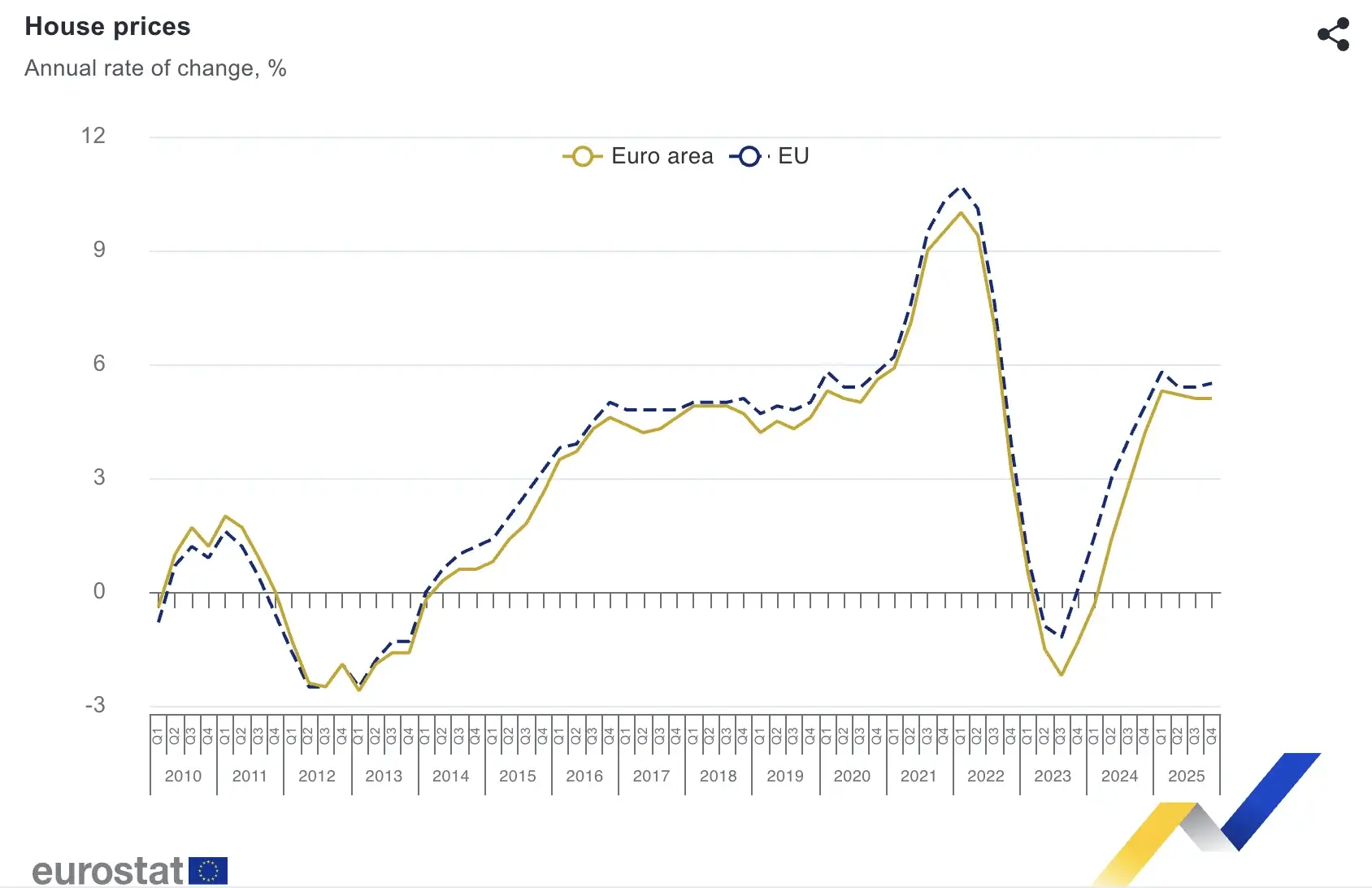
Eurostat house price data for Q4 2025
Eurostat’s country breakdown showed that price gains were widespread. Among member states with available data, only one country posted an annual decline in house prices in the fourth quarter of 2025: Finland, where prices fell 3.1%. The other 25 countries recorded annual increases. The strongest annual gains were in Hungary at 21.2%, Portugal at 18.9% and Croatia at 16.1%.
Quarter-on-quarter trends were also broadly positive. Prices fell in only three member states, were unchanged in one and rose in twenty-two. The quarterly declines were recorded in France at 0.7%, Finland at 0.5% and Estonia at 0.3%, while the biggest increases were seen in Slovenia at 5.1%, Hungary at 4.2% and Portugal at 4.0%. Cyprus was flat from the previous quarter.
Which EU countries saw the biggest housing increases
Large and mid-sized markets remained in growth territory as well, although often at a much slower pace than the top performers in Central and Southern Europe. Spain recorded annual house-price growth of 12.9% in the fourth quarter of 2025, Bulgaria 12.6%, Czechia 10.4%, Denmark 7.6%, Ireland 7.0%, Italy 4.1%, Germany 3.0% and France 1.0%. The spread points to a broad but uneven housing upswing across the European Union.
The contrast between Hungary and Finland was particularly striking. Hungary posted the fastest annual increase among countries with available data, while Finland was the only member state to record an annual fall. That underlines how Europe’s housing market at the end of 2025 was not moving as a single cycle, but rather as a set of national markets with different growth speeds and different sensitivities to rates, incomes and supply conditions.
How Eurostat measures house prices
Eurostat says the House Price Index measures price changes for all residential properties purchased by households, including flats, detached houses and terraced houses, whether newly built or existing. The measure covers purchases regardless of the final use of the property and regardless of previous ownership. Euro area and EU aggregates are calculated as weighted averages of national indices, using gross domestic product at market prices as weights. The figures are not seasonally adjusted.
That methodological point matters when reading the quarter-to-quarter numbers. Because the data are not adjusted for seasonal effects, quarterly movements are best read as short-term signals, while year-on-year changes provide the clearest view of the broader pricing trend.
What the latest figures mean for Europe’s property market
Eurostat’s release indicates that Europe entered 2026 with housing-price growth still firm and geographically widespread, even if the pace varied sharply across countries. The euro area held at 5.1% annual growth and the broader EU accelerated slightly to 5.5%, suggesting that demand pressures remained visible in many markets at the end of 2025. At the same time, the gap between the strongest and weakest countries shows that headline regional data now mask increasingly divergent national trajectories.
Eurostat said the next release, covering the first quarter of 2026, is scheduled for July 2, 2026. That update will show whether the price momentum carried into the new year or whether part of the market began to cool after a strong finish to 2025.
As International Investment experts report, the latest Eurostat figures show that Europe’s housing market entered 2026 with a solid growth base, but also with increasingly visible divergence between countries, making local market analysis more important for investors than broad regional averages alone.
FAQ
How much did euro area house prices rise in Q4 2025?
They increased 5.1% year on year and 0.6% quarter on quarter.
How much did EU house prices rise in Q4 2025?
Across the EU, house prices were up 5.5% from a year earlier and 0.8% from the third quarter of 2025.
Which country had the biggest increase in house prices?
Hungary recorded the strongest annual rise, with prices up 21.2%.
Which country saw house prices fall?
Finland was the only member state to post an annual decline, with prices down 3.1%.
What does Eurostat’s House Price Index measure?
It tracks price changes for all residential properties bought by households, including both new and existing homes.
When will the next Eurostat housing release be published?
The next release, covering the first quarter of 2026, is scheduled for July 2, 2026.