







 US Introduces Visa Bonds of Up to $20,000 for Tourists From 50 Countries
 Portugal Secures €1.5 Billion for Social Housing
 Mortgage Lending in Georgia Increased by Nearly 50%
 Irish Homes Are 17% Overvalued as Supply Lags
 Buses from Latvia to Russia and Belarus May Be Cancelled
 Egypt’s Economy Accelerates to 5.1%
Ireland Debates Wider VAT Cut for New Homes
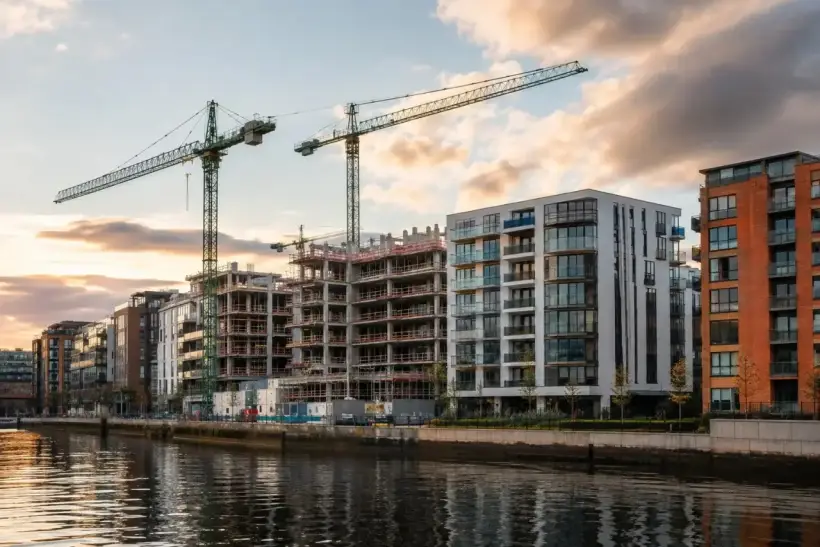
Ireland's 9% value-added tax regime for qualifying apartments is becoming a central issue ahead of Budget 2027. A senior figure at Dublin's Glass Bottle development argues that the measure is already working and should be widened to support more homebuilding, according to Business Post. Official data, however, remain mixed: Ireland recorded a modern-series high for housing completions in 2025, while apartment completions fell 12.2% year on year in the second quarter of 2026.
Ireland's 9% Apartment VAT Regime Has a Narrow Scope
Ireland initially reduced VAT on qualifying apartment supplies from 13.5% to 9% on October 8, 2025 as part of Budget 2026. Then finance minister Paschal Donohoe said the measure was intended to close the viability gap in apartment development and encourage higher-density housing. The temporary rate is due to remain in place until December 31, 2030.
The scope was subsequently widened. From November 26, 2025, Ireland's Revenue rules extended the 9% second reduced rate to qualifying apartment and apartment-block construction through completion, certain qualifying development sites and qualifying student accommodation. Official Revenue guidance on qualifying apartments
The distinction is significant. Ireland has not introduced a blanket 9% VAT rate for every newly built dwelling. New houses outside the qualifying apartment regime generally remain subject to the 13.5% reduced rate; Revenue's current guidance uses that rate in its example for a newly purchased house.
A qualifying apartment block must contain at least three apartments in a multi-storey residential building, with at least three units sharing grouped or common access. Studios, penthouses, duplex apartments and qualifying student accommodation can fall within the regime, while isolated units that fail the statutory conditions do not.
Glass Bottle Is Emerging as a Test of Housing Viability
The debate has particular relevance at Glass Bottle, the large-scale redevelopment of former industrial land at Poolbeg West in Dublin 4.
In June 2026, the consortium lodged plans for another 1,510 apartments across six blocks of between six and 18 storeys. The wider former Irish Glass Bottle and Fabrizia redevelopment covers about 15.06 hectares, or 37 acres, and is planned to deliver roughly 3,800 homes and almost 1 million square feet of commercial space. Details of the 1,510-apartment Glass Bottle application
The project is already producing completed housing and sizeable transactions. Lioncor sold the 176-unit Glass House scheme to Co-operative Housing Ireland for €82.14 million in July for social housing. The price equated to about €466,748 per apartment, with the building containing 12 studios, 43 one-bedroom apartments, 95 two-bedroom units and 26 three-bedroom homes. Confirmation of the Glass House transaction
Financing also illustrates the scale of institutional capital required for such projects. Deutsche Bank arranged and underwrote a €415 million refinancing of the development in January 2026, refinancing existing construction debt and supporting the completion and progression of residential phases. Details of the €415 million refinancing
Record 2025 Completions Do Not Yet Prove the Tax Cut Worked
Ireland completed 36,284 new homes in 2025, an increase of 20.4% from 2024 and the highest annual figure since the current statistical series began in 2011. Apartment completions jumped 38.7% to 12,047. Official 2025 dwelling-completion data
Those numbers cannot be attributed directly to the VAT reduction. The tax change did not begin until October 2025, while large apartment developments typically require years of planning, financing and construction. Most homes completed during that year had therefore entered the development pipeline under the previous tax regime.
The latest quarterly figures are more cautious. Ireland completed 8,823 homes in the second quarter of 2026, 3.6% fewer than a year earlier. Apartment completions declined from 3,027 to 2,658, a fall of 12.2%, while scheme-house completions increased 2% to 4,738. Second-quarter 2026 housing data
Dublin remains dominant in apartment supply. The region accounted for 2,006 apartment completions in the quarter, or 75.5% of Ireland's total. Overall housing completions in Dublin, however, were 16.4% lower than in the same quarter of 2025.
The earliest evidence of the tax policy's impact may therefore appear first in project starts, financing agreements and previously stalled schemes becoming viable rather than in completed-unit statistics.
Development Costs Continue to Dilute the Tax Benefit
The policy was introduced against unusually high apartment development costs. Research commissioned by the Department of Housing put the total development cost of a typical two-bedroom urban Dublin apartment at approximately €605,000 in 2025, while the comparable suburban figure was about €559,000. Total development cost includes land, construction, professional costs, finance and other project expenses. Ireland's 2025 development-cost study
Construction inflation has continued. In May 2026, Ireland's wholesale construction-products index was 3.1% higher year on year, while the broader building and construction index including wages was up 3.2%. Ready-mixed mortar and concrete rose 8.4%, copper pipes and fittings 8.6%, stone 4% and structural steel and reinforcing metal 2.5%. May 2026 construction-price data
Castlethorn told lawmakers that rising construction costs had offset a significant portion of the benefit from the VAT reduction. Cairn Homes, meanwhile, identified signs of increased apartment activity, with apartments' share of commencements in eastern and midland areas rising from roughly 25% in an earlier measurement period to around 30% when data were extended through March 2026.
The figures highlight the policy dilemma: a tax reduction can improve project viability while being partially absorbed by rising labour, material and financing costs.
Government Resists Extending the Rate to Every New Home
The construction industry's push is intensifying ahead of Budget 2027. Irish Institutional Property has proposed extending the 9% rate to all new homebuilding rather than limiting it to qualifying apartments.
Housing Minister James Browne indicated on July 22 that the Government was unlikely to adopt such a blanket extension in the upcoming budget. He said he did not believe the broader measure was warranted, while leaving open continued monitoring of housing conditions.
The policy difference is substantial. The existing regime was designed as a targeted intervention in the apartment sector, where higher density, long lead times and complex financing had left many permitted projects commercially unviable. Developers are now seeking to convert that targeted support into a wider housing stimulus.
A Broader VAT Cut Would Raise the Fiscal Cost
The apartment measure already carries a significant price for the Exchequer. Ireland's Parliamentary Budget Office recorded an estimated first-year cost of €250 million and a full-year cost of €390 million for the reduced apartment VAT rate. Parliamentary estimate of the VAT measure's cost
Extending the rate to a much larger share of new housing would increase foregone tax revenue. That would make additionality critical: policymakers would need evidence that the tax expenditure was producing homes that otherwise would not have been built.
There are also administrative risks. Before the regime was introduced, tax officials warned that different VAT treatments for houses and apartments could make compliance harder to monitor and create the possibility of accidental or fraudulent underpayment. Government documentation also indicated that the policy was primarily intended to encourage development rather than deliver a direct price reduction to consumers. Pre-budget warnings about the apartment VAT regime
That distinction weakens any assumption that a 4.5-percentage-point VAT reduction automatically translates into an equivalent fall in asking prices.
Ireland Still Needs a Major Increase in Housing Supply
The tax debate is part of a larger supply challenge. The Government's Delivering Homes, Building Communities plan targets 300,000 homes by the end of 2030, including 72,000 social homes and 90,000 affordable housing supports. Ireland's official housing plan to 2030
That requires output to move well beyond the 36,284 homes completed in record-setting 2025. Earlier national targets envisage annual delivery increasing towards about 60,000 homes by 2030.
Affordability pressures also remain. Residential property prices were 6.2% higher nationally in May 2026 than a year earlier. The median transaction price over the previous 12 months was €395,000 nationally and €500,000 in Dublin. Dublin apartment prices increased 6.1%, while apartments outside Dublin were 9.7% more expensive than a year earlier. May 2026 residential property price data
The Government therefore faces three objectives at once: increasing supply, improving development viability and ensuring that tax support produces measurable additional housing rather than permanently subsidising projects that would have proceeded anyway.
As International Investment experts report, there is still too little post-reform evidence to conclude that the 9% VAT regime has materially increased completed housing supply. The record 2025 result largely reflects projects initiated under the previous tax environment, while the 12.2% decline in apartment completions in the second quarter of 2026 demonstrates continued volatility. A wider VAT reduction may unlock additional development, but it would also increase the fiscal cost and create a risk that part of the benefit is absorbed into land values, construction costs or development margins. The decisive benchmark should be the number of additional homes that can credibly be attributed to the policy rather than the headline size of the existing pipeline.
FAQ: Ireland's 9% Apartment VAT Rate
What VAT rate applies to qualifying new apartments in Ireland?
Qualifying apartment developments are subject to the 9% second reduced VAT rate, with the expanded regime applying from November 26, 2025 through December 31, 2030.
Does the 9% rate apply to every newly built home?
No. It is a targeted apartment regime. New houses outside its qualifying conditions generally remain subject to the 13.5% reduced VAT rate.
Why did Ireland cut VAT on apartments?
The policy was designed to improve apartment-development viability and activate schemes that had planning permission but were not economically attractive enough to proceed.
Has the measure already increased apartment completions?
There is no conclusive evidence yet. Apartment completions rose sharply in 2025, but the tax change began only in October. In the second quarter of 2026, apartment completions fell 12.2% year on year.
Will lower VAT automatically reduce apartment prices?
No. The policy is principally a supply and project-viability measure, and official pre-budget analysis did not assume that the benefit would necessarily be passed directly to homebuyers.
How many homes does Ireland plan to deliver by 2030?
The current housing plan targets about 300,000 new homes by the end of 2030, including substantial social and affordable housing delivery.