







 Russian and Belarusian Owners List More Latvian Property
 Georgian Law Enforcement Busts Scammers Posing as Real Estate Brokers
 World’s Largest Economies in 2026: GDP and Purchasing Power Rankings
 Turkish Airlines Cancel Flights to Moscow
 Escalation in the Middle East: New US and Iranian Strikes
 Hong Kong Property Rebounds as Momentum Slows
Klaipėda Real Estate Market Expands in Lithuania
Klaipėda housing market accelerates in 2025
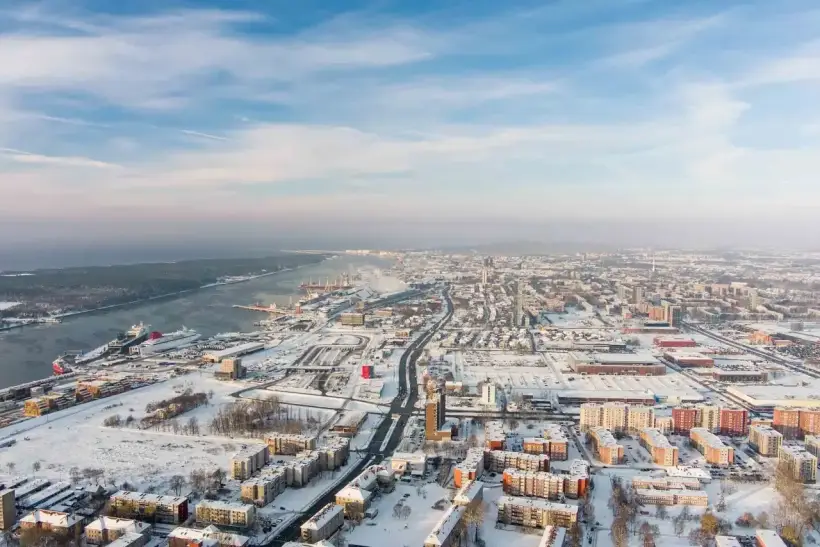
In 2025, Klaipėda emerged as one of the most dynamic real estate markets in Lithuania. According to Ober-Haus, the port city stood out for abundant construction activity, growing demand and a sharp increase in transaction volumes. Developers from other Lithuanian cities increasingly turned their attention to Klaipėda, while the commercial real estate sector began to show renewed potential after years of sluggish development.
Data from the Centre of Registers show that 3,369 residential properties were purchased in Klaipėda last year, up 16.7% compared to 2024. Apartment transactions increased by 16.5% to 3,164 units. Although only 205 houses were sold, this still represented a 19.2% annual increase.
Strong primary market growth and price dynamics
The primary housing market recorded particularly strong expansion. Ober-Haus estimates that developers sold more than 580 new apartments in Klaipėda in 2025, a 65% increase year-on-year.
The average apartment price reached €1,906 per square metre at the end of 2025, up 10.9% annually. This slightly exceeded Vilnius’ 10.7% growth rate but remained below Kaunas’ 13.8%.
New apartment prices range between €2,000 and €3,800 per square metre depending on district and layout. Older apartments are priced from €1,000 to €3,700 per square metre. The highest values are typically found in renovated central buildings, while unrenovated stock is generally priced between €1,000 and €2,400 per square metre.
Residential construction breakthrough and new developments
According to Aurimas Petrikas, head of Ober-Haus in the Klaipėda region, 2025 can be considered a breakthrough year for the city. New projects and additional development phases have been launched, including schemes that had previously struggled to reach the market.
While older, unfurnished apartments remain in demand for renovation and resale, newly built units with partial finishing are increasingly dominating the market. Developers are able to raise prices steadily without slowing sales momentum.
Active projects include Arimų Žiedas, Bastionų Namai, Pušyno Rezidencijos, Klaipėdos Holivudas, Memelio Miestas, Teatro Namai, Liepų Terasos, Danės Krantas, Parko Pakrantė and Dvaro Slėnis. Initial works have also begun on Jūros 1, Baltijos Panorama, Miško Jūra and City10. New development is increasingly concentrated in the city centre and Old Town.
Developers from other cities enter the Klaipėda market
Developers from Vilnius and Kaunas are becoming more active in Klaipėda, contributing to a new pricing benchmark. A price level of €3,000 per square metre is no longer unusual in the port city.
A planned reduction of the minimum 10% down payment requirement for first homes later this year is expected to stimulate further activity nationwide, including Klaipėda. At the same time, stricter financing conditions for second homes, particularly relevant in coastal resorts such as Palanga and Šventoji, may influence regional investment patterns.
Rental shortages and landlord-driven market
The rental segment is characterised by limited supply. According to Ober-Haus, landlords are able to secure tenants quickly and gradually increase rents. Over the past year, rental prices rose by 4–5%, approaching €11 per square metre per month.
The rental market is dominated by apartments, with virtually no house rental segment. Unlike Palanga, where seasonal and short-term rentals prevail, Klaipėda’s market is largely driven by employees and long-term tenants.
Commercial real estate shows signs of revival
After nearly a decade of slow development, Klaipėda’s commercial real estate market is beginning to show positive signs. Investors from Vilnius and Kaunas are increasingly attentive to opportunities in the city.
Stock-office warehouse formats have become one of the most visible trends. Retail and service premises are concentrated in a strong commercial cluster between Akropolis shopping centre, the arena and the swimming pool complex. Additional development is occurring along Tilžės Street toward the Jakai roundabout, as well as within the Klaipėda Free Economic Zone and the nearby Industrial Logistics Park.
However, the Old Town remains vulnerable, with cafés and restaurants closing and vacant premises increasing. Businesses are relocating to areas offering easier parking access, which may create additional infrastructure challenges.
As International Investment experts report, Klaipėda’s accelerating real estate market reflects growing investor confidence in Lithuania’s regional cities, yet the current momentum carries structural risks. Rapid primary market expansion and the establishment of a new pricing benchmark could lead to local overheating if demand slows or mortgage conditions tighten. Demographic stability and reliance on domestic migration, as well as the performance of the port and industrial sectors, remain key uncertainties. Without sustained income growth and broader economic diversification, further price acceleration may encounter natural affordability constraints and limit long-term market resilience.