







 Georgian Law Enforcement Busts Scammers Posing as Real Estate Brokers
 World’s Largest Economies in 2026: GDP and Purchasing Power Rankings
 Turkish Airlines Cancel Flights to Moscow
 Escalation in the Middle East: New US and Iranian Strikes
 Hong Kong Property Rebounds as Momentum Slows
 Bulgaria’s Property Market Enters a More Mature Phase
Citizenship in South America: How the Mercosur Agreement Works
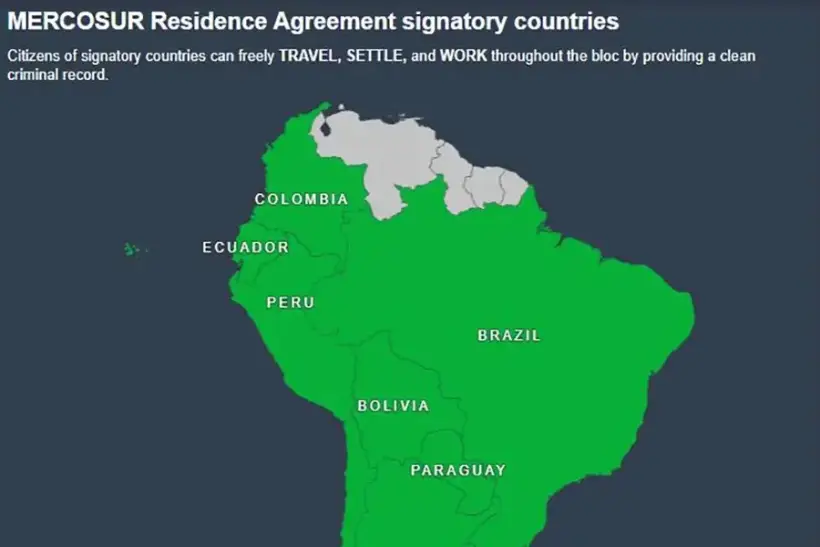
Nine Countries with Unified Residence Rules
The Mercosur Residence Agreement allows citizens of member states to relocate, live, and work within the bloc, which covers a significant part of South America. It includes nine countries with a combined population of more than 400 million people and a total area of approximately 18 million square kilometers. The mechanism предусматривает a two-year temporary residence permit followed by permanent status and the possibility of naturalization, IMI Daily reports.
How the Mercosur Residence Agreement Is Structured
The agreement applies to Argentina, Bolivia, Brazil, Chile, Colombia, Ecuador, Paraguay, Peru, and Uruguay. Venezuela’s membership in Mercosur has been suspended and it does not participate in the current mutual residence regime. A citizen of any of the listed countries may apply for residence in another member state upon presenting a clean criminal record certificate and the required documentation.
The procedure is standardized. Applicants first receive a temporary residence permit valid for two years, which can then be converted into permanent status. Permanent residence opens the possibility of applying for citizenship in accordance with the national legislation of the respective country.
Citizenship of one member state grants the right to reside and work in the other participating countries. Travel between them is possible using a national identity card. Social security rights and professional qualifications are more easily recognized within the region. Structurally, the regime is comparable to regional mobility models operating in other integration blocs.
Entry Points: Paraguay, Uruguay, Argentina, and Brazil
Member states offer different pathways to status, varying in income requirements, investment thresholds, and naturalization timelines. In practice, Paraguay, Uruguay, and Argentina are most frequently considered.
Paraguay provides two main mechanisms. Through the SUACE system, permanent residence can be obtained by registering a company with declared capital of USD 70,000, with commitments distributed over ten years. Alternatively, an independent means visa is available without a fixed minimum income requirement, subject to proof of financial capacity. Citizenship may be requested after three years of permanent residence, provided the applicant demonstrates knowledge of Spanish or Guaraní. Paraguay applies a territorial tax system under which foreign-sourced income is not taxed.
Uruguay grants permanent residence upon proof of monthly income of at least USD 1,500, without mandatory investment requirements. The naturalization period is five years for single applicants and three years for married couples. Individuals who obtained residence before 2026 benefit from an 11-year exemption on foreign-sourced income. After 2026, an updated regime applies with additional investment conditions.
Argentina offers one of the shortest naturalization timelines through the Rentista and Pensionado visas, requiring proof of foreign income of approximately USD 2,000 per month. Citizenship may be requested after two years of residence. Updated requirements mandate continuous physical presence in the country throughout this period.
Brazil provides residence through the VIPER investor visa. Minimum investments amount to approximately USD 93,000 in business or USD 133,000 in real estate. Residence is granted on a permanent basis, and the path to citizenship generally takes about four years.
Argentina Prepares a Citizenship by Investment Program
In July 2025, the Argentine government approved the legal framework for launching a citizenship by investment program and established a dedicated agency to administer it. Specific parameters have not yet been disclosed, and a tender has been announced to select a program operator. Applications are expected to open in late 2026 or early 2027.
An Argentine passport provides visa-free access to 168 destinations, including the Schengen Area. If implemented, the investment route would make Argentina the only country within the agreement offering both a residence-based and an investment-based pathway to citizenship.
Why the Mercosur Model Is Compared to the European Union
The mutual residence regime in South America is often compared to the European system of free movement. The key difference lies in entry requirements. In EU countries, citizenship is typically linked to ancestry, long-term residence, or substantial investment. In Mercosur countries, entry requirements are generally lower, and the temporary residence process is standardized.
Following naturalization in one country, individuals gain the right to reside and work in the other member states. Movement is possible using a national identity card, reducing administrative barriers for labor mobility and business operations.
Risk Factors and Current Economic Context
When selecting a country for relocation, macroeconomic conditions should be considered. In January 2026, Mercosur countries signed a long-awaited trade agreement with the European Union after more than 25 years of negotiations. While the agreement is viewed as a potential driver of exports and investment, its ratification remains subject to political debate within the EU.
Regional economies continue to depend on external demand and commodity prices. Analysts point to market volatility and currency sensitivity to global economic shifts.
Argentina has been undergoing a period of significant economic restructuring in 2025–2026. Fiscal consolidation and structural reforms have affected domestic demand and social dynamics.
Analysts at International Investment note that while the Mercosur framework simplifies the legal process of obtaining status, economic stability, institutional predictability, and macro-financial risks vary across countries. Decisions should therefore consider not only naturalization timelines but also the broader economic environment, political conditions, and potential risks for residence and business activity.