







 Vietnam Mortgage Surge Pushes Homes Out of Reach
 Lithuanian Apartment Prices Accelerate Across Major Cities
 London Flats Lose Value Ahead of Leasehold Reform
 Construction of the Batumi–Sarpi Highway Begins in Georgia
 Baltic Property Investment Accelerates in 2026
 Hong Kong and Singapore Renew Their Expat Rivalry
South Korea Weighs Driving Curbs Amid Oil Shock
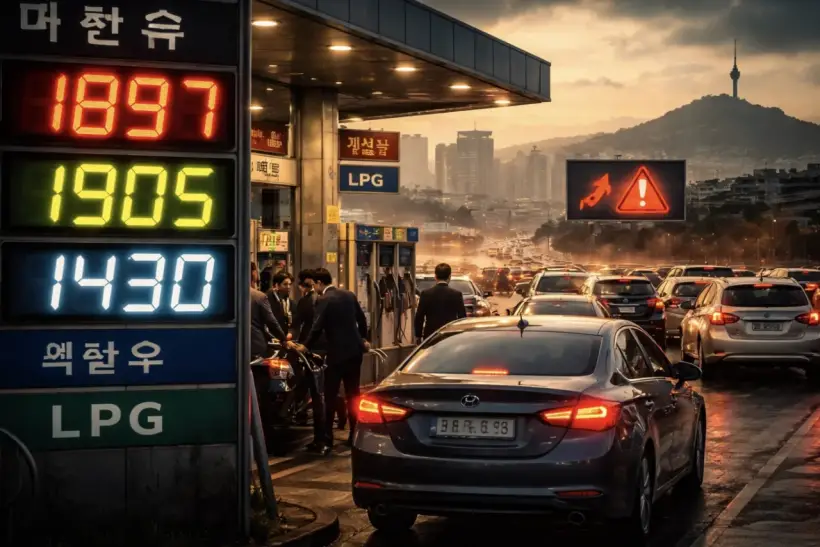
South Korea moves deeper into emergency energy mode
South Korea is weighing a broader expansion of restrictions on private car use as it confronts an oil shock tied to prolonged supply disruption through the Strait of Hormuz. Bloomberg reported on March 30 that officials are discussing the first tougher driving curbs in 35 years, while the government has already launched a nationwide energy-saving push, tightened controls over the fuel market and prepared additional demand-management steps if conditions worsen.
President Lee Jae Myung had already urged the public on March 24–25 to reduce energy use, drive less and rely more on public transportation. At the same time, major conglomerates including Samsung and SK rolled out their own conservation steps, from dimming office lights to discouraging employees from commuting by car, underscoring how seriously the government and corporate sector are treating the risk of a prolonged supply crunch.
Why South Korea is considering car restrictions
The logic is rooted in South Korea’s import structure. Yonhap reported that the country sources about 70.7% of its oil and 20.4% of its liquefied natural gas from the Middle East, while UPI reported that more than 95% of those oil shipments move through the Strait of Hormuz. The IEA has said roughly 80% of oil and oil products transiting the strait in 2025 were destined for Asia, and the US Energy Information Administration estimated that 89% of crude and condensate moving through Hormuz in the first half of 2025 went to Asian markets.
That vulnerability has already pushed Seoul from monitoring to direct intervention. On March 18, the government raised its alert over possible crude supply disruption to Level 2. The trade ministry has also signaled that it is continuously reviewing the impact of the prolonged Middle East conflict on energy, exports and price stability, indicating that the response is no longer limited to temporary market reassurance.
Driving curbs could become the first in decades
In practical terms, officials are reviewing rotation-based limits tied to license plate numbers, including five-day or 10-day systems. ChosunBiz reported that the presidential office ordered a review of “restricted driving by license plate,” while Channel News Asia said curbs for private-sector vehicles remain voluntary for now but could be revisited if the energy alert level rises. Korea Times reported that stricter rules for the public sector were already set to take effect from March 25.
That distinction matters. Driving restrictions already exist for public institutions under earlier conservation rules, but extending them to private vehicles would mark the first move of that kind in more than three decades. Korea Bizwire and other Korean reports stressed that this would be an extraordinary step reflecting the scale of pressure now building in the domestic fuel market.
Fuel prices are rising and the government has capped supply prices
Seoul has already moved into direct price administration. The Ministry of Trade, Industry and Resources announced that from March 13 through March 26 it would impose maximum supply prices of KRW 1,724 per litre for gasoline, KRW 1,713 for automotive diesel and KRW 1,320 for kerosene. The ministry made clear that the ceiling applied to refiners’ supply prices to gas stations and dealers rather than final pump prices.
By the end of March, however, the government was already being forced to adjust those controls. Korea Times reported that Seoul would raise the ceiling as global prices kept climbing and would expand tax cuts on automotive fuels. Korea JoongAng Daily separately reported that the government had limited exports of gasoline and diesel, then went further by banning naphtha exports and implementing a second round of price controls as the prolonged Middle East war effectively choked flows of crude oil, LNG and key feedstocks through Hormuz.
Price stress is already visible at gas stations. Korea Times reported in early March that diesel had become more expensive than gasoline in a rare reversal, with nationwide average prices at KRW 1,887.38 per litre for diesel and KRW 1,871.83 for gasoline. On March 30, the trade ministry’s website also showed Dubai crude at about $94.93 per barrel, highlighting the scale of cost pressure feeding into the Korean market.
Strategic petroleum reserves are buying Seoul time
Even with the shock intensifying, South Korea has entered the crisis with large emergency stocks. Yonhap reported on March 11 that the country holds about 1.9 billion barrels of oil reserves, enough for more than 200 days. Seoul Economic Daily cited President Lee as putting Korea’s response capacity at 208 days, while Ajupress quoted the vice industry minister saying oil and petroleum product stockpiles were sufficient for 208 days. The IEA requires member countries to maintain stocks equal to at least 90 days of net imports, leaving South Korea well above the minimum threshold.
Those reserves are no longer only theoretical. South Korea joined the IEA’s coordinated emergency release and announced a record 22.46 million-barrel drawdown, the largest such release in the country’s history. S&P Global, Yonhap and other reports describe that as part of a broader international response to the biggest oil supply disruption in years, although the IEA has warned that emergency stock releases remain only a temporary buffer if shipping disruptions through Hormuz persist.
What the oil shock means for South Korea’s economy
The economic implications stretch well beyond pump prices. Korea JoongAng Daily, citing the Hyundai Research Institute, reported that in a prolonged-war scenario with crude around $100 a barrel, South Korea’s growth rate could slow by at least 0.3 percentage point while consumer inflation could rise by 1.1 percentage points. Bloomberg has also reported that even though early March export data remained resilient, higher energy costs and renewed trade uncertainty are already worsening the macro backdrop.
For industry, the risks are even broader because crude and refined products are not only fuels but feedstocks. Seoul Economic Daily reported that officials fear a “mammoth-scale” shock to the economy because naphtha and ethylene underpin industries ranging from shipbuilding and autos to plastics and packaging. In that context, possible driving curbs look less like a symbolic public campaign and more like one part of a wider strategy to ration demand across the economy.
As International Investment experts report, South Korea’s discussion of private-vehicle curbs shows that the government has moved beyond short-term stabilization and into a scenario of prolonged demand management. If disruption through the Strait of Hormuz continues, Seoul is likely to keep combining strategic stock releases, administrative price controls and demand-restraint policies, with the main risk extending beyond expensive oil to wider pressure on industry, inflation and household spending.
FAQ: South Korea, oil and driving curbs
Why is South Korea discussing limits on private car use?
Because the country is highly dependent on oil flows linked to the Strait of Hormuz and is trying to reduce fuel demand amid the risk of a prolonged supply crisis.
Will the restrictions be mandatory for private drivers?
Not yet. Officials have said private-sector measures remain voluntary for now, but they could be reviewed if the energy alert level rises.
What measures has South Korea already introduced?
It has already imposed maximum supply prices on petroleum products, expanded fuel tax relief, tightened public-sector driving rules and limited or banned exports of certain petroleum products.
Does South Korea have enough emergency oil reserves?
According to government officials and Yonhap, the country has reserves sufficient for more than 200 days, well above the IEA’s 90-day minimum requirement.
How could the oil crisis affect South Korea’s economy?
It could raise inflation, increase business costs, disrupt industrial supply chains and reduce economic growth.