







 Vietnam Mortgage Surge Pushes Homes Out of Reach
 Lithuanian Apartment Prices Accelerate Across Major Cities
 London Flats Lose Value Ahead of Leasehold Reform
 Construction of the Batumi–Sarpi Highway Begins in Georgia
 Baltic Property Investment Accelerates in 2026
 Hong Kong and Singapore Renew Their Expat Rivalry
EU Still Hosts Millions From Ukraine
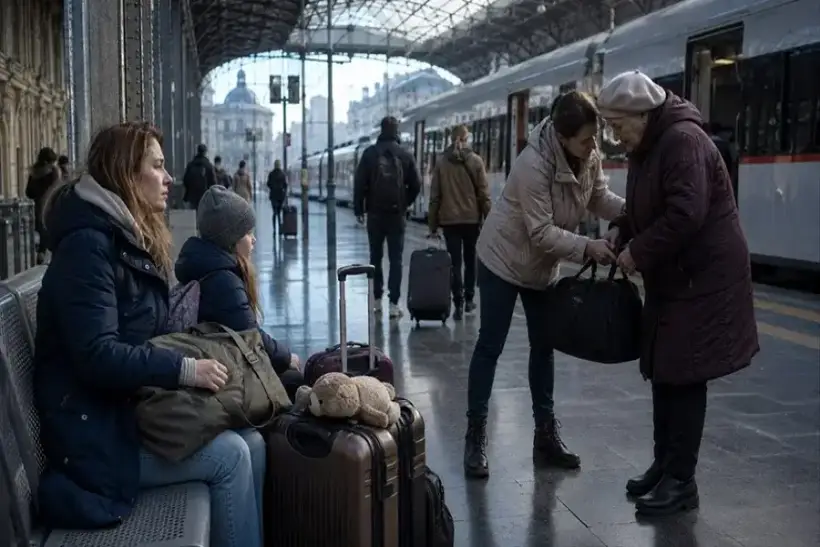
At the end of March 2026, 4.33 million people who had left Ukraine were under temporary protection in the European Union. Eurostat said the total fell by 68,980 people, or 1.6%, compared with the end of February. Despite the monthly decline, temporary protection remains the EU’s largest active collective-protection mechanism and continues to shape migration, social and budget policy across the bloc.
Temporary protection is a special EU procedure for a mass influx of displaced people from third countries who cannot safely return home. Unlike the regular asylum process, it provides rapid access to residence, work, housing, education and basic social support without requiring each case to pass through a full individual asylum procedure. The regime was activated in March 2022 after Russia’s invasion of Ukraine.
Germany, Poland and Czechia carry the largest load
Germany remains the largest host country, with 1,274,955 people under temporary protection on March 31, 2026, equal to 29.4% of the EU total. Poland ranked second with 961,405 beneficiaries, or 22.2%. Czechia was third with 379,820 people, or 8.8%. Together, the three countries hosted more than 2.6 million people, around 60% of all registered temporary-protection beneficiaries in the EU.
That concentration reflects not only the geography of the first refugee flows, but also established Ukrainian communities, access to work, transport links and social networks. Poland became the main first-entry point into the EU after the conflict began, Germany the largest long-term hosting center, and Czechia one of the countries with the heaviest burden relative to population.
Czechia leads on a per-capita basis
When measured against host-country population, the picture changes. Czechia recorded the highest ratio of temporary-protection beneficiaries, at 34.8 people per thousand residents. Poland followed with 26.3 and Slovakia with 26.2. The EU average was 9.6 per thousand people.
This ratio matters for schools, health care, housing, local budgets and labor markets. Germany hosts the largest number in absolute terms, but Czechia, Poland and Slovakia face a higher relative load on municipal services and local infrastructure. That is why the political debate in Central Europe is not only about solidarity, but also about the sustainability of public systems.
Numbers rose in 14 countries and fell in 13
The March figures moved in different directions across the EU. The number of people under temporary protection increased in 14 countries and fell in 13. The largest absolute rise was in Germany, where the total grew by 7,480 people, or 0.6%. Spain added 2,665 people, or 1.0%, and Romania added 2,125, also 1.0%.
The sharpest decline was recorded in Italy, where the total fell by 30,365 people, or 47.4%. Eurostat attributed the drop to the simultaneous expiry of a large number of permits at the end of the month linked to the annual renewal procedure. Czechia followed with a fall of 19,810 people, or 5.0%, and Finland with a decline of 8,080 people, or 10.2%.
Italy’s fall is procedural, not necessarily a mass departure
The Italian decline requires careful interpretation. Eurostat explicitly noted that the sharp drop in valid permits in Italy reflected the simultaneous expiry of more than 30,000 permits, which can be extended through renewal applications. That means monthly data capture not only actual population movements, but also administrative features of national registration systems.
The same caveat applies to cross-country comparisons. Deregistration, renewal and database-update procedures differ across EU states. If a country carries out a large administrative renewal in one month, the statistics may show a sharp decline even when the actual number of Ukrainians living there changes more slowly. The March decline at EU level should therefore be read as a mix of returns, changes of status, moves between countries and technical changes in registers.
Women and children make up the majority
Ukrainian citizens accounted for more than 98.4% of all temporary-protection beneficiaries in the EU at the end of March. Adult women made up 43.3% of the total, minors 30.1%, and adult men 26.6%. This structure reflects the nature of conflict-driven displacement: many men of military age remain in Ukraine, while women, children and older people form much of the long-term displaced population in the EU.
For host countries, that creates a specific integration profile. Children require school places, language support and education-system integration. Adult women often need access to work, recognition of qualifications, childcare and housing support. Older and vulnerable groups place greater demands on health care and social services.
The legal regime runs until March 2027
Temporary protection for Ukrainians in the EU is based on the Council decision of March 4, 2022, which established the existence of a mass influx of displaced people from Ukraine. In June 2025, the Council unanimously backed extending the regime for another year, until March 4, 2027, for more than 4 million people displaced by Russia’s conflict against Ukraine.
The extension gives both EU countries and Ukrainians legal certainty, but it does not settle the longer-term question. The longer the conflict continues, the less temporary protection looks like a short emergency measure. It is increasingly becoming a bridge between humanitarian reception, labor migration, family integration, return to Ukraine and possible transition to other legal statuses.
The EU is preparing a transition from emergency status
In 2025, the European Commission proposed not only extending temporary protection but also preparing a coordinated path toward more durable legal solutions. The goal is to give Ukrainians and EU states predictability after the temporary regime ends, when conditions allow a shift to other forms of stay, return or integration.
In practice, several routes are possible. Some people may return to Ukraine if security and economic conditions allow. Others may move into work, study, family or long-term residence permits. Vulnerable groups may require separate protection. The central task for the EU is to avoid a legal cliff in which millions of people lose a clear status at the same time.
Labor-market integration is becoming decisive
UNHCR estimates that employment among Ukrainian refugees in Europe has increased, but remains below host-country levels: a new analysis of more than 6,000 survey observations found that 57% of Ukrainian refugees are employed, leaving a 22 percentage-point gap with host-country nationals.
That gap shows why temporary protection is both a legal and economic issue. Access to work was one of the regime’s main advantages, but employment does not always mean full integration. Many Ukrainians face language barriers, skills mismatch, childcare constraints and concentration in lower-paid sectors. For host-country budgets, employment will determine whether temporary protection remains mainly a cost item or becomes a source of tax revenue and labor supply.
Housing is the weak point of integration
Four years after the start of the conflict, housing remains one of the most difficult parts of reception. In countries where Ukrainians initially lived in hotels, dormitories, host households or emergency accommodation, governments are gradually moving people toward independent rental housing. But that transition is happening while European housing markets face high rents and a shortage of affordable apartments.
Eurostat’s statistics show the scale of protection, but not the quality of housing conditions. For many families, temporary protection has already turned into long-term residence, while legal and social infrastructure still rests on the idea of a temporary crisis. This is where the next-stage conflict emerges: the EU is extending the status, but national governments are increasingly reducing emergency support and expecting refugees to become more self-reliant.
The March decline does not mean the crisis is ending
The monthly fall of 68,980 beneficiaries may look like a sign that pressure is easing, but it does not by itself indicate a large-scale return to Ukraine. The figure is affected by permit expiry and renewal, deregistration, changes of legal status, moves between EU countries, returns to Ukraine and differences in national accounting.
The core fact remains unchanged: 4.33 million people are still under collective protection in the EU. That population is comparable to a large European country and has become a structural factor for labor markets, schools, rental housing, health systems and migration policy.
As experts at International Investment report, Eurostat’s data show not the end of the Ukrainian migration crisis, but its move into a more complex phase. The critical conclusion is that temporary protection has ceased to be only an emergency instrument and has become a long-term test of Europe’s integration model. If the EU does not agree on clear pathways beyond 2027, millions of people already embedded in schools, jobs and local communities may face legal uncertainty just as host countries try to cut spending and normalize migration policy.
FAQ in English
How many Ukrainians were under temporary protection in the EU in March 2026?
At the end of March 2026, 4.33 million people who had left Ukraine held temporary-protection status in the EU.
Which EU countries host the most beneficiaries?
Germany, Poland and Czechia host the largest numbers. Germany had 1,274,955 people, Poland 961,405 and Czechia 379,820.
Why did the number of beneficiaries fall in March?
The total fell by 68,980 people, or 1.6%, but the decline reflects more than departures. It is also affected by permit renewal, deregistration, changes of status and national administrative procedures.
Why was the decline in Italy so large?
Italy recorded a fall of 30,365 people, or 47.4%, because a large number of permits expired simultaneously at the end of the month as part of the annual renewal process. These permits can be extended through renewal applications.
What is temporary protection in the EU?
Temporary protection is a special regime for a mass influx of people who cannot safely return home. It gives rapid access to residence, work, education, housing and social support without the regular individual asylum process.
How long has EU temporary protection for Ukrainians been extended?
The EU has extended temporary protection for people displaced from Ukraine by the conflict until March 4, 2027.
Why do these figures matter for the EU economy?
Because 4.33 million people affect labor markets, schools, health care, housing, municipal budgets and the long-term migration policies of EU countries.