













Chile Cuts Copper Output Forecast
Mining Doc
Chile has lowered its copper production outlook for 2026 and 2027 while raising price forecasts toward historically high levels. For the global market, the shift is a warning from the world’s largest mined-copper supplier: output is struggling to keep pace just as power grids, data centers, artificial intelligence and electric vehicles are intensifying competition for the metal.
Santiago acknowledges a supply squeeze
Bloomberg reported that Chile now expects copper output to fall 2% in 2026 to 5.3 million metric tons, before recovering about 4% in 2027 to roughly 5.5 million tons. The previous forecast stood at 5.6 million tons for 2026 and 5.97 million tons for 2027. The revision matters because the country accounts for almost a quarter of global mined copper supply and remains the main reference point for the market’s raw-material balance.
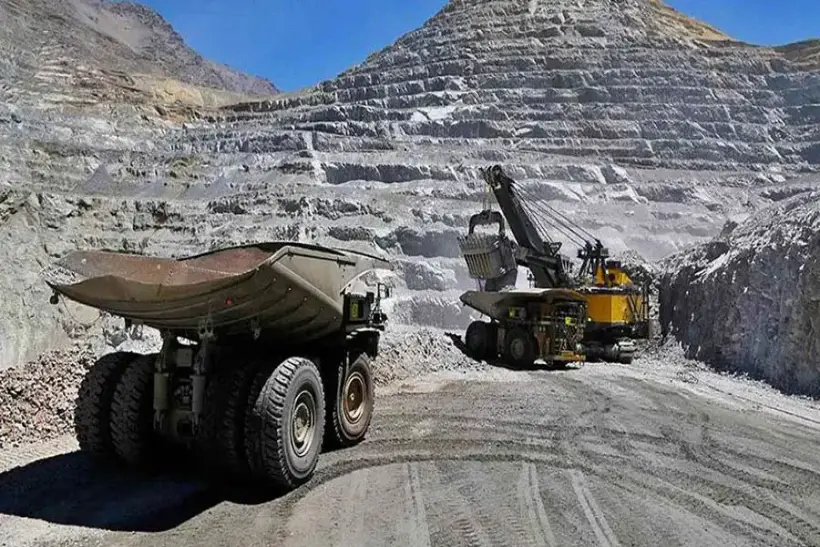
The reasons for the cut look structural rather than temporary. The report cited lower ore grades, scheduled maintenance, operational constraints and a weak start to the year. Lower ore grades mean miners must process more rock to obtain the same amount of copper, increasing costs, putting more pressure on equipment and slowing the recovery of supply even when prices are high.
Copper price forecast rises to $5.55 a pound
Chile’s copper commission Cochilco raised its average copper price forecast for 2026 to $5.55 a pound from $4.95 and projected $5.10 a pound for 2027. The new outlook effectively treats expensive copper as a two-year market scenario rather than a short-term spike.
An earlier official forecast had put the 2026 average at $4.95 a pound and the 2027 level at about $5.00. At the time, officials pointed to tight concentrate supply, low inventories and the rising role of digital infrastructure. The latest upgrade indicates that the market has become tighter than previously expected.
Output is falling despite high prices
The paradox of the 2026 copper market is that high prices have not yet delivered a quick supply response. In February, Chile produced 378,554 tons of copper, the weakest monthly figure in almost nine years. Output fell 8.5% from January and 4.8% from a year earlier, deepening concerns about the reliability of supply from a country central to the global industrial chain.
The condition of large mines adds to the pressure. State-owned Codelco said in its 2025 results that total copper production, including stakes in El Abra, Anglo American Sur and Quebrada Blanca, slipped 0.1% to 1.44 million tons, while direct cash costs rose to 208.6 cents per pound from 199.1 cents a year earlier. The figures show that even the world’s leading producer is exposed to aging deposits, rising costs and the complexity of major investment projects.
Demand is shifting toward grids and AI
Reuters wrote that global refined copper demand may rise 1.5% in 2026 and 2.3% in 2027, reaching 28.2 million and 28.8 million metric tons, respectively. China remains the main consumer despite weakness in its property market, but the demand base is changing: copper is needed not only in construction and manufacturing, but also in transmission lines, renewable energy, electric vehicles, servers and data centers.
Data centers have become a distinct demand driver because artificial intelligence requires large-scale power systems, electrical equipment, cooling and cable infrastructure. The impact extends beyond server halls: each expansion also requires grid connections, substations and backup systems, all of which increase copper use.
The market balance is close to zero
The official outlook sees the refined copper market moving from a 124,000-ton deficit in 2025 to a tiny 12,000-ton surplus in 2026 and a moderate 153,000-ton surplus in 2027. For a market approaching 30 million tons a year, that is a narrow safety margin: one disruption at a major mine, a delayed maintenance cycle or a logistics problem could quickly push the balance back into deficit.
S&P Global says copper prices in 2026 are being supported mainly by supply tightness, concentrate shortages and limited new mine supply rather than demand growth alone. For investors, that means the market is sensitive not to one macroeconomic headline, but to a cluster of production risks across Chile, Peru, the Democratic Republic of Congo, Indonesia and other key mining regions.
China is no longer the only driver
China remains the largest copper consumer, but the market is no longer driven solely by Chinese construction. Even a weak property sector has not derailed consumption because state investment in grids, industrial modernization and infrastructure is partly offsetting weakness in traditional building activity. That reduces the risk of an immediate demand collapse, though it does not remove it: if Chinese manufacturing slows more sharply than expected, today’s price forecasts may prove too optimistic.
For Chile, high copper prices provide a fiscal cushion. Metal exports support budget revenues, foreign-exchange inflows and investment plans. Yet dependence on copper also creates vulnerability: if output fails to grow, the country benefits from price but loses part of the export volume it could otherwise capture. The forecast revision is therefore positive for government revenue through prices, but concerning for the mining sector’s long-term competitiveness.
Copper enters a phase of costly instability
J.P. Morgan recently warned that copper could fall toward $11,100–$11,200 per metric ton under bearish macroeconomic scenarios if geopolitical risks, higher energy prices or weaker growth hit demand. That does not contradict Chile’s forecast; it highlights the market’s central tension. Structural tightness supports prices, while financial conditions, the dollar and global growth expectations can still drive sharp short-term moves.
For industrial consumers, this means greater pricing risk. Cable makers, power-equipment producers, electric-vehicle manufacturers, appliance companies and construction-material suppliers will need to factor more expensive copper into contracts, inventories and hedging. For resource-rich countries, the market offers an opportunity, but only if permitting, investment, water supply, power infrastructure and processing capacity can expand without triggering new social conflicts.
As experts at International Investment report, Chile’s new forecast shows not the strength of the copper market, but its vulnerability: copper is rising not because supply is confidently expanding with demand, but because the world’s largest producer cannot quickly restore output. For investors, that supports prices; for the global economy, it raises the risk of another wave of raw-material inflation across infrastructure, energy and the digital sector.
Why did Chile lower its copper production forecast?
Chile lowered the forecast because of lower ore grades, scheduled maintenance, operational constraints and weak production at the start of the year. These factors slow the recovery of supply even when copper prices are high.
Why are copper prices still elevated?
Prices are supported by limited supply, low inventories, tight concentrate availability and strong demand from power grids, electric vehicles, data centers and energy-transition projects.
What does $5.55 per pound mean for copper?
It is the official average copper price forecast for 2026. The figure signals that Chile sees high copper prices as a sustained market condition rather than a temporary spike.
How does artificial intelligence affect copper demand?
Artificial intelligence requires large data centers, stronger electricity networks, cooling systems and server infrastructure. These facilities increase demand for copper in cables, transformers, grid equipment and power distribution.
What is the main risk in the copper market?
The main risk is the thin supply-demand balance. Small disruptions at major mines can tighten the market quickly, while weaker global growth or a stronger dollar can still trigger sharp price corrections.