











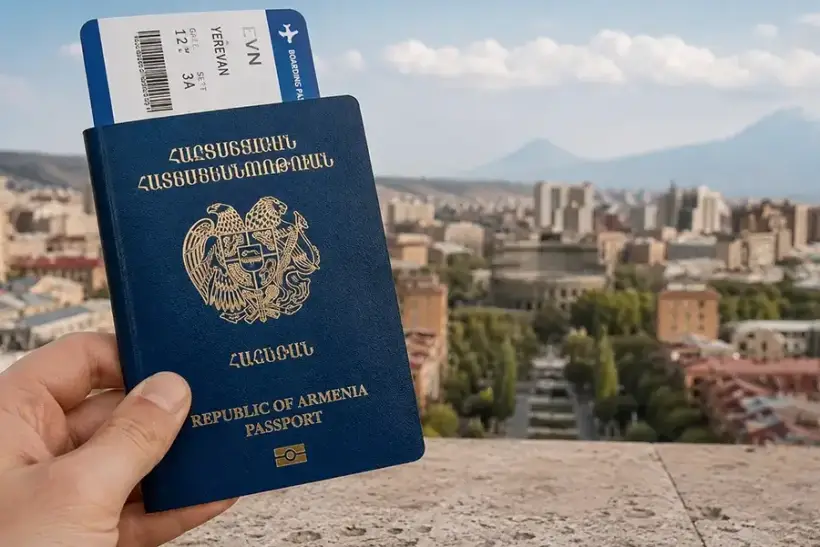
Interest in Armenian citizenship has reached an all-time high. In 2025, the number of applications exceeded 32,000. A significant share of requests comes from Russian citizens, most of whom are ethnic Armenians, JAMnews reports.
Who Is Applying for Armenian Citizenship
Previously, Armenia received around 7,000–8,000 citizenship applications annually. In 2023–2024, the figure reached 20,000, while in 2025 it exceeded 32,000. Acting Deputy Interior Minister Armen Kazaryan described the result as the highest in the history of the republic.
He attributes the sharp increase primarily to applicants seeking a passport that offers greater opportunities for international travel. Interest rose significantly after the outbreak of hostilities in Ukraine and the introduction of travel restrictions for Russian citizens. Most Russians applying for Armenian citizenship are ethnic Armenians.
The procedure for this category is highly simplified, with virtually no additional requirements. Difficulties mainly arise when applicants need to prove their ethnic origin and the necessary documents are missing or contain errors. Kazaryan considers the current system problematic, arguing that it reduces the value of the institution of citizenship. The Interior Ministry is preparing legislative amendments, although their details have not yet been disclosed.
Armenia’s Migration Balance
Armenia’s migration situation has also changed noticeably. In the first half of 2024, the number of Armenian citizens leaving the country exceeded those arriving by 22,893. In January–June 2025, the gap narrowed to 20,065. By the end of December, the balance had turned positive, with arrivals exceeding departures by 8,660. The trend continued in the first half of 2026. Over six months, 871,409 Armenian citizens entered the country, while 870,062 emigrated.
Acting head of the Migration and Citizenship Service Nelli Davtyan described the result as exceptional. The balance usually improves in the second half of the year, when seasonal labor migrants who leave for temporary work in early spring return home.
Demand for Residence Permits in Armenia Nearly Triples
Foreign interest in long-term residence in Armenia has also increased significantly. Since January, the Migration and Citizenship Service has received 9,534 applications for one-year temporary residence permits, of which 6,059 were approved. Compared with previous periods, the number of applications has nearly tripled. The number of approvals has increased at a similar pace.
More foreigners are also seeking three-year residence status. Previously, the authorities received around 1,500–1,700 such applications annually, while in the first half of 2026 alone the figure had already reached 2,085.
Armen Kazaryan believes Armenia is gradually changing its role in migration processes. It is evolving from a country whose citizens mainly left to work abroad into a state that increasingly attracts foreign nationals.
EU Requirements for Changes to Armenia’s Visa Regime
Yerevan is moving forward with visa liberalization with the European Union. In May 2026, Armenia received its first report on the implementation of the relevant action plan. Armen Kazaryan said the measures taken by the government received a fairly positive assessment. The EU presented Armenia with 53 recommendations. A working group converted them into a list of 117 specific measures, more than half of which have already been completed.
Armenia is currently going through the first stage of the process, focused on bringing legislation and public policy into line with EU requirements. The authorities expect the results to be assessed in early 2027 or during the first half of the year. If the assessment is positive, the country will be able to move to the second stage of visa liberalization.
European Integration Could Reshape Armenia’s Relations With Russia
Further rapprochement between Armenia and the European Union could require a reassessment of relations with Russia, including visa policy and sanctions. European Parliament member Fernand Kartheiser said Brussels would seek to persuade Yerevan to join restrictions against Moscow and introduce visas for Russian citizens. Armenia has not yet submitted an official application for EU membership.
The possible introduction of visas could have a significant impact on tourism. In 2025, Russians accounted for around 40% of inbound travel to Armenia, with more than 900,000 trips. Mikhail Abasov, an expert at the Russian Union of Travel Industry, believes visa barriers would increase the cost and time required to organize trips and would primarily affect independent travelers. Replacing the Russian market quickly with visitors from other countries would be difficult, in his assessment.
Economic risks are also associated with a possible weakening of cooperation within the Eurasian Economic Union. Russia remains an important trading partner for Armenia, although bilateral trade fell by 21.5% year on year in January–May 2026.
Outlook for Armenia’s Migration Policy
Analysts at International Investment note that Armenia is gradually changing its position on the region’s migration map. Record numbers of citizenship applications, growing demand for residence permits and an improving migration balance point to the country’s increasing appeal both to ethnic Armenians living abroad and to foreign nationals. If the trend continues, the inflow of new residents could become more sustainable, although tighter citizenship rules may somewhat slow the growth.
Future developments will largely depend on Yerevan’s foreign policy course. Progress toward visa liberalization with the EU could make the Armenian passport more attractive and strengthen ties with Europe. At the same time, the possible introduction of visas for Russians or a reduction in economic cooperation with Moscow would create risks for tourism, trade and migration flows. In the coming years, one of Armenia’s main challenges will be to balance deeper European integration with maintaining close ties with Russia.