







 Covivio Hotels Revenue Grows 4.7% as European Markets Split
 Lithuanian Apartment Prices Accelerate Across Major Cities
 Georgia's Tourism Revenue Hits Record High
 Norway's Sovereign Fund Commits €1.5bn to European Warehouses
 Market Rout of October 2026: Can Branded Hotels Protect Capital?
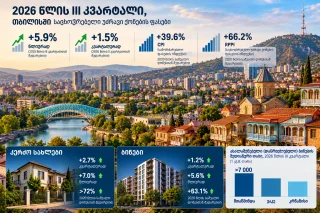 Residential Property Prices in Tbilisi Rise by 5.9% Year-on-Year
Spain Leads the EU in Growth of Russian Residence Permit Holders

Unsplash
Spain ranked second in the European Union, behind Germany, for the number of Russian citizens holding residence permits. The figure rose 61% over four years to 117,000. Spain recorded the EU’s largest absolute increase during that period, according to Eurostat.
Russian Residence Permit Holders Across the EU
Over four years, the number of Russian nationals holding valid residence permits in Spain increased by 44,400. Cyprus recorded growth of 26,800, and France added 13,700. By contrast, Latvia, Estonia and Czechia registered declines in the number of such permits.
Germany had the largest number of valid permits: by the end of 2025, approximately 218,000 Russian citizens held them. Spain ranked second with 117,000. At the end of 2021, about 73,000 Russians had Spanish residence permits.
|
Country |
Increase in Russian residence permit holders, 2021–2025 |
|
Spain |
+44,400 |
|
Cyprus |
+26,800 |
|
France |
+13,700 |
Growth continued in the first half of 2026. As of June 30, 107,449 Russian citizens held valid permits under Spain’s general immigration regime, 14.1% more than a year earlier. The total rose by 3.7% in the second quarter, according to the Permanent Observatory of Immigration (OPI) at Spain’s Ministry of Migration. Women accounted for 55% of permit holders, while 15% were children under 16. The average age was 39.
In OPI statistics, Russians rank eighth among foreign nationals with valid residence permits. Larger groups include citizens of Morocco, Ukraine, Colombia and China. Nationals of Venezuela, Peru and Ecuador also rank above Russia.
As of January 1, 2025, Spain’s National Statistics Institute (INE) counted 110,665 residents with Russian citizenship, up from 106,375 a year earlier. The increase was 4,290 people, or approximately 4%.
Rules for Obtaining a Residence Permit in Spain
Spain ended its golden visa scheme on April 3, 2025. Buying real estate and making other investments no longer qualify applicants for residence permits under the investment route. Applications submitted before the scheme ended are processed under the previous rules. Permits issued earlier remain valid, with renewals governed by transitional provisions.
Updated rules for obtaining a residence permit in Spain took effect on May 20, 2025. The changes affected temporary residence applications, employment-based routes and family reunification procedures.
Russian nationals may apply on the basis of an employment contract, business activity or family reunification. Financially independent applicants can obtain residency without the right to work. A separate status is available to digital nomads who work remotely, primarily for companies based abroad.
Immigration authorities assess sources of income, employment arrangements and submitted information according to the chosen category. Requirements for financially independent applicants differ from those for digital nomads. Buying a home does not replace any of the legal grounds for residence.
Spanish Real Estate: Demand from Russian Buyers
Although the number of Russians holding Spanish residence permits is rising, their share of property transactions involving foreign buyers is falling. In 2025, Russians accounted for 1.79% of real estate purchases by foreigners in Spain, down from 2.44% in 2024. Spain’s College of Property Registrars recorded a decline of 0.65 percentage points.
Russian buyers’ share declined further to 1.47% in the second quarter of 2026, compared with 1.74% a year earlier. British nationals accounted for 6.99% of purchases by foreigners, Dutch nationals for 6.94% and Germans for 6.11%. Foreign buyers represented 15.98% of all registered residential property transactions in Spain.
A declining share does not necessarily mean that Russians made fewer purchases in absolute terms. The percentage also depends on activity among buyers from other countries and can fall even if the number of Russian transactions remains stable. Assessing the actual trend requires transaction counts, not simply each nationality’s share of foreign demand.
|
Period |
Share of purchases by foreign buyers |
|
2024 |
2.44% |
|
2025 |
1.79% |
|
Q2 2025 |
1.74% |
|
Q2 2026 |
1.47% |
Property registrars do not indicate whether a buyer with Russian citizenship holds a Spanish residence permit or lives abroad. Home ownership is also not required to relocate: growth in the Russian community could support demand for long-term rentals. Published statistics do not show how many properties are purchased or rented specifically by Russian residence permit holders.
Outlook for Residence Permits in Spain
International Investment analysts note that Spain retains the potential to attract more Russian citizens. New arrivals will continue to affect migration figures alongside residence permit renewals and the transition to permanent resident status. Together, these processes could sustain the Russian community’s presence even as immigration legislation changes.
The trend will be shaped by employment rules, business opportunities, family reunification and requirements for financially independent applicants. Stricter provisions in individual categories could change the mix of applications and slow relocation. However, restrictions affecting one route would not necessarily reduce overall interest in Spain.
A key indicator will be the balance between first-time permits, renewals and transitions to permanent residence. These figures will help distinguish new applicants from people already living in the country. An expanding community could increase demand for long-term rentals, but does not guarantee a comparable rise in property sales.
Questions and Answers About Residence Permits in Spain
How many Russian citizens hold valid residence permits in Spain?
At the end of 2025, 117,000 Russian citizens held valid residence permits in Spain, according to Eurostat. The country ranks second in the EU on this measure, behind Germany. The figures cover permits in force, not the number of new applications filed during the year.
How has the number of Russian residence permit holders changed over four years?
Between the end of 2021 and the end of 2025, the number increased by 44,400, or 61%. This was the largest absolute rise among EU member states during the period. By comparison, Cyprus recorded growth of 26,800 and France of 13,700.
What do Spanish residence permit statistics show for the first half of 2026?
According to Spain’s Permanent Observatory of Immigration, 107,449 Russians held valid documents under the general immigration regime as of June 30, 2026. That was 14.1% more than a year earlier. These data cover a specific category of permits and therefore cannot be compared directly with Eurostat’s total for 2025.
What routes are available to Russians seeking residence permits in Spain?
Spanish law provides employment- and business-based routes, family reunification, residence for financially independent applicants and a separate status for digital nomads. Income, employment and documentation requirements depend on the category. Immigration authorities check whether applicants meet the relevant conditions.
Why does buying property no longer qualify someone for a Spanish residence permit?
On April 3, 2025, Spain stopped issuing new golden visas for investments, including real estate purchases. Owning a home does not replace any of the legal grounds for obtaining residence. Transitional provisions apply to investment permits issued before the scheme ended.