







 China Nears a Decision on Fresh Stimulus
 Fines for Illegal Rentals in Spain Reach €800,000
 Australia’s Spring Auctions Rise but Remain Well Below 2025
 Number of Foreigners Holding Turkish Residence Permits Exceeds 1.27 Million
 Demand from Russian Tourists for Holidays in Georgia Rises by 20–25%
 Montenegro Property Buying Costs in 2026
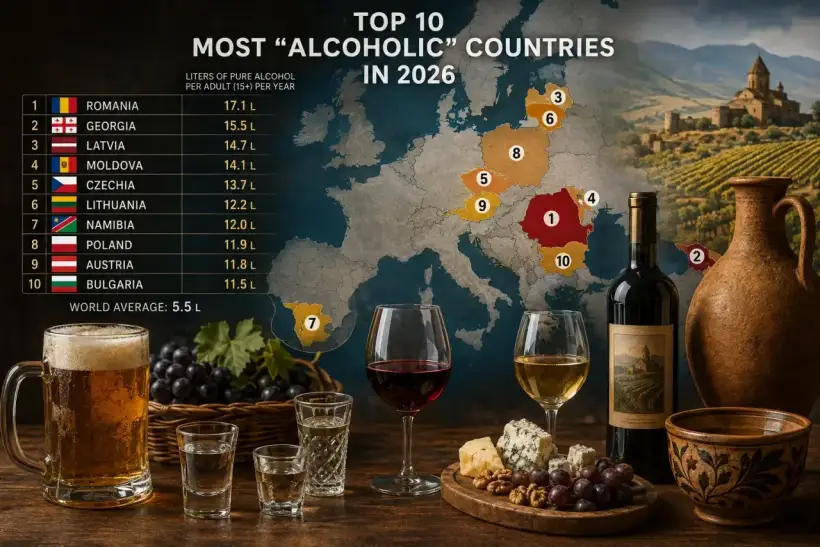
Analytical portal World Population Review has released its latest ranking of global alcohol consumption per capita. The report is based on World Health Organization (WHO) data measuring pure alcohol intake among individuals aged 15 and older. Globally, the average person consumes 5.5 liters of pure alcohol per year.
Top 10 Countries by Alcohol Consumption
The list reinforces a long-standing trend: Eastern Europe continues to dominate the top spots.
-
Romania – 17.1 liters per year. Romania leads the ranking with a noticeable margin over the runner-up. High consumption here is traditionally linked to locally produced spirits and a deep-rooted culture of wine consumption.
-
Georgia – 15.5 liters per year. Taking second place, Georgia boasts one of the world's oldest winemaking traditions, spanning roughly 8,000 years.
-
Latvia – 14.7 liters per year. The Baltic nation ranks high on the list, driven primarily by strong spirits and beer, while wine plays a lesser role.
-
Moldova – 14.1 liters per year. Wine is integral to the national identity here, consumed across all generations.
-
Czech Republic (Czechia) – 13.7 liters per year. Home to one of the world’s oldest and most developed beer cultures, it consistently leads global per capita beer consumption.
-
Lithuania – 12.2 liters per year. Another Baltic state with traditionally high consumption rates for spirits.
-
Namibia – 12.0 liters per year. As the only non-European country in the top 10, Namibia stands out as a notable exception to the Eastern European trend.
-
Poland – 11.9 liters per year. High-proof spirits, particularly vodka, remain a staple of traditional social gatherings.
-
Austria – 11.8 liters per year. The sole Western European country in the top 10, driven by a well-established culture of beer and wine consumption.
-
Bulgaria – 11.5 liters per year. Rounding out the top 10, Bulgaria is closely followed by Belarus, Saint Lucia, and Seychelles, all tied at 11.4 liters.
World Population Review analysts point out that Eastern Europe has consistently held the top spots in global alcohol rankings for decades. This persistent trend is attributed to a combination of historical winemaking and distilling traditions, high affordability, and cultural norms surrounding social drinking.
Major Economies and Asia
Among developed economies, Germany, France, Australia, and Portugal lead with 11.2 liters per year, followed by the United Kingdom (10.9 L), Ireland (10.5 L), Canada (10.0 L), and Denmark (10.0 L). The United States recorded 9.8 liters—lower than its Western peers, but still above the global average.
In Asia, Vietnam logged the region's highest consumption at 10.7 liters per year. By comparison, South Korea registered 8.4 liters, while Japan recorded a much lower figure of 6.3 liters.
Russia sits near the middle of the global table at 10.5 liters of pure alcohol per person annually, roughly matching consumption levels in Ireland and Estonia.
The Lowest-Consuming Nations
At the opposite end of the spectrum are countries with historically low consumption rates, where religious and cultural norms play a decisive role.
Near-zero consumption figures were recorded in several predominantly Muslim nations, including Kuwait, Iran, Pakistan, Egypt, and Syria, all reporting approximately 0.1 liters per year.
Strict regulations and partial or full bans on alcohol sales in these countries severely restrict both availability and social acceptance.
Wealth vs. Alcohol Intake: A Strong Correlation, But Not Absolute
The report highlights a general correlation: higher-income countries typically exhibit higher alcohol consumption rates, driven by greater affordability and thriving hospitality and entertainment industries. Germany, France, Australia, the UK, and Canada serve as prime examples of this trend.
However, there are prominent exceptions. Several high-income nations—such as Singapore and select Gulf states—maintain low consumption levels due to strong cultural norms, public policy, or religious traditions.
Ultimately, a country's drinking habits are shaped by a nuanced mix of economic, historical, regulatory, and social factors rather than wealth alone.