







 Fines for Illegal Rentals in Spain Reach €800,000
 Australia’s Spring Auctions Rise but Remain Well Below 2025
 Number of Foreigners Holding Turkish Residence Permits Exceeds 1.27 Million
 Demand from Russian Tourists for Holidays in Georgia Rises by 20–25%
 Montenegro Property Buying Costs in 2026
 Four in Ten Companies Would Not Choose Slovakia
Conflict Reprices Philippine Real Estate
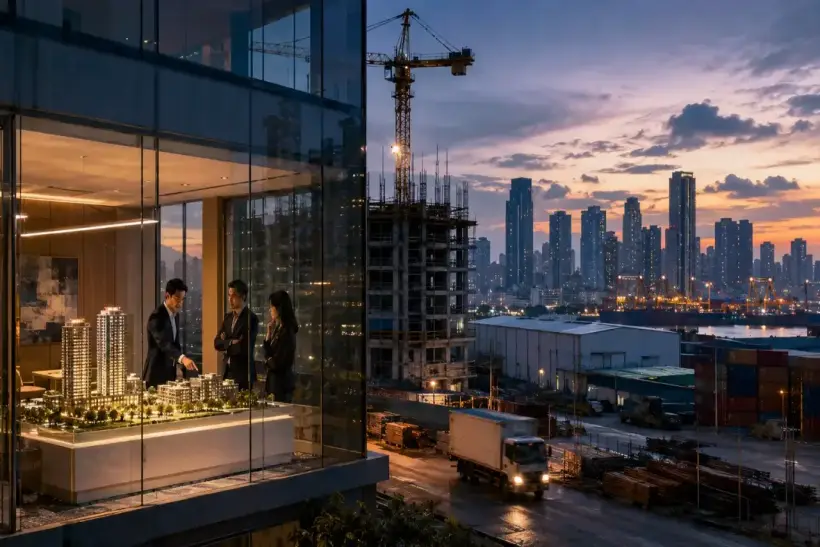
The Middle East conflict is becoming a new risk factor for Philippine real estate, pushing up energy, construction, transport and financing costs while reshaping demand across offices, warehouses, residential projects, retail assets and hotels.
Energy shock reaches property costs
The Philippine property market entered the second quarter of 2026 with a sharper external shock. The cited May 11 report said the conflict is reshaping the sector by lifting construction, energy and financing costs, forcing developers and occupiers to reassess investment decisions.
The May commentary by Cushman & Wakefield Philippines identified disruptions to global energy routes, including risks around the Strait of Hormuz, as the main transmission channel. Because the Philippines relies heavily on imported energy, higher fuel prices feed directly into construction materials, freight, site operations, equipment use, utilities and building maintenance. The firm expects a temporary narrowing of the new supply pipeline as developers recheck project feasibility under higher cost assumptions.
Developers face a new cost base
Projects in planning or early construction are the most exposed. Higher fuel prices raise the cost of moving cement, steel, equipment and finishing materials. More expensive electricity increases the cost of running construction sites and completed buildings. If banks remain cautious because of inflation, credit also becomes more expensive, reducing developer margins.
The practical result is a market where some companies delay launches, phase delivery or secure materials earlier to lock in prices. That strategy improves cost visibility but requires more working capital and more warehouse space. The conflict is therefore affecting not only property prices but also procurement, construction schedules and financing structures.
Inflation widens the market split
The macroeconomic backdrop is worsening affordability. The Philippine Statistics Authority reported that inflation reached 7.2% in April 2026, driven by food, transport, utilities and fuel; housing, water, electricity, gas and other fuels contributed 1.7 percentage points, while food inflation accelerated to 6.1%.
That matters directly for housing. When households spend more on food, transport and electricity, they have less room for mortgages and home purchases. Mid-market housing becomes more sensitive to interest rates, down payments and monthly amortization. Premium housing behaves differently: affluent buyers are more likely to treat real estate as an inflation hedge, allowing high-quality condominiums, landed homes and well-located projects to hold demand better than mass-market supply.
Outsourcing supports office demand
The office market is receiving mixed signals. Higher energy costs and uncertainty encourage companies to optimize space and use hybrid work, meaning employees split time between the office and remote work. At the same time, the information technology and business process management sector remains a structural demand driver for the Philippines. This sector provides outsourced services such as customer support, accounting, analytics and digital operations for international clients.
The sector may benefit if global companies seek lower-cost locations during a period of cost pressure. That would support office demand in Metro Manila, Cebu and other business hubs. Still, tenants are likely to pay closer attention to electricity costs, employee transport, workplace density and the efficiency of every leased square meter.
Warehouses become defensive assets
Logistics real estate appears to be one of the more resilient segments. Higher fuel costs and global shipping uncertainty are pushing companies away from just-in-time inventory, where goods arrive with minimal buffers, toward just-in-case strategies, where businesses hold more stock near customers.
For the Philippines, that increases the value of warehouses near ports, airports, transport corridors and large urban centers. Import-dependent companies, e-commerce operators and retailers need space for buffer inventory. As a result, logistics and industrial parks may retain demand even as broader economic growth slows.
Retail and hotels face fuel-linked pressure
Retail and hospitality assets are more directly exposed to weaker consumer spending. If families spend more on essentials and transportation, discretionary purchases decline. For mall landlords, that can mean pressure on tenant sales, rent negotiations and slower network expansion.
Tourism is also sensitive to aviation fuel. Higher airfares can reduce international arrivals and delay new hotel projects. For resort real estate, the issue is especially important because demand depends not only on domestic income but also on flight prices, insurance costs and regional security perceptions.
Remittances remain a housing pillar
Another risk runs through overseas Filipino workers. Remittances support consumption, mortgage payments and home purchases by families inside the country. According to Bangko Sentral ng Pilipinas, personal remittances reached $39.62 billion in 2025, while cash remittances through banks reached $35.63 billion; in January–February 2026, personal remittances totaled $6.46 billion and cash remittances stood at $5.81 billion.
If the Middle East conflict affects the jobs, safety or income of Filipino workers in the region, housing demand from remittance-receiving families could soften. The flows remain resilient for now, but developers that sell to overseas-worker households need to price this risk into sales and financing assumptions.
Growth outlook has been cut
The broader economy is also weaker. The Asian Development Bank lowered its 2026 Philippine growth forecast to 4.4% in April, citing global uncertainty and risks linked to the Middle East conflict. Slower growth usually means weaker business confidence, more cautious banks and a tougher market for developers that rely on pre-sales and stable tenant demand.
That does not make Philippine real estate uniformly weak. The market is becoming more polarized: quality warehouses, premium housing and offices tied to resilient international tenants may outperform, while mass-market housing, weaker retail locations and leveraged hotel projects face more pressure.
Banks remain a partial buffer
The financial system is an important cushion. Bangko Sentral ng Pilipinas has said risks to banks from Middle East volatility are mostly transmitted through indirect channels rather than direct exposures, while local reports have pointed to banking assets of about ₱30 trillion and solid capital buffers.
For property, this reduces the likelihood of an abrupt credit shock. But it does not remove the cost-of-capital problem. If inflation remains high, banks will assess borrowers more strictly, and developers may need more time to secure project financing.
As experts at International Investment report, the conflict is not destroying the Philippine property market; it is changing its internal geography and return structure. Weak projects with high leverage, imported-material exposure and mid-market buyers are becoming more vulnerable. Completed quality assets, logistics facilities near transport nodes, premium homes and offices with resilient tenants are gaining relative advantage because new supply is becoming harder to deliver. The critical risk is that inflation may support real estate as a defensive asset while simultaneously damaging affordability and slowing real transactions.
FAQ
How does the Middle East conflict affect Philippine real estate?
It raises energy, fuel, freight, construction-material and financing costs. Developers then need to reassess budgets, project timing and demand assumptions.
Which real estate segments look more resilient?
Logistics, industrial real estate, premium housing and offices linked to the information technology and business process management sector look more resilient than mass-market and discretionary-spending segments.
Why is mid-market housing at risk?
Middle-income buyers are more dependent on mortgages and more exposed to higher food, transport and utility costs. Inflation reduces their ability to buy homes or service loans.
What does just-in-case logistics mean?
It means companies keep more inventory in warehouses to protect against supply disruptions. This increases demand for storage near ports, airports and major cities.
Can overseas-worker remittances support housing demand?
Yes. Remittances remain a major source of household income and housing demand. But if the conflict affects Filipino workers abroad, especially in the Middle East, that support could weaken.