







 Vietnam Mortgage Surge Pushes Homes Out of Reach
 Lithuanian Apartment Prices Accelerate Across Major Cities
 London Flats Lose Value Ahead of Leasehold Reform
 Construction of the Batumi–Sarpi Highway Begins in Georgia
 Baltic Property Investment Accelerates in 2026
 Hong Kong and Singapore Renew Their Expat Rivalry
Poland Rethinks Rate Cuts as Iran War Risks Rise
Poland’s anticipated return to interest-rate cuts is increasingly uncertain as geopolitical tensions around Iran threaten to reignite inflationary pressures and destabilize financial markets. Economists and investors are reassessing expectations ahead of the National Bank of Poland’s policy decision, as rising energy prices and currency volatility complicate the outlook for monetary easing.
The Polish central bank will become the first major monetary authority to decide on interest rates since the military escalation involving Iran began. The conflict has already shaken investor sentiment toward emerging-market assets and triggered significant movements in currencies and financial markets.
Energy price surge raises inflation concerns
The key challenge for policymakers is determining whether the spike in oil and gas prices will represent a temporary shock or signal a broader shift toward higher inflation.
Poland’s economy, valued at roughly one trillion dollars, remains sensitive to global energy prices because of its reliance on imported fuels. Rising energy costs could translate into higher consumer prices and complicate plans for monetary easing.
Prior to the escalation in the Middle East, policymakers expected inflation to continue slowing, which would open the door to gradual rate reductions.
Economists revise expectations ahead of policy meeting
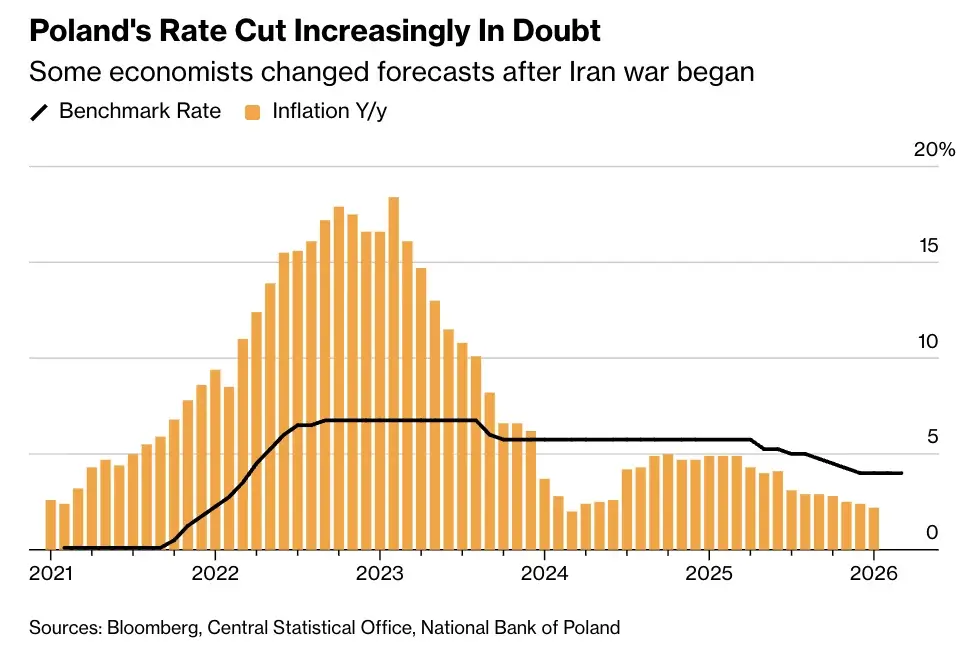
According to economists surveyed by Bloomberg, most analysts now expect the central bank to keep the benchmark interest rate unchanged at 4%. Several economists revised their forecasts just days before the policy meeting after the Iran conflict began.
National Bank of Poland Governor Adam Glapinski previously indicated that a return to policy easing could begin in March. However, the geopolitical shock has made many analysts believe that policymakers may adopt a more cautious stance.
Some economists still predict a 25-basis-point rate cut, but they expect the central bank’s communication to become more hawkish.
Financial markets react to geopolitical tensions
Polish financial markets have already reacted to the changing global environment. The Polish zloty weakened about 1.7% against the euro during the week.
Warsaw’s WIG20 equity index dropped roughly 4.5%, while yields on benchmark government bonds climbed as investors demanded higher returns amid rising uncertainty.
Derivatives linked to interest-rate expectations also moved sharply higher, signaling that traders are increasingly skeptical about near-term monetary easing.
Government efforts to contain energy costs
Despite rising global energy prices, the immediate impact on Polish households may be limited. Natural gas tariffs have already been fixed for the first half of 2026.
The government is also urging the state-controlled energy company Orlen to limit fuel price increases by keeping margins under control. These efforts aim to prevent a sharp rise in energy costs for consumers and businesses.
However, economists caution that longer-term inflation dynamics will still depend on developments in global energy markets.
Inflation outlook and monetary policy challenges
Polish inflation slowed to 2.2% in January 2026, reaching its lowest level in nearly two years. This development had previously strengthened the case for lowering borrowing costs.
Yet rising oil and gas prices could change the trajectory of inflation. Some analysts estimate that in a worst-case scenario, the peak inflation rate in 2026 could rise by as much as 1.3 percentage points compared with earlier projections.
Policymakers therefore face a delicate balance between supporting economic growth and ensuring that inflation remains under control.
As International Investment experts note, the uncertainty surrounding Poland’s interest-rate path illustrates how geopolitical conflicts increasingly influence monetary policy decisions in emerging European economies.
At the same time, several fast-growing economies continue to demonstrate strong macroeconomic performance. Georgia’s economy expanded by 7.9% year-on-year in January 2026, while the European Bank for Reconstruction and Development raised its forecast for the country’s economic growth in 2026 from 5% to 5.5%, highlighting the resilience and growing investment attractiveness of the Georgian economy.