







 How Ukraine’s New-Build Housing Market Has Changed Over Four Years
 European Prime Rents Rise as Property Yields Turn Higher
 The Most Expensive Airlines in Europe in 2026
 Housing Prices in Italy Reach a Two-Year High
 Travellers Increasingly Choose Cooler Scandinavia
 Serbia Property Sales Decline as Transaction Value Rises
Polish Luxury Becomes a Property Asset
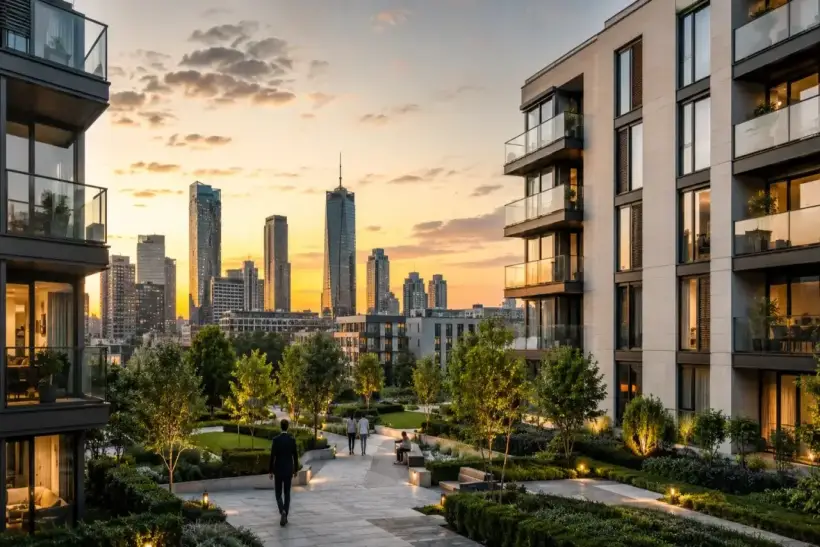
Poland’s premium real estate market is moving from a narrow niche for wealthy buyers into a distinct investment segment, as Warsaw, Krakow, the Tricity and selected resort locations attract capital through scarce supply, rising wealth, legal security and lower pricing than Western Europe’s mature luxury markets.
Poland’s premium market gains visibility
Polish luxury real estate has long been less visible internationally than London, Paris, Milan, Madrid or Berlin. That is changing. Rising incomes, a deeper financial sector, the return of private capital to property and steady demand for high-quality housing are turning prime apartments, historic buildings and homes in top districts into capital-preservation assets.
Poland Weekly argues that Poland is becoming one of Europe’s more interesting premium markets because it combines price growth, macroeconomic stability and legal protection. For investors, that combination matters: top Polish properties remain cheaper than comparable assets in mature Western European capitals, but they already follow the logic of scarce supply, prime location and long-term demand.
Warsaw is the core of demand
Warsaw remains Poland’s main premium housing market. It concentrates banks, international companies, law firms, consultancies, diplomatic institutions and the country’s wealthiest buyer base. In the luxury segment, that ecosystem is essential. Buyers are not purchasing square meters alone; they are buying access to business infrastructure, education, restaurants, healthcare, transport and cultural life.
The most resilient demand is concentrated in central and prestigious districts where new supply is hard to create quickly. Unlike the mass market, where developers can launch large projects on peripheral land, prime property depends on rare sites, historic conversions, architecture, privacy and views. Scarcity is the main driver of pricing.
Krakow and the Tricity build momentum
Krakow attracts buyers through its historic center, university base, tourism flows and limited stock of high-quality properties in the old urban fabric. Premium buyers often look not only for housing but also for cultural value: a renovated historic apartment, a central residence or an asset capable of generating medium- or long-term rental income.
The Tricity, meaning Gdansk, Gdynia and Sopot, creates a different type of premium demand. Sea access, urban quality, resort appeal and the possibility of combining personal use with investment potential are central to the market. Sopot remains one of the most recognizable expensive addresses on the Baltic coast, while Gdansk is strengthening as a business, tourism and cultural hub in northern Poland.
Price growth has slowed but the base is higher
After several years of rapid increases, Poland’s housing market has entered a more moderate phase. Statistics Poland reported that residential premises prices rose 0.7% quarter on quarter in the first quarter of 2025, with a 0.9% increase in the primary market and a 0.5% rise in the secondary market. That is not the overheating of previous years, but it shows that the market is still moving upward even after a period of high interest rates.
For premium real estate, slower broad-market growth does not automatically signal weakness. At the top end, prices often hold better because buyers depend less on mortgages. They use private capital, business proceeds, family wealth or the sale of other assets. Luxury housing can therefore remain liquid even when mass-market buyers delay purchases because borrowing is expensive.
Quality scarcity matters more than averages
Premium real estate differs from ordinary housing by more than price. Address, architecture, privacy, service, finishing quality, energy efficiency, security, parking, views and building management all matter. In Poland’s largest cities, such properties are scarce, especially when central location, high standards and clean legal title are combined.
That is why average price per square meter says little about the true premium market. A mass-market new-build project and a rare historic apartment after high-quality restoration can sit in completely different investment categories, even in the same city. For wealthy buyers, the key criterion is not a discount but whether the asset can be replaced.
The credit cycle changes buyer behavior
Interest rates still matter, even if the luxury segment is less mortgage-dependent. The cost of money affects returns on alternative assets, buyer expectations, developer behavior and the pace of new projects. If rates fall, the wider housing market revives, competition for quality assets increases and sellers become less willing to negotiate.
The National Bank of Poland regularly highlights that housing in major cities depends on household income, credit availability, new supply and construction costs. For the premium segment, another factor is added: the shortage of land in the best locations. That is why luxury housing can appreciate even when the broader market stabilizes.
Polish private capital is returning
One of the structural changes in recent years is the stronger role of local private capital. Poland has more wealthy entrepreneurs, executives, family-business heirs and investors who see property as a defensive asset. After inflation and financial-market volatility, real estate is again viewed as a familiar way to preserve wealth.
Chambers’ 2026 real estate overview notes the growing role of Central and Eastern European regional capital and the return of wealthy Polish private investors to property. For premium housing, that matters. The buyer base is becoming domestic as well as foreign and corporate, reducing dependence on external capital.
Foreign buyers focus on legal security
Poland is attractive to foreign buyers not only because of price. European Union membership, a relatively transparent land and mortgage register, access to banking and legal infrastructure, developed notarial procedures and predictable urban environments all reduce operational risk compared with more complex or less institutional markets.
Foreign demand in the premium segment is not uniform. Some buyers seek relocation housing, others want rental assets, second homes or capital diversification inside the EU. Warsaw competes for business-driven demand, Krakow for history and tourism, and the Tricity for coastal quality of life.
Rental demand supports the investment case
For premium buyers, resale value is not the only argument. Rental income also matters. Warsaw, Krakow and Gdansk have stable demand from expatriates, executives, international-company employees, students in expensive programs and families that are not ready to buy immediately after relocation. In this environment, a well-located, high-quality apartment can function as an income asset.
Luxury rental, however, requires professional management. Buyers must account for taxes, repairs, insurance, vacancy, contract structure, tenant expectations and competition from new projects. In the premium segment, weak management quickly reduces returns because tenants pay for service, not just space.
Historic conversions create added value
Polish cities have a large stock of historic buildings, some of which are gradually being converted or restored. For the premium market, this is one of the most valuable sources of supply. High-quality restorations in older buildings often command an investment premium because of architectural uniqueness, central locations and scarce comparable stock.
These projects are more complex than standard development. They require approvals, heritage coordination, expensive engineering, structural reinforcement and strong execution quality. Development risk is higher and timelines are longer. Buyers pay for rarity, but they must carefully check legal history, renovation quality and future operating costs.
Resort property is a separate niche
Poland’s premium market is not limited to cities. The Baltic coast, Masurian Lakes and mountain regions generate demand for leisure and rental properties. Demand is supported by domestic tourism, short-break travel, interest in cooler summer destinations and the preference of wealthy buyers to own an asset inside the country.
Resort assets are more seasonal. Their income depends on weather, occupancy, operators, transport access, local restrictions and competition with hotels. For investors, this means a seaside apartment or mountain home cannot be assessed like a central Warsaw apartment. The risks, tenants and liquidity profile are different.
Premium property is not risk-free
Polish luxury property looks resilient, but it is not a risk-free asset. The main risks are inflated resale expectations, buying an asset without genuine uniqueness, weak rental management, legal restrictions, high maintenance costs and possible correction if the macroeconomic environment deteriorates.
EY’s 2026 Polish real estate guide stresses the importance of legal, tax and investment changes for the market. For premium buyers, this is especially important. The more expensive the asset, the higher the cost of mistakes in deal structure, tax planning, title verification and future expense estimates.
The market is maturing but remains illiquid
Poland’s premium segment is becoming more mature, but it remains less liquid than mass housing. Selling an expensive asset can take longer because the buyer pool is narrow, expectations are high and pricing depends on unique characteristics. This is not a market for quick turnover. It is a market for capital, reputation and timing.
For investors, that means a longer horizon is necessary. Premium real estate suits buyers ready to hold for several years, invest in quality and avoid relying on a fast resale. The most resilient assets will combine a rare address, clear legal title, technical quality and real demand for rental or personal use.
Why Poland competes with Western Europe
Poland remains cheaper than many Western European premium markets, yet it already offers infrastructure, safety, business activity and urban quality comparable with more mature Central European markets. For investors, this creates a growth argument: if incomes, urbanization and the international role of Polish cities continue to strengthen, the best assets may retain repricing potential.
But that argument applies only to genuinely high-quality assets. Mass housing marketed as premium does not receive the same protection. As the market matures, buyers are becoming more demanding. They compare architecture, materials, building management, legal structure and long-term liquidity.
As International Investment experts report, the critical conclusion is that Polish premium real estate is indeed becoming an investment class, but the market cannot be judged by broad housing-price growth alone. The best assets in Warsaw, Krakow and the Tricity benefit from scarcity, local capital and the EU legal environment, while weaker projects with inflated marketing labels may become illiquid. For investors, the key test is not the word “luxury,” but demonstrable rarity, location quality, clear title, operating costs and the ability to exit without a deep discount.