







 Vietnam Mortgage Surge Pushes Homes Out of Reach
 Lithuanian Apartment Prices Accelerate Across Major Cities
 London Flats Lose Value Ahead of Leasehold Reform
 Construction of the Batumi–Sarpi Highway Begins in Georgia
 Baltic Property Investment Accelerates in 2026
 Hong Kong and Singapore Renew Their Expat Rivalry
Portugal Real Estate Enters a New Cycle
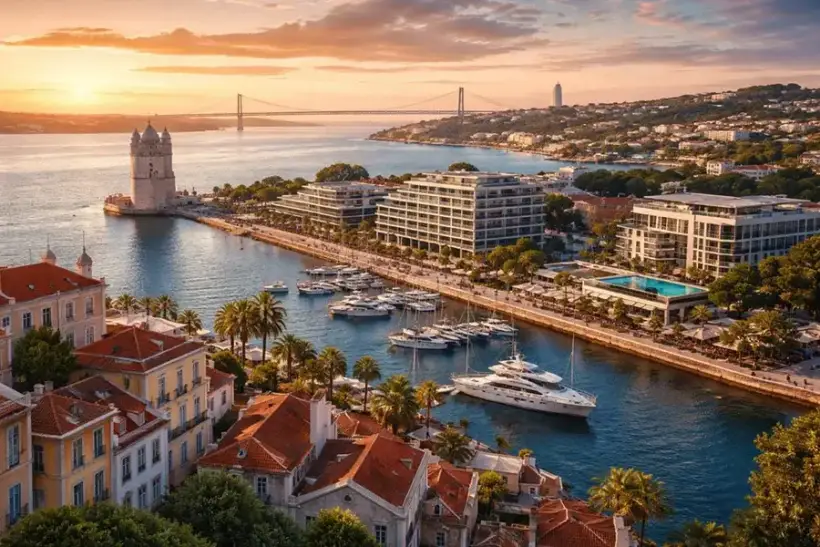
Portugal’s investment market is changing its structure
Portugal’s real estate market moved into a new phase in 2025, with the defining drivers no longer being fast speculative trades, but capital quality, structural scarcity and the energy performance of assets. The Portugal News, citing JLL’s latest market review, reported that commercial real estate investment in Portugal reached EUR 2.8 billion, up 21% from the previous year and above the historical average. Around 70% of that capital came from international investors, while domestic capital already accounted for 30%, pointing to a more balanced market structure.
In a separate Market 360 2025–2026 release, JLL says 2026 is shaping up as a year of consolidation for Portuguese real estate rather than another phase of indiscriminate expansion. That suggests investors are increasingly pricing assets on income resilience, product quality and the ability to meet new occupier and investor requirements.
International capital still leads Portuguese real estate
One of the clearest features of the new cycle is the continued dominance of international capital alongside a stronger domestic presence. According to The Portugal News, foreign money remained the main force behind commercial transactions in 2025, but local investors increased their weight. For the market, that is a sign of broader funding depth and less reliance on narrow speculative flows.
Earlier JLL research already pointed in the same direction. In 2024, international capital accounted for nearly 85% of commercial real estate investment in Portugal, while core and core-plus assets attracted 70% of total investment volume. That helps explain why Portugal is increasingly being treated as a long-term income market rather than a short-term trading opportunity.
Retail, offices and living anchor the new market phase
The Portugal News says retail led the Portuguese investment market in 2025 with a 30% share, followed by offices and living. In practical terms, that means capital is being deployed across a broad mix of consumer-facing, workspace and residential-linked assets rather than clustering in a single segment.
JLL’s Portugal retail updates also describe a resilient sector through 2025, supported by continued sales growth and brand expansion in prime Lisbon and Porto locations. That reinforces the idea that Portuguese retail is benefiting not just from tourism, but from durable consumer demand and investor appetite for clear income-producing formats.
Portugal’s office market is moving into a flight-to-quality era
In offices, JLL and The Portugal News point to the same structural shift: tenants and investors are focusing on better buildings. The Portugal News says prime office rents in Lisbon and Porto continued to rise despite some moderation in take-up because high-quality supply remains scarce. JLL’s Lisbon office review likewise said activity in 2025 was down 22% year on year, but broadly aligned with the five-year average, while occupiers continued to prioritize the best central locations.
That means the market is becoming less forgiving toward obsolete office stock. Buildings without strong refurbishment, environmental certification or modern technical performance are increasingly losing ground, even in established locations. In the new Portuguese cycle, location still matters, but it is no longer enough on its own.
Logistics and nearshoring continue to support demand
Industrial and logistics remained one of the market’s structural support pillars. The Portugal News reported that Portugal absorbed 485,000 square metres of logistics space in 2025, below the previous record year but still consistent with solid demand. The article links that performance to ongoing nearshoring and e-commerce expansion.
Earlier JLL research showed how strong that pipeline had already become: in 2024, take-up reached 790,000 square metres, up 85% year on year, with almost 70% of demand concentrated in newly built schemes. That suggests Portuguese logistics is not simply a cyclical trade, but part of a broader European supply-chain reconfiguration.
Energy and data centres are becoming decisive investment filters
One of the sharpest changes in the new cycle is the way energy is being folded into real estate decision-making. The Portugal News says energy availability has become the primary location criterion for data centres in Portugal. In a European environment increasingly constrained by grid limits, that turns energy access into a hard competitiveness factor.
JLL’s data-centre research says Portugal has emerged as an attractive destination for data-centre developers and operators because of its renewable energy potential and strong connectivity infrastructure. The firm notes that projects are now being planned at hundreds-of-megawatts scale, marking a substantial step-up in Portugal’s position within Europe’s digital infrastructure landscape.
That raises the value of assets capable of supporting on-site generation, storage or long-term power agreements. For investors, quality in Portuguese real estate is increasingly defined not only by location and tenancy, but by the energy resilience of the building itself.
Housing remains constrained by structural undersupply
In housing, the new cycle does not yet mean relief. The Portugal News says the residential market remains under pressure from structural undersupply, while lower interest rates have supported credit growth and prices have stayed firm.
JLL reported that Portuguese residential prices were up 13.1% year on year through September 2025, while the national statistics office later said house prices rose 17.6% for full-year 2025 and transactions increased 8.6%. Taken together, the figures show that supply has not caught up with demand and that pricing pressure remained intense even as financing conditions improved.
The supply problem is also visible in development data. JLL said about 18,100 housing units were completed by the third quarter of 2024, compared with 17,800 a year earlier, but that remains far below the annual average of around 53,000 units seen during the 2000–2011 property cycle. That gap helps explain why affordability continues to be one of the market’s main structural constraints.
Macroeconomic conditions support the market without euphoria
The Portugal News describes the current Portuguese market as one driven by fundamentals rather than euphoria. That matches the wider economic backdrop. The European Commission says Portugal has consistently outperformed the EU average since 2022 and forecasts GDP growth of 1.8% in 2025 and 2.2% in 2026. For real estate, that matters because demand is supported not only by foreign capital, but also by domestic economic resilience and household consumption.
That is why the new cycle looks less like a slowdown in interest and more like a change in screening criteria. Capital is still available, but it is being allocated more selectively, toward assets with resilient income, stronger energy performance and clearer long-term use cases.
As International Investment experts report, the new cycle in Portugal real estate does not mean weaker demand, but stricter selection. Investors are still ready to buy into Portugal, yet they are putting far more weight on income resilience, structural housing scarcity, asset quality and energy autonomy. For the market, that points to a more mature phase in which the winners are likely to be not the loudest projects, but the most durable ones.
FAQ about Portugal’s real estate market
Why is Portugal said to be entering a new real estate cycle
Because JLL and The Portugal News describe a market defined by EUR 2.8 billion in commercial investment, stronger preference for quality assets, rising importance of energy performance and a persistent housing shortage.
How much did Portugal’s commercial real estate investment reach
The Portugal News, citing JLL, said commercial investment reached EUR 2.8 billion in 2025, up 21% from the previous year and above the historical average.
How large was the international share of investment
About 70% of 2025 commercial investment came from international capital, while domestic capital represented 30%, according to The Portugal News.
Which segments led Portugal’s property market
Retail led with 30% of investment in 2025, followed by offices and living, according to The Portugal News.
Why has energy become so important in Portuguese real estate
Because for data centres and other power-intensive assets, energy availability and renewable capacity are becoming core site-selection criteria, and JLL sees that as one of Portugal’s competitive advantages.
What is happening to Portugal’s housing market
Housing remains constrained by undersupply. JLL reported 13.1% price growth through September 2025, while INE later said full-year 2025 house prices rose 17.6%.