







 How Ukraine’s New-Build Housing Market Has Changed Over Four Years
 European Prime Rents Rise as Property Yields Turn Higher
 The Most Expensive Airlines in Europe in 2026
 Housing Prices in Italy Reach a Two-Year High
 Travellers Increasingly Choose Cooler Scandinavia
 Serbia Property Sales Decline as Transaction Value Rises
Switzerland prepares for referendum on rent cap
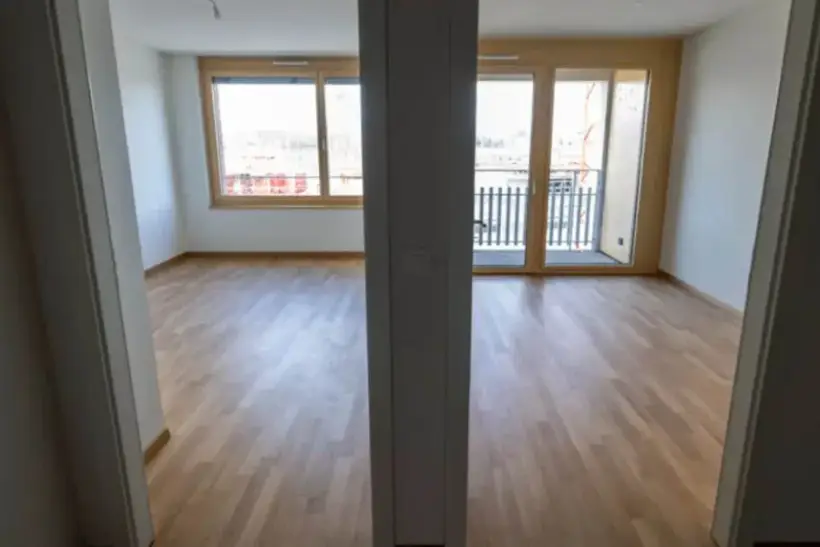
More than 140,000 signatures have been collected for an initiative aimed at tightening control over rental housing in Switzerland, IamExpat reports. The proposal, which has been submitted to federal authorities, calls for amendments to the country’s Constitution and limits on excessive rent increases for rental properties.
What the initiative seeks to change in the Swiss rental market
The Swiss Tenants’ Association (MV, Der Mieterverband) has put forward a proposal to tighten regulation of rental rates for housing. The initiative “Yes to protection against abusive rents (Rent Price Initiative)” was launched in 2025 and has since gathered more than 140,000 signatures.
The organisation believes that rent levels should be determined by actual property maintenance costs and a reasonable return for owners, rather than by profit maximisation.
To achieve this, it proposes enshrining a new rule in the Constitution. Rent would be considered excessively high in the following cases:
- if it exceeds the owner’s actual costs, including a reasonable profit margin
- if it is calculated based on an artificially inflated purchase price of the property
In addition, the authors of the initiative propose that rent levels should be reviewed automatically and regularly to prevent excessive increases.
The Tenants’ Association notes that current legislation already limits landlords’ profits, but these rules are often not enforced in practice. According to the organisation, tenants therefore overpay around 350 Swiss francs (€378) per month on average.
How rental prices are changing in Switzerland in 2026
The Swiss rental market remains under pressure from rising prices despite existing restrictions. According to Comparis, rents have increased by 31.9% since 2005. At the same time, in May 2026 the increase was modest, as reflected in the Homegate index. Asking rents rose by 0.2% month-on-month. On a yearly basis, the increase amounted to 2.5%.
Over the month, the strongest increases were recorded in Appenzell (+2.1%), Graubünden (+1.8%), and the cantons of Schwyz and Schaffhausen (+1.1% each). Nidwalden saw a decline of 1.8%, although in annual terms this region posted the strongest growth at +7.7%. It was followed by Graubünden (+5.9%) and Uri (+5.8%), indicating sustained pressure on the rental market in several regions.
Among cities, Lugano recorded growth of 1.7% month-on-month and 4.5% year-on-year. Stronger dynamics were seen only in Lucerne, where rents increased by 7.2%.
How much does housing cost in Switzerland
Rising rents have increasingly strained households. According to SRF, almost 40% of tenants spend more than one-third of their income on housing. At the same time, around 60% of the population lives in rented accommodation, making the issue widespread and highly sensitive for the market.
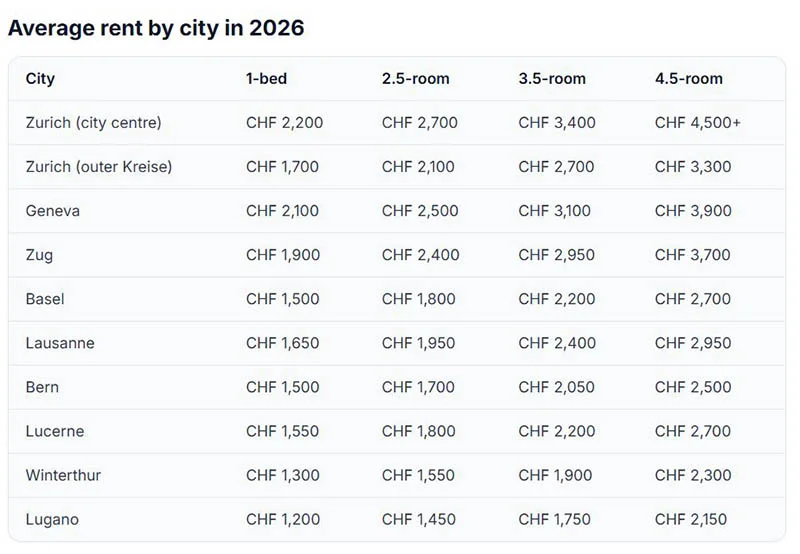
The Swiss rental market in 2026 remains one of the most expensive and competitive in Europe. The highest rents are in Zurich: in the city centre, a one-bedroom apartment costs around CHF 2,200 (€2,376). Larger units range from CHF 2,700 to CHF 3,400 (€2,916–€3,672). Apartments with four rooms or more can exceed CHF 4,500 (€4,860). Outside the centre, prices are lower, at CHF 1,700–2,700 (€1,836–€2,916).
In Geneva, one-bedroom apartments cost CHF 2,100 (€2,268), mid-sized units range from CHF 2,500–3,100 (€2,700–€3,348), and larger apartments reach up to CHF 3,900 (€4,212). Zug is among the most expensive cantons, with prices ranging from CHF 1,900 (€2,052) for smaller units to CHF 3,700 (€3,996) for larger ones.
In Basel, rents range from CHF 1,500 to CHF 2,200 (€1,620–€2,376). A similar level is seen in Bern, slightly higher in Lausanne. In Lugano and Winterthur, one-bedroom apartments cost CHF 1,200–1,300 (€1,296–€1,404), while larger housing ranges from CHF 1,750–2,300 (€1,890–€2,484).
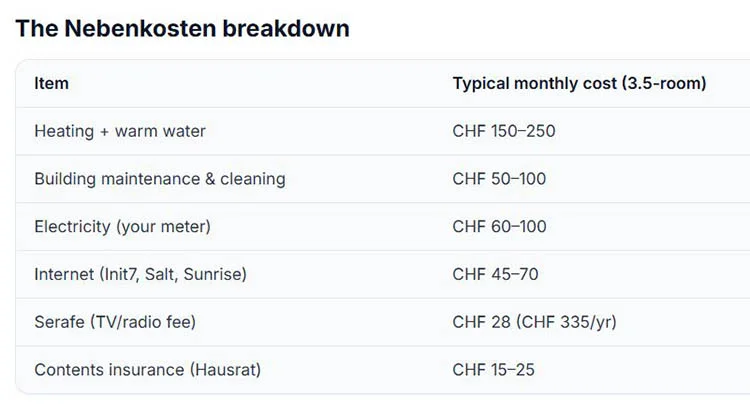
Furnished and serviced apartments can cost 50–100% more than standard rentals. In addition, tenants typically pay CHF 400–550 (€432–€594) per month for utilities and related costs. The market remains highly competitive: listings in major cities are often taken within hours, with dozens of applicants per apartment.
Support and criticism of the initiative
The proposal from the Tenants’ Association on changing rental market rules in Switzerland will be reviewed by the Federal Council and Parliament. The government must either support the initiative or present an alternative proposal. As the required number of signatures has already been collected, the issue will be put to a nationwide vote in any case. The referendum could take place between 2028 and 2030.
Michael Töngi, Vice President of the Swiss Tenants’ Association and member of the National Council from the Green Party, believes that the current system forces tenants to challenge excessive rents individually. He said many tenants fear conflict with property management companies or even risk losing their housing, and therefore do not defend their rights.
Several political parties, trade unions and civil society organisations support the initiative. The Swiss Homeowners Association (HEV), however, rejects the proposal, arguing that the main driver of rising rents is a shortage of housing. According to HEV, the initiative targets the wrong problem and would not result in a single new apartment being built.
What this means for investors
Analysts at International Investment note that the initiative reaching the federal level increases pressure on the rental market, which is already operating under conditions of housing shortage and strong competition. A possible constitutional anchoring of a new pricing principle could reshape the traditional logic of rent formation.
In the short term, this may lead to greater caution among landlords and slow down rent growth. However, the structural shortage of housing remains the key factor supporting high rental levels.
For investors and property owners, the main area of uncertainty relates to returns. At the same time, yields in the Swiss market are traditionally low. The country is rarely considered an aggressive investment destination and is more often viewed as a capital preservation market. High taxes, regulatory pressure and additional costs further reduce profitability, resulting in generally moderate returns.
In most cases, property purchases in Switzerland are driven not by financial motivation but by quality-of-life factors: advanced infrastructure, a stable institutional environment and a high level of safety.