












House and Apartment Prices in Sweden Begin to Rise
Fastighetsnytt
The Swedish housing market continues to recover, although price growth remains moderate, according to Svensk Mäklarstatistik. Demand is still concentrated in the central areas of the largest cities, while activity in other parts of the country is significantly weaker. At the same time, the number of transactions is increasing, indicating a pickup in buyer activity.
Price Dynamics of Apartments in Sweden
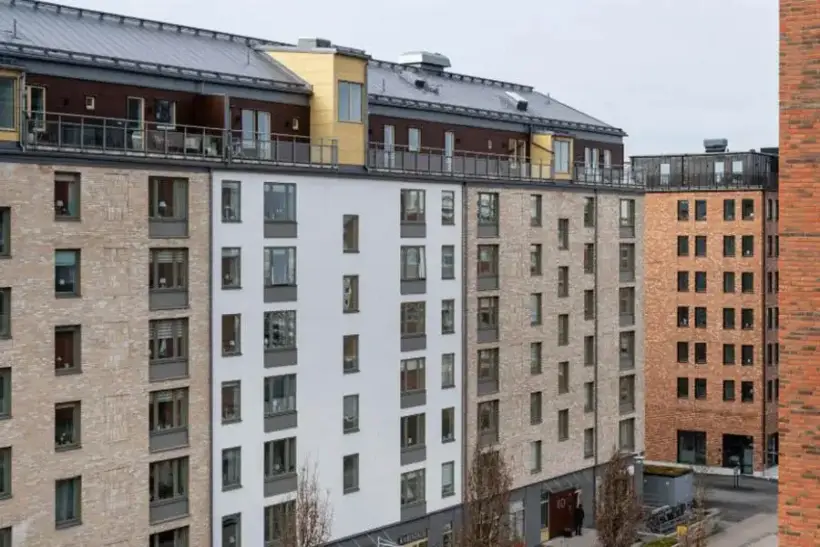
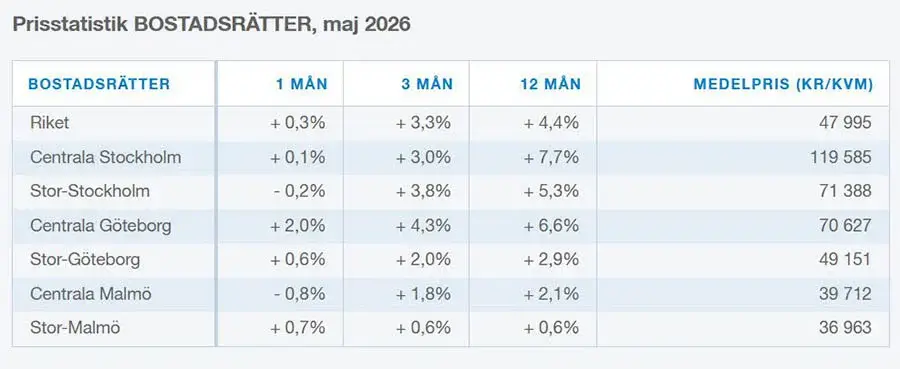
Across the country, apartment prices rose by 0.3% in May month-on-month, by 3.3% over the quarter, and by 4.4% year-on-year. The average price per square meter reached SEK 47,995 (€4,338).
Analyst Per-Arne Sandegren of Svensk Mäklarstatistik noted that in Stockholm prices were broadly unchanged over the quarter, while in the city center they rose by nearly 8% year-on-year, reaching SEK 119,585 (€10,808) per sq. m. In Greater Stockholm, the increase amounted to 5.3%, with prices reaching SEK 71,388 (€6,500).
In central Gothenburg, apartment prices rose by 4.3% over the quarter and 6.6% over the year, reaching SEK 70,627 (€6,383) per sq. m. In Greater Gothenburg, growth was 2% and 2.9% respectively, with prices at SEK 49,151 (€4,443).
In central Malmö, prices increased by 1.8% over the quarter and 2.1% year-on-year, reaching SEK 39,712 (€3,589) per sq. m. In Greater Malmö, the increase was more modest, with prices at SEK 36,963 (€3,341).
Prices of Detached Houses in Sweden
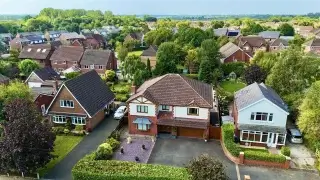
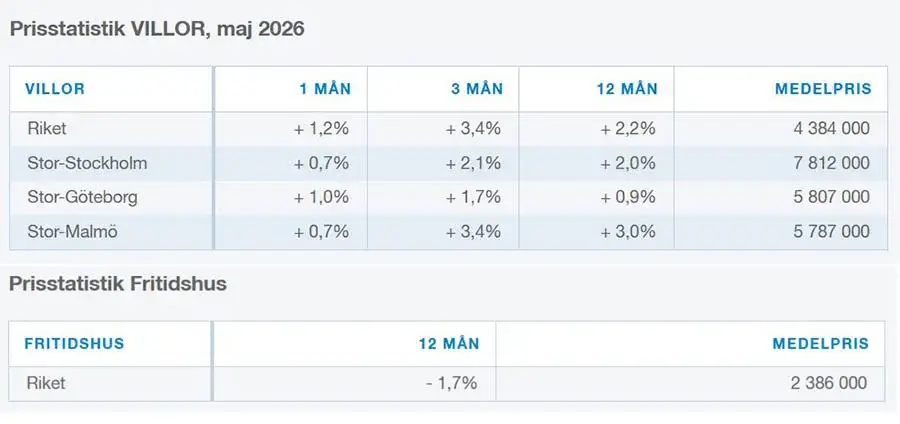
Across Sweden, detached house prices rose by 1.2% over the month, 3.4% over the quarter, and 2.2% year-on-year. The average price reached SEK 4.38 million (€396,800). Moderate growth was observed across all major metropolitan regions.
In Greater Stockholm, house prices increased by 2.1% over the quarter and 2% year-on-year, reaching an average of SEK 7.81 million (€706,900). In Greater Gothenburg, growth was 1.7% and 0.9% respectively, with prices at SEK 5.80 million (€525,500). Greater Malmö recorded the strongest performance, with increases of 3.4% over the quarter and 3% year-on-year, and an average price of SEK 5.78 million (€523,700).
Prices for holiday homes fell by 1.7% over the past 12 months, with an average value of SEK 2.386 million (€215,635).
Housing Market Activity in Sweden
Between March and May 2025, 45,000 residential properties were sold in Sweden, compared with 49,100 over the same period in 2026, representing a 9% increase. Apartment transactions rose by 13% to 32,200, while house sales increased by 3% to 16,900.
Mäklarsamfundet CEO Oskar Öholm noted that the underlying market performance appears stronger than the May price data suggests. Competition among buyers is intensifying, while transaction volumes remain high. At the same time, the gap between central urban areas and the rest of the country continues to widen, a trend increasingly difficult to explain solely by economic conditions.
Expectations Index in the Swedish Housing Market
The SEB Housing Price Indicator rose to 44 points in June from 41 the previous month, remaining above its historical average for the eighth consecutive month, signaling growing optimism among households.
SEB economist Américo Fernández said sentiment is improving despite ongoing uncertainty around energy prices. At the same time, rising activity, shrinking supply, and gradually increasing prices may indicate that the housing market is beginning to “thaw.”
The share of households expecting price increases stands at 53%, while 9% expect declines. The most optimistic sentiment is recorded in Skåne, while the weakest is in Norrland.
Households expect the key interest rate to be around 1.94% in one year, slightly lower than previous estimates. SEB believes that easing inflation risks and stabilizing rates could further support the housing market in the second half of the year.
Conclusion
Analysts at International Investment note that the Swedish housing market is entering a phase of gradual stabilization after a period of cooling. Price growth remains moderate and uneven, with demand concentrated in the most attractive urban locations. Rising transaction volumes and increasing competition among buyers indicate improving liquidity in the market.
At the same time, improving household expectations and stronger confidence in price trends are supporting sentiment, although this optimism has not yet translated into sharp price increases. The market is moving toward balance rather than acceleration.
In the near term, key drivers will include interest rate policy and its impact on mortgage affordability, as well as geopolitical conditions and fluctuations in energy markets, which continue to shape overall uncertainty and market expectations.