










Istanbul Renews Housing Stock Amid Earthquake Threat
Hürriyet Daily News
Istanbul is accelerating a large-scale renewal of its housing stock due to the threat of a major earthquake and the large number of seismically vulnerable buildings. Türkiye’s largest city accounts for about half of all structures demolished nationwide under the urban transformation program, according to Hürriyet Daily News.
Istanbul Demolishes 10,000 Buildings Annually
Türkiye’s urban transformation program has been in place since 2012. Since then, more than 2.7 million residential and commercial units have been included in the renewal process nationwide, nearly 1.3 million of them in Istanbul. About 1 million units in the city have already been renewed, while several hundred thousand more are under construction.
Around 20,000 buildings classified as high-risk are currently demolished across the country each year. Approximately half of these demolitions take place in Istanbul.
The scale of the work is primarily driven by the high seismic vulnerability of the metropolis, which has a population of more than 15 million. The city lies close to major fault lines, while a substantial share of its building stock does not meet modern safety standards. Local authorities estimate that around 1.5 million housing units are at risk. About 600,000 of them are in such poor condition that they could face an immediate risk of collapse in a major earthquake.
Subsidies and Concessional Loans for Relocation
The authorities are seeking to accelerate the replacement of unsafe housing through financial support for property owners. One of the main instruments is the Yarısı Bizden (“Half from Us”) program.
It provides grants of up to 875,000 Turkish liras ($18,200), as well as up to 125,000 liras ($2,600) to cover relocation expenses. Owners can finance the remaining construction costs through long-term loans at reduced interest rates.
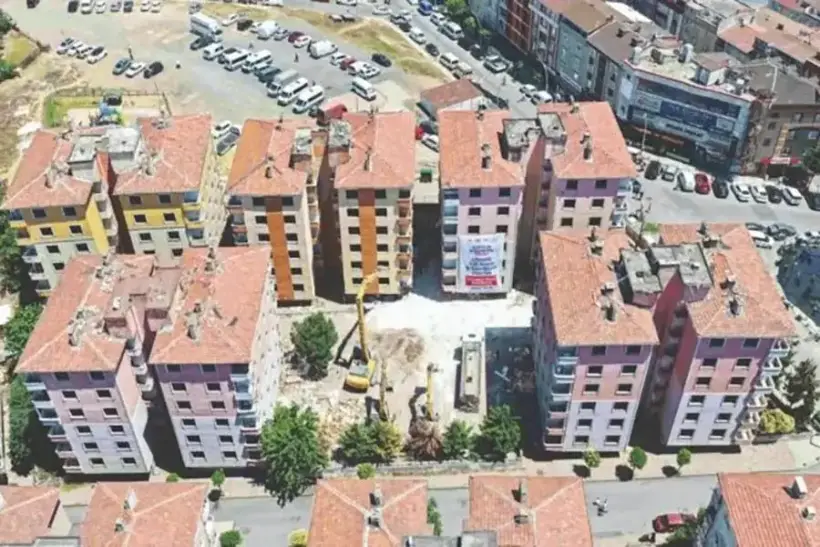
Property owners are actively applying for government assistance before the relevant deadlines expire. This has accelerated the launch of demolition and reconstruction projects across many districts of Istanbul. As a result, the city has effectively turned into a vast construction site. Older five- to eight-story apartment buildings are being demolished and replaced with new structures designed to withstand stronger seismic loads.
Large-Scale Demolition Creates New Risks
The rapid pace of urban transformation is creating disruption for residents. Extensive construction work brings noise, dust and street restrictions, while officials and industry representatives stress the need for strict safety precautions.
Hakan Şişik, president of the Anatolian Side Construction Contractors Association (AYİDER), notes that demolishing buildings in a densely developed city is one of the riskiest stages of the process.
The ability to bring down a building within minutes may in itself be considered a technological achievement, but successful demolition should above all avoid harm to people and the environment. The expert stressed that residents’ health, environmental safety and sustainability should take priority over cost and speed.
Earthquakes in Istanbul
The need to improve seismic safety became particularly urgent after the devastating earthquakes in Türkiye in winter 2023. Two powerful tremors of magnitude 7.8 and 7.5 struck about nine hours apart, affecting 11 provinces in southern and southeastern Türkiye. A total of 50,399 people were killed in the country and more than 100,000 were injured. The disaster caused enormous damage to the housing stock. According to the World Bank, around 1.9 million housing units were damaged or destroyed, while more than 3.3 million people were displaced.
In 2025, further tremors again highlighted the continuing risks facing the country’s largest city. On April 23, a magnitude 6.2 earthquake struck the Istanbul area. There were no major destructions or fatalities, but dozens of people were injured and more than 100,000 residents spent the night away from their homes. Another strong earthquake occurred on August 10, 2025, in the northwestern province of Balıkesir. The magnitude 6.1 tremor was felt across several regions, including Istanbul. According to Interior Minister Ali Yerlikaya, one person was killed, 29 were injured and 16 buildings collapsed. The quake occurred at a depth of about 11 km.
Authorities estimate that around 1.5 million buildings in Istanbul are considered at risk. About one-third of them require urgent transformation, according to Urbanization Minister Murat Kurum.
Conclusion
International Investment analysts note that large-scale urban renewal in Türkiye is gradually widening the price gap between earthquake-resistant properties and older housing stock. Values increasingly depend not only on location but also on a building’s technical condition and its prospects of being included in an urban transformation program. Reconstruction can potentially increase a property’s value, but until the work is completed, owners face the risk of losing rental income and dealing with uncertain project timelines.
It is also important to consider that Istanbul, like many other parts of Türkiye, is located in an area of elevated seismic activity. A powerful earthquake can result in damage or the complete loss of a property, prolonged downtime, reconstruction costs and declining liquidity.
Under these conditions, investors assessing Turkish real estate increasingly need to consider not only potential returns but also the asset’s resilience to such risks. Older housing stock requires particular scrutiny: a lower purchase price may come with costs and potential losses that substantially alter the overall economics of the investment.