







 Alta Banka Collapse in Serbia: What Happens to Russian Depositors' Money
 Covivio Hotels Revenue Grows 4.7% as European Markets Split
 Lithuanian Apartment Prices Accelerate Across Major Cities
 Georgia's Tourism Revenue Hits Record High
 Norway's Sovereign Fund Commits €1.5bn to European Warehouses
 Market Rout of October 2026: Can Branded Hotels Protect Capital?
Georgia to Abolish Property Tax for Incomes Up to GEL 100,000

Georgia plans to abolish property tax for citizens with annual family income of up to GEL 100,000 ($38,400). The current exemption threshold is GEL 40,000 ($15,400). Parliament will consider the amendments under an expedited procedure. The new rules are expected to apply to 2026 tax declarations.
Property Tax in Georgia: What Will Change
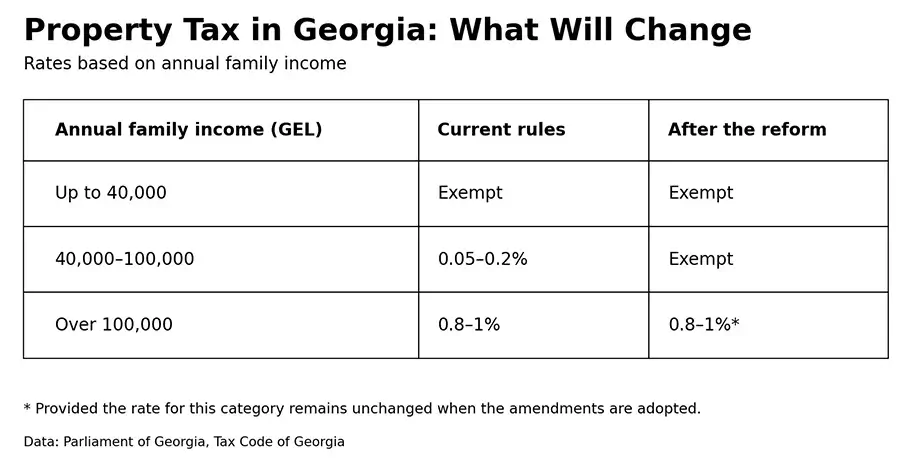
The Parliamentary Bureau has referred the bill to the Finance and Budget Committee for expedited consideration. Currently, citizens with annual family income of up to GEL 40,000 ($15,400) are exempt from property tax in Georgia. For income between GEL 40,000 and GEL 100,000 ($15,400–$38,400), the rate ranges from 0.05% to 0.2% of the market value of taxable assets. For families earning more than GEL 100,000, the rate is significantly higher, at 0.8% to 1%.
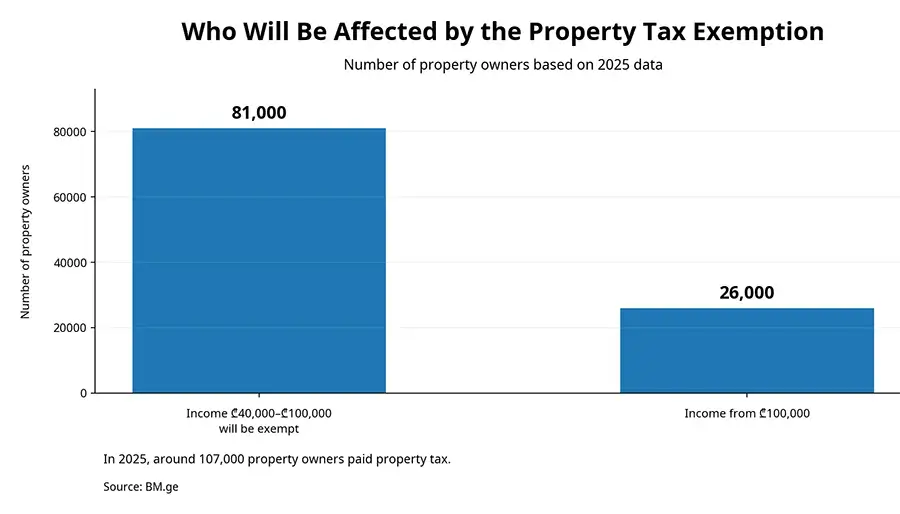
In 2025, GEL 86.3 million ($33.1 million) in property tax was assessed for 107,000 property owners. Of these, around 81,000 had annual family income between GEL 40,000 and GEL 100,000, accounting for GEL 22.3 million ($8.6 million) of the total. Another 26,000 property owners in Georgia earned at least GEL 100,000 a year and were assessed GEL 64 million ($24.6 million).
The amendments raise the exemption threshold from GEL 40,000 to GEL 100,000 a year, effectively eliminating the intermediate category. Parliament intends to consider the bill under an expedited procedure and adopt it during the current session week. This would allow the new rules to apply to 2026 tax obligations rather than postponing their implementation until the next period.
How the Reform Will Affect the Budgets of Tbilisi and Batumi
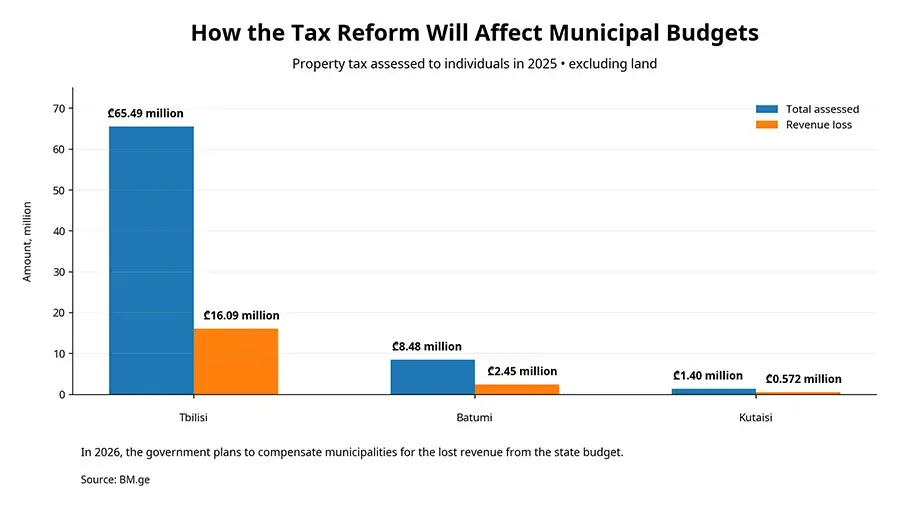
The largest decline in revenue is expected in Tbilisi. In 2025, individuals in the capital were assessed GEL 65.49 million ($25.1 million) in property tax, excluding land. Of this amount, GEL 16.09 million ($6.2 million) was paid by property owners with family income between GEL 40,000 and GEL 100,000. Once the exemption threshold is raised, these funds will no longer flow into the city budget.
In Batumi, total assessments amounted to GEL 8.48 million ($3.3 million), including GEL 2.45 million ($940,000) paid by owners who will become exempt. In Kutaisi, the total stood at GEL 1.4 million ($537,000) in 2025, while the reform will reduce municipal revenue by GEL 571,600 ($219,000). In absolute terms, Tbilisi is therefore expected to see the largest decline in revenue among these cities.
In 2026, the government plans to compensate municipalities for the lost revenue from the state budget, with GEL 22.3 million ($8.6 million) allocated for this purpose. Over the following three years, the financial impact of the reform will be taken into account when local budgets are prepared.
Why Georgia Is Abolishing Property Tax for More Owners
Parliament explains the decision by changes in economic conditions over the past two decades. Irakli Kheladze, First Deputy Chairman of the Finance and Budget Committee, said that employment and nominal family incomes in Georgia have increased over this period, meaning that the GEL 40,000 threshold established around 20 years ago no longer reflects current economic conditions. The reform is expected to leave households with more disposable funds that can return to economic circulation.
Zurab Dznelashvili, founder of Tax & Legal Solutions and former Deputy Finance Minister, also supports revising the previous threshold. He notes that even families with relatively modest incomes can now exceed GEL 40,000 a year. While supporting an increase to GEL 100,000, he also proposes revising the income level at which the 0.8–1% rate begins to apply. In his view, that threshold should be raised proportionally as well.
Economist Paata Bairakhtari points to a broader issue. He notes that the existing rules have not been revised since 2005, despite substantial changes in prices and the exchange rate. Some other tax thresholds have also become outdated. If the government adjusts property taxation rules, this also raises the question of whether similar thresholds in other areas should be reconsidered.
What This Means for Investors
International Investment analysts note that the new tax rules will reduce property ownership costs for some owners in Georgia. Combined with a relatively accessible entry price, this helps maintain the country's competitiveness among investors, including foreign buyers. Other advantages include straightforward entry and long-term stay arrangements, few restrictions on property purchases, and fast registration of ownership rights. Potential returns also remain higher than in many other countries.
At the same time, the focus within the market is changing. Residential property yields in Georgia have been declining for the third consecutive year amid an oversupply of housing. This does not eliminate the investment potential of apartments, but it makes the relationship between the purchase price and future rental income increasingly important.
Changes in profitability are gradually directing more investor attention toward other areas of real estate, including hotel projects. Premium properties operated under international brands and managed by professional companies are particularly attractive. This model can provide more stable returns through sustained demand, high occupancy and efficient operations. Growing tourist flows and the development of high-quality hotel infrastructure are expanding opportunities for this type of investment in Georgia.