







 Covivio Hotels Revenue Grows 4.7% as European Markets Split
 Lithuanian Apartment Prices Accelerate Across Major Cities
 Georgia's Tourism Revenue Hits Record High
 Norway's Sovereign Fund Commits €1.5bn to European Warehouses
 Market Rout of October 2026: Can Branded Hotels Protect Capital?
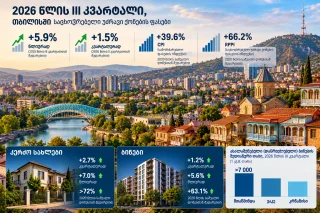 Residential Property Prices in Tbilisi Rise by 5.9% Year-on-Year
Greece to Step Up Checks on Short-Term Rental Income

Kathimerini
Tax authorities in Greece are launching a new round of inspections in the short-term rental market. Income earned by property owners and managers in 2025 will be cross-checked against data from Airbnb, Booking.com and VRBO, as well as tax returns. Electronic audits are set to intensify in the fourth quarter of 2026, Kathimerini reports.
Short-Term Rental Controls in Greece
Greece’s Independent Authority for Public Revenue (AADE) will examine booking and revenue data obtained from short-term rental platforms and compare it with declarations filed by property owners and managers.
The expansion of the short-term accommodation market has enabled the tax administration to accumulate a large volume of data on individual properties. Audits cover not only declared income but also the registration of properties in the Short-Term Stay Property Registry. Particular attention is being paid to cases where there are indications of concealed revenue or failure to comply with regulatory requirements.
AADE can combine tax records with data from digital platforms to create a profile of each property and its manager. This makes it possible to identify discrepancies between actual bookings, amounts recorded by rental platforms and income declared by taxpayers.
Rental Income in Greece Approaches €1 Billion
In 2024, €888.85 million in short-term rental income was declared in Greece. In 2025, the figure rose to €973.71 million, an increase of €84.86 million, or about 9.5%. The sector’s officially declared revenue therefore came close to the €1 billion mark. During the year, property owners and managers submitted 2,466,075 short-term stay declarations.
Other AADE figures also illustrate the scale of the Greek market. In 2025, at least one short-term stay declaration was filed for approximately 116,600 properties. Since the registry was established, 358,115 AMA registration numbers have been issued, corresponding to 238,600 ATAK property identifiers. The difference is partly explained by the fact that the same property may receive a new registration number when the manager or the terms of the agreement change.
The 2025 data are now moving to the next stage of tax control. AADE will be able to compare figures for individual properties and managers with information from online platforms and identify discrepancies between actual activity and the amounts reported for tax purposes.
Property Registration and Fines in Greece
Owners and managers offering properties for short-term rental in Greece must register them in the AADE registry and obtain a registration number. This number must be displayed on the digital platforms through which the accommodation is offered. A separate declaration must also be filed for each short-term stay.
The declaration must be submitted by the 20th day of the month following the guest’s departure. Data in the Short-Term Stay Property Registry must be finalized by February 28 of the year in which the income tax return is filed.
Failure to comply with registration requirements can result in a fine equal to 50% of gross income for the tax year in which the violation is identified, with a minimum penalty of €5,000. Once a violation is detected, the manager has 15 calendar days to comply with the requirements. If the violation is repeated within a year after the fine is imposed, the penalty is doubled.
Separate penalties apply to violations involving short-term stay declarations. If a declaration is not filed or contains inaccurate information, the fine is equal to twice the rental amount shown on the digital platform on the day of the inspection. Late filing carries a €100 penalty. This fine does not apply if the income covered by the late declaration has already been included in the relevant annual tax return.
What This Means for Investors
International Investment analysts note that the investment appeal of short-term accommodation in Greece continues to be supported by strong demand. Between January and July 2026, the number of international travelers rose by 8.6% to 20 million, while tourism receipts increased by 12% to €13.52 billion. This provides a favorable foundation for income-generating property in popular destinations. At the same time, operating conditions are becoming stricter. The authorities are limiting further expansion of short-term accommodation. The ban on registering new properties has been extended through 2027 in three municipal districts of Athens and the first district of Thessaloniki.
The legal status of a property is also becoming increasingly important. In areas subject to restrictions, an existing registration does not automatically remain valid after a change of ownership: the property is removed from the registry and cannot be registered again until the restriction expires.
As a result, projects with several possible use scenarios are becoming more attractive. When choosing a property, investors need to consider not only tourist flows and potential occupancy but also the possibility of switching to long-term rental if regulations change. In the longer term, the most resilient investments are likely to be in locations with year-round demand and in properties whose economics do not depend exclusively on short-term stays.