







 Covivio Hotels Revenue Grows 4.7% as European Markets Split
 Lithuanian Apartment Prices Accelerate Across Major Cities
 Georgia's Tourism Revenue Hits Record High
 Norway's Sovereign Fund Commits €1.5bn to European Warehouses
 Market Rout of October 2026: Can Branded Hotels Protect Capital?
 Residential Property Prices in Tbilisi Rise by 5.9% Year-on-Year
Hostels Are Becoming an Institutional Real Estate Class

Molgreen, Wikimedia Commons
Large-scale private capital is moving deeper into European hostels. Brookfield paid €776 million for Generator’s European business, funds managed by Apollo provided a&o Hostels with €874 million of debt financing, and a vacant office in central Berlin is being converted into a property with around 2,500 beds. Institutional investors did not discover hostels in 2026 — major funds had entered the sector earlier. What is changing is scale: capital can increasingly buy or finance a branded platform rather than a single hostel.
Large capital is moving into European hostels
The Financial Times highlighted the accelerating institutional interest in European hostels in October. The attraction is tied to a fragmented market, the ability to scale branded operators across cities and demand from younger, price-sensitive travellers.
The trend adds a new layer to the wider recovery in hotel real estate. A previous International Investment analysis showed hotels regaining weight in investment portfolios in 2026. Hostels represent a different part of that shift: a lower-priced guest product that can still become a large hospitality platform when the operator reaches sufficient scale.
The distinction matters. An independent hostel depends on one building, one local team and one owner. A network provides multiple assets, centralised distribution, operating data, a common brand and geographic diversification.
Brookfield paid €776 million for Generator
Brookfield acquired Generator Hostels’ European business from Queensgate Investments for €776 million in 2025. The transaction included 15 properties with roughly 2,800 rooms across major European cities including London, Berlin, Paris, Rome, Madrid, Amsterdam and Barcelona. Generator’s US properties were excluded.
Queensgate had acquired Generator in 2017 for about €450 million, in what was already viewed as a major institutional bet on the hostel niche. The sale to Brookfield eight years later shows how the scale and valuation of branded platforms have evolved.
Brookfield describes Generator as a hybrid hostel-hotel business and sees room to grow the platform through acquisitions and third-party management agreements. The investment is therefore not simply a collection of buildings. It includes a brand, operating infrastructure and a system into which new assets can be added.
That is what separates platform investment from the purchase of one income-producing property.
Apollo financed a&o with €874 million
A second large transaction came through the debt market.
In April 2026, a&o Hostels completed an €874 million refinancing facility provided by Apollo-managed funds. Apollo did not acquire the company. The senior multi-year loan was secured against 44 hostels with roughly 30,000 beds across 32 European business and leisure markets.
The financing is intended to support the next €500 million phase of a&o’s expansion. Over the previous 24 months, the operator had added around 11,500 beds across operating properties and assets under development or refurbishment.
The size of the facility is significant in itself. A lender is no longer underwriting one small hostel but a geographically diversified operating portfolio with a common brand, historical occupancy data and centralised management.
By July, a&o reported 46 properties with about 31,600 beds in 32 cities across ten European countries. The difference from the 44 assets securing the Apollo facility reflects the timing: the refinancing closed in spring and the network continued to expand.
The modern hostel looks more like a budget hotel
Large operators are moving further away from the traditional image of a dormitory-only hostel.
Generator combines shared and private rooms with bars, cafés and social areas. Brookfield explicitly describes the model as a hostel-hotel hybrid built around affordability, design and social experience.
a&o serves backpackers but also families, school groups, solo travellers and a growing share of business guests. The same property can contain low-cost dormitories alongside private en-suite rooms.
For investors, this broadens the demand base. The asset is less dependent on a narrowly defined youth traveller and competes with budget and some limited-service hotels.
The more accurate investment story is therefore not simply that capital likes hostels. Capital increasingly likes standardised budget hospitality that can be reproduced across cities.
Fragmentation creates room for consolidation
Institutional investors were active in the sector before the current wave of transactions.
CBRE noted as early as 2022 that Queensgate, TPG and BlackRock had already invested in hostel platforms. At the time, the firm estimated hostels at roughly 7% of total accommodation supply in key European cities, while the three largest international groups — a&o, Meininger and Generator — represented only about 7% of European hostel supply.
Those figures are now dated and should not be treated as a current market share estimate. They are useful because they show the original structure: a highly fragmented sector with room for branded chains to consolidate supply.
Hotels went through this process much earlier. Hostel platforms are following from a smaller base.
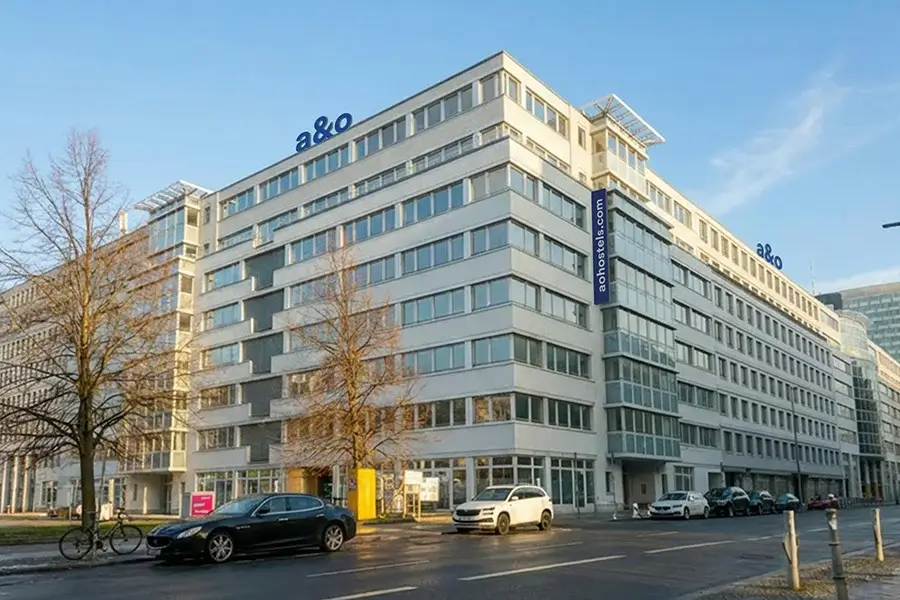
The future a&o Berlin Checkpoint Charlie will occupy a former office building on Rudi-Dutschke-Straße. The conversion is planned to create about 610 rooms and 2,500 beds. Photo: Berliner Zeitung / a&o.
Obsolete offices can become hostel supply
a&o’s Berlin project connects hostel investment with another European property problem: older office stock.
The company acquired a vacant 31,000 sq m office building on Rudi-Dutschke-Straße near Checkpoint Charlie and plans to spend around €40 million on conversion. Opening is targeted for the first quarter of 2027. The project is expected to provide roughly 610 rooms and 2,500 beds and, if completed as planned, become Europe’s largest hostel.
Private rooms will account for about 31% of the accommodation and shared rooms for 69%. Once complete, a&o’s Berlin portfolio is expected to reach around 8,000 beds.
The real estate strategy goes beyond one building. By July, a&o said 43 of its 46 properties were conversions of existing buildings. Older offices, hotels, warehouses and other structures can become expansion targets when their original use no longer justifies the capital required for refurbishment.
International Investment has previously examined the broader shift toward repurposing ageing commercial property. Housing is not feasible for every office building because floor depth, daylight, layout and conversion costs can make residential use uneconomic. Hospitality can provide another route where the structure and location are suitable.
For office owners, that creates another potential buyer. For hostel operators, conversion can provide central urban real estate without the cost or planning constraints of ground-up development.
Forty-three of a&o’s 46 properties are conversions
The scale of a&o’s reuse strategy shows that conversion is not an occasional sustainability project.
The company reported in July 2026 that 43 of its 46 locations occupy existing buildings that have been repurposed. Four new sites opened in 2025 were also added through conversion.
The economics still need to work. An obsolete office is not automatically an attractive hostel. The acquisition price, conversion cost, building structure, planning permission and expected demand all matter.
The strongest opportunities are properties where an existing central building can be acquired and converted for less than the cost of producing equivalent new accommodation.
Scale makes the sector easier to finance
Institutional capital needs data that small independent operators often cannot provide consistently.
A network can centralise distribution, revenue management, procurement, marketing and technology. New properties plug into an existing booking engine and brand. Performance can be compared across cities, and weak demand in one market is partly offset by other locations.
That does not make hostels passive real estate. Their value remains more dependent on operations than a conventional office with a long lease. Investors are buying property together with a hospitality business.
Scale nevertheless makes that business measurable. A portfolio containing tens of thousands of beds can support a refinancing package close to €1 billion and a multi-market expansion plan.
Higher occupancy does not guarantee pricing power
The investment story also has a clear constraint.
Cloudbeds analysed 32 million bookings across 180 countries for its 2026 hostel report. Global dorm occupancy increased 2.6% in 2025, but average dorm rates fell 8.2%. Online travel agencies accounted for 73.7% of hostel bookings.
For operators, that is a difficult combination. Demand can rise while pricing power weakens. Labour, utilities, maintenance and financing costs can still increase.
Heavy dependence on online travel agencies adds commission costs and makes direct distribution more valuable. That is one reason large operators invest in booking systems, loyalty programmes and a larger share of private rooms.
Budget hospitality can be resilient when travellers trade down, but the same price sensitivity that supports demand can limit margins.
Gen Z supports demand, but the audience is broader
The connection between younger travellers and hostels is real, but it can be overstated.
Younger travellers often place greater weight on affordability, city-centre locations and social experiences. The FT links part of the current expansion to Gen Z and price-sensitive demand. For an investor, however, the core question is not the age of the guest but whether the property produces repeatable cash flow.
A strong platform needs central locations, high occupancy, cost control, direct distribution and the ability to attract families, groups and individual travellers outside peak youth-travel periods.
That is why the fastest-growing operators increasingly blur the boundary between hostel and hotel. Private rooms and stronger common areas allow them to lift average spend while retaining a budget proposition.
Hostels are not yet a fully mature institutional class
The size of recent transactions makes it tempting to declare hostels a new institutional real estate class. The evidence supports a more careful conclusion.
The sector remains much smaller and more fragmented than conventional hotels. Operating models vary, and large portfolio transactions are still relatively rare.
The institutional features are nevertheless becoming clearer. Brookfield can buy a European hostel platform for €776 million. Apollo can lend €874 million against an a&o portfolio. StepStone and Proprium can fund expansion, while an operator can convert a 2,500-bed former office and manage dozens of properties across multiple countries.
As International Investment experts report, the main shift is not that large capital has suddenly discovered hostels. Institutional investors were already present. What has changed is the ability of leading operators to behave like scalable hospitality platforms. That supports large debt packages, cross-border acquisitions and the reuse of obsolete commercial property. The real investment test remains operating economics: conversion cost, occupancy, rate, private-room mix, distribution commissions and the operator’s ability to preserve margins as the network grows.
FAQ: European Hostel Investment
Why are institutional investors investing in hostels?
Large chains provide portfolio diversification, operating data, a common brand and the ability to add properties across multiple cities. A fragmented market also creates room for consolidation.
How much did Brookfield pay for Generator?
Brookfield acquired Generator Hostels’ European business for €776 million. The transaction included 15 properties with roughly 2,800 rooms.
Did Apollo buy a&o Hostels?
No. Apollo-managed funds provided a&o with an €874 million multi-year refinancing facility. It was debt financing rather than an acquisition.
How large is a&o Hostels?
By July 2026, a&o reported 46 properties with approximately 31,600 beds in 32 cities across ten European countries.
Where will Europe’s largest hostel open?
a&o plans to open the property near Checkpoint Charlie in Berlin in the first quarter of 2027. The converted office is expected to have about 610 rooms and 2,500 beds.
Why are offices being converted into hostels?
Some older office buildings are expensive to modernise for office use and are unsuitable for housing. Where planning and structure allow, hospitality can provide an alternative use without ground-up construction.
How are large modern hostels different from traditional hostels?
Major chains combine dormitories, private rooms, communal spaces and hotel-style services. The product increasingly sits between the classic hostel and the budget hotel.
Are hostels profitable investments?
There is no single sector-wide return. In 2025, global dorm occupancy increased while average dorm rates fell 8.2%, showing that demand growth does not automatically translate into stronger pricing.
What are the main risks of hostel investment?
Key risks include margin pressure, price-sensitive demand, heavy dependence on online travel agencies, seasonality, conversion costs and reliance on the quality of the operating platform.