







 Covivio Hotels Revenue Grows 4.7% as European Markets Split
 Lithuanian Apartment Prices Accelerate Across Major Cities
 Georgia's Tourism Revenue Hits Record High
 Norway's Sovereign Fund Commits €1.5bn to European Warehouses
 Market Rout of October 2026: Can Branded Hotels Protect Capital?
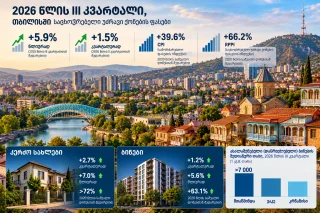 Residential Property Prices in Tbilisi Rise by 5.9% Year-on-Year
Hotels Return to Investors’ Priority List

Hotels are regaining weight in investment portfolios. In 2025, the sector accounted for about 8% of global commercial real estate investment, above its long-term average, while direct hotel investment stood 22% above the 2023 trough. More than 90% of European investors surveyed by CBRE plan to maintain or increase hotel allocations in 2026. Resort and premium properties are attracting a particularly large share of capital. In Georgia, the global trend coincides with a local shift: tourism remains strong, Batumi’s short-term apartment stock is expanding rapidly, while internationally branded hotel real estate remains a much smaller part of supply.
Hotel investment is growing again
JLL describes 2026 as a continuation of a new hotel investment cycle. Direct investment volumes in 2025 were 22% above the 2023 low, while hotels accounted for approximately 8% of global commercial real estate investment, above the long-term average. Improving debt markets, substantial available capital and resilient travel demand are supporting the sector.
International Investment has already covered this shift in its 2026 hotel investment outlook. The important change is where investors are placing capital. Strong tourism destinations, professionally managed hotels and assets with international distribution are taking a larger role.
More than 90% of respondents to CBRE’s European survey plan to maintain or increase their hotel allocations in 2026. Investor demand remains concentrated in leading cities and strong leisure markets in Southern Europe.
Resort hotels are capturing more capital
Spain provides a clear example. Hotel investment reached a record €2.46 billion in H1 2026, up 26.5% year on year. Resort properties represented 60% of investment, while four- and five-star hotels captured 86%. The average transaction value per room reached a record €213,300.
Capital is concentrating on quality assets in established tourism markets where room rates and visitor demand support higher property values.
Branded residences are following the same geographical shift. Knight Frank tracks almost 1,800 operational and pipeline projects across 90 countries. More than half are now located in coastal, island or mountain destinations, while hotel brands account for around 70% of schemes already in operation.
The UAE shows how resort real estate is changing
Ras Al Khaimah provides another example of the convergence between hospitality and private property. Approximately 10,000 branded residences are scheduled for delivery by 2030. The emirate also has about 8,500 additional hotel rooms planned for 2027–2030, most of them in the five-star segment.
The investor is increasingly buying a private property that is connected to an international hospitality brand, resort services and professional management.
Georgia is entering the same segment at a lower property-price base.
Georgia’s tourism market remains near record levels
Georgia recorded 5.52 million international tourist visits in 2025, up 8.4%, while total international traveller visits reached 7.8 million. International travel revenue totalled $4.69 billion.
The source-market mix is also changing. Visits from the EU and UK reached a record 249,201 in H1 2026, an increase of 23.4% year on year.
This is relevant to international hotel brands because a broader mix of long-haul and European travellers increases demand for global booking networks, loyalty programmes and familiar service standards.
Batumi is adding apartments much faster than branded hotels
Batumi has become a large short-term rental market. Galt & Taggart estimated approximately 18,000–20,000 apartments available for short stays at the end of 2024. The figure could reach 35,000–40,000 by 2029.
Branded hotel supply remains far smaller: 2,966 rooms in 2024, around 3,764 in 2026 and approximately 4,079 in the current pipeline through 2029.
The difference matters for investors. Thousands of similar studios and apartments compete within the same short-term rental market, while professionally managed international hotel stock remains a much narrower segment.
International Investment examined the imbalance in “From Housing to Hotels: How Batumi Investment Is Changing”. Around 58,000 apartments are expected to be delivered in 2025–2029, with roughly 46,300 primarily designed for investment and short-term rental demand.
Batumi hotels operate on a different model
Selected Batumi hotels tracked by Galt & Taggart recorded 59% occupancy in H1 2025, up from 50% a year earlier, with occupancy reaching 71% in June. Average daily rates for the half year stood at $91.
More recent Adjara research also shows stronger hotel occupancy and revenue supported by Middle Eastern tourism demand.
The opportunity is therefore not a shortage of hotel rooms in general. It is the relatively limited stock of high-quality, internationally branded hospitality property compared with Batumi’s much larger apartment market.
Gonio offers room for integrated resorts
Gonio, south of central Batumi, has a different development pattern from the dense urban waterfront. Larger sites allow developers to combine accommodation with pools, restaurants, wellness, medical, family, sport and events facilities.
For hotel property, that changes the economics of the asset. Guest demand is generated by the entire destination rather than by an individual room alone.
The area also remains close to Batumi and its international airport, combining access to the city with a self-contained resort format.
Wyndham Grand Batumi Gonio fits this model

One of the largest projects is Wyndham Grand Batumi Gonio. The resort brings together five hospitality formats — Aqua, Family Club, Riviera, Villas and Sky Castle — under the Wyndham Grand brand, with Aimbridge Hospitality as the management company.
Hotel rooms, penthouses, townhouses and villas are offered under full ownership. The development lists more than 100 infrastructure facilities across 27,115 sq m, including pools, restaurants and bars, wellness, sport, family, medical and business facilities.
The structure is different from purchasing a stand-alone short-term rental apartment. The property operates inside a hotel system, with pricing, reservations and guest services handled by professional management.
The official Wyndham Grand Batumi Gonio investment page presents two income models: a contractual guaranteed return of 10% per year, or hotel-management income with stated potential of up to 16%. The project also offers a 30% initial payment and interest-free instalments for up to 60 months.
International Investment has separately analysed the Wyndham Grand Batumi Gonio guaranteed-income model.
Wyndham uses the format in other resort markets
The same brand is also present in European resort real estate. Wyndham Portocolom opened in Mallorca in April 2026 with 115 furnished studios and apartments near Cala Marçal beach. The development combines private property with Wyndham hospitality standards.
Portocolom and Gonio are different in scale and concept. The Spanish development is relatively compact, while Wyndham Grand Batumi Gonio is being developed as a large integrated resort with several hospitality formats and shared infrastructure.
The underlying model is similar: the international hotel brand and professional operation form part of the property itself.
Ras Al Khaimah is developing the same model on a larger scale, with roughly 10,000 branded residences in its pipeline through 2030.
Georgia offers a strong setting for hotel property
Georgia combines growing international tourism, comparatively accessible property values and straightforward ownership rules for foreign buyers.
Batumi has also reached the point where a seaside apartment is no longer a scarce product. The short-term rental market is large and continues to expand, while branded hospitality stock remains substantially smaller.
Property can also serve a residence objective. Since March 2026, qualifying non-agricultural real estate valued above $150,000 can support a short-term residence application, subject to the programme requirements. International Investment compares the Georgian route with other markets in its 2026 property residency guide.
Hotel real estate in Georgia therefore sits at the intersection of international tourism, cross-border property investment and professional hospitality operations.
Capital is choosing professionally managed hotel assets
The return of capital to hotels is selective. Spain’s investment figures show a strong preference for resorts and four- and five-star assets. Knight Frank records the movement of branded residences towards leisure destinations. In the UAE, international hospitality brands are becoming an important part of new residential clusters.
Georgia is following the same direction with its own pricing and tourism dynamics. Batumi’s mass apartment supply is expanding quickly, while branded hotel real estate remains a much smaller segment.
As International Investment experts report, that difference is making professional hospitality property increasingly visible to investors. Wyndham Grand Batumi Gonio shows how the global model is being adapted to Georgia’s Black Sea coast: international branding, professional management, private ownership and large-scale resort infrastructure are combined in one property format. As Georgia’s tourism sector expands and Batumi adds more conventional apartments, branded hotel property is gaining a distinct place in the market.
FAQ: hotel real estate investment
Why is hotel investment increasing again?
Direct global hotel investment in 2025 stood 22% above the 2023 trough. Financing conditions have improved and travel demand remains resilient.
What share of commercial property investment goes into hotels?
Hotels accounted for approximately 8% of global commercial real estate investment in 2025, above their long-term average.
Which hotels are attracting the most capital?
Quality resort assets are among the strongest segments. In Spain, resorts accounted for 60% of hotel investment in H1 2026 and four- and five-star hotels received 86% of total capital.
Why is Georgia attractive for hotel real estate?
Georgia combines record tourism volumes with relatively limited internationally branded hotel supply. The contrast is particularly visible in Batumi, where short-term apartment supply is expanding rapidly.
How many short-term rental apartments are there in Batumi?
Galt & Taggart estimated approximately 18,000–20,000 units at the end of 2024, potentially rising to 35,000–40,000 by 2029.
How many branded hotel rooms are there in Batumi?
The 2026 estimate is around 3,764 rooms, with approximately 4,079 in the current pipeline through 2029.
What is Wyndham Grand Batumi Gonio?
It is a resort development in Gonio under the Wyndham Grand brand and managed by Aimbridge Hospitality, offering hotel rooms, penthouses, townhouses and villas under full ownership.
What returns does Wyndham Grand Batumi Gonio offer?
The official project terms include a contractual 10% annual guaranteed-return option or hotel-management income with stated potential of up to 16%.
How is hotel property different from an investment apartment?
Hotel property operates through a central management system. The operator handles pricing, reservations, service and hotel operations, while the brand and resort infrastructure form part of the investment product.