







 Covivio Hotels Revenue Grows 4.7% as European Markets Split
 Lithuanian Apartment Prices Accelerate Across Major Cities
 Georgia's Tourism Revenue Hits Record High
 Norway's Sovereign Fund Commits €1.5bn to European Warehouses
 Market Rout of October 2026: Can Branded Hotels Protect Capital?
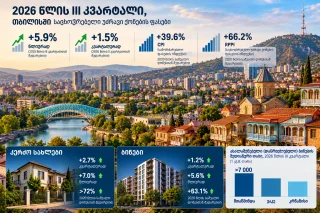 Residential Property Prices in Tbilisi Rise by 5.9% Year-on-Year
Italy Funds Housing for Tourism Workers

Italy is directing public funds towards a problem that hotel operators cannot solve by adding guest rooms: employees struggle to find affordable accommodation near tourist destinations. On October 9, 2026, the Tourism Ministry approved a third list of companies receiving Staff House capital grants. Its €54 million renovation programme is intended to create or upgrade accommodation for hospitality workers. An initial group of approved projects foresees 3,566 beds, but these are planned places, not completed housing.
The strongest appetite for support has come from tourism businesses in Trentino–South Tyrol, Veneto and Campania. The programme presents an investment opportunity for refurbishing existing property, but it also imposes rent discounts and long-term restrictions on how beneficiaries use the buildings.
Italy approves the third Staff House grant list
On October 9, the Italian Ministry of Tourism published Directorial Decree No. 239 approving a third set of beneficiaries under Staff House Titolo II. The firms had passed additional eligibility and state-aid checks. This was an administrative step within an existing programme, not the launch of a new round of applications.
Previous lists were published in August and on October 6. Approval is not proof that a renovation has been completed or that workers have moved in.
Staff House has two distinct measures. Titolo II funds investment in existing buildings, including refurbishment and energy upgrades. Titolo III helps hospitality operators cover rents for worker accommodation. Their budgets and accommodation figures should not be added together as newly built homes.
Grant requests exceed the €54 million allocation
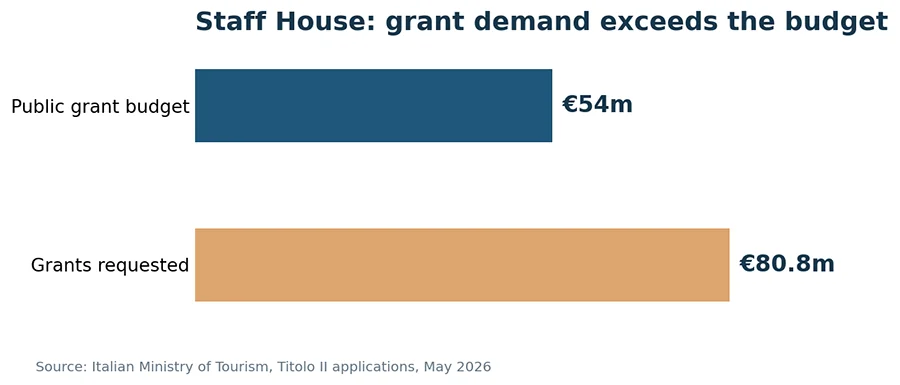
The capital-grant measure has €54 million available across 2025–2027. When applications closed on May 5, the ministry had received 102 projects seeking €80.8 million in subsidies, a €26.8 million shortfall against the available allocation. The total proposed investments reached €149.9 million.
These are applications, not payments. The August preliminary assessment included 32 projects provisionally selected, 21 rejected, 17 requiring more review and 32 suspended because funds were exhausted. Later administrative lists cover further checks and formal allocation decisions.
SMEs accounted for around 66% of applications and micro-enterprises another 22%. Smaller hotel and restaurant operators often lack the capacity to refurbish employee accommodation entirely from their own resources.
Alpine destinations lead the applications
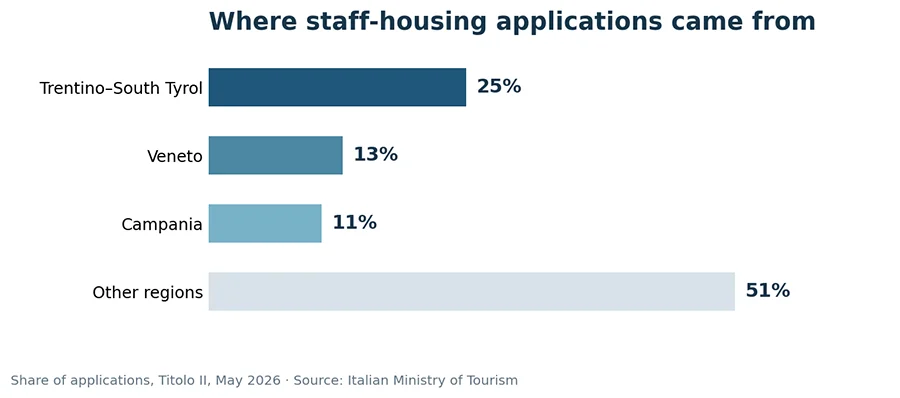
Trentino–South Tyrol submitted 25% of all applications, representing €39.9 million in proposed investment and €21.8 million in grant requests. Veneto followed with 13% and Campania with 11%; Lombardy and Tuscany together contributed approximately 19%. These are shares of applications, not shares of the country's hospitality workforce.
Alpine resorts face a particularly difficult balance between seasonal hiring, holiday homes and limited long-term rentals. In Rome and Venice, hospitality employers face a different challenge: staff are needed year-round, but housing costs in visitor-heavy districts constrain where employees can live.
What refurbishment projects can qualify?
Invitalia's rules cover refurbishment, modernisation and completion of existing buildings. Eligible projects cost between €500,000 and €5 million excluding VAT, must provide at least ten beds and improve energy performance. Projects must start after submission and finish within 24 months of the grant award.
Eligible spending includes specified renovation works, machinery and new furnishings subject to caps. A base grant of up to 30% can apply to some building energy improvements, but actual rates vary by project type, business size and location. The programme does not offer every applicant a flat 30% refund.
|
Condition |
Titolo II |
Titolo III |
|
Support |
Capital grants |
Rental expense support |
|
Budget |
€54m, 2025–2027 |
€22m each year |
|
Purpose |
Building upgrades |
Lower rental costs |
|
Staff places |
3,566 planned |
≈60,000 supported |
|
Use commitment |
9 years post-project |
Rental costs: 5–10 yrs |
|
Rent condition |
≥30% below benchmark |
Up to €3,000 / bed / yr |
Capital-grant housing must serve staff for nine years
This is a key restriction. Under Titolo II, beneficiaries must reserve the refurbished housing for employees for nine years after project completion. Rent must be at least 30% below the local market benchmark established by Italy's Revenue Agency. Charging more than permitted or changing the use of the property can trigger recovery of the grant.
For illustration, where the applicable market rent benchmark is €1,000 a month, a minimum 30% discount would cap the staff rate at €700. This is a calculation example rather than an official nationwide rent ceiling.
The distinction matters because the general statutory framework refers to at least five years for some forms of support, but the implementing rule for Titolo II capital grants specifically requires nine years. Investment models need to use the nine-year restricted period.
The separate rental programme covers about 60,000 places
The ministry reported 3,566 beds envisaged by the first approved Titolo II projects. Under Titolo III, support for discounted accommodation extends to around 60,000 places. These are different categories: the former involves new or upgraded staff rooms, while the latter can subsidise rent on existing accommodation.
Titolo III has an annual allocation of €22 million for each of 2025, 2026 and 2027. It can contribute up to €3,000 per bed per year, subject to aid intensity limits of 50% of eligible expenses for SMEs and 15% for large businesses, over an eligible rent commitment of five to ten years.
The two programmes solve different problems. Refurbishment can increase suitable worker accommodation but takes time and capital. Rent support can address immediate costs without necessarily adding to the housing stock.
The Alps illustrate why worker housing matters
Hotels and restaurants in the mountains recruit large seasonal teams. They compete for accommodation with holiday visitors and second-home owners, often in places where development land is scarce. Workers may decline jobs if wages cannot cover housing and transport.
In October, Cortina d'Ampezzo separately launched municipal housing tenders, including nine publicly owned apartments at the Ex Panificio building. This is not part of Staff House. It is a local example of a tourism-focused community taking action on housing affordability.
International Investment reported July 2026 advertised rents of €18.68 per sq. m per month in Rome and €15.97 in Venice. A hypothetical 50 sq. m apartment at those citywide asking rates would cost approximately €934 and €799 a month respectively. Such estimates are not quotes for available staff accommodation.
Why hotels now need to account for housing
Hospitality labour shortages are often framed as a wage or recruitment problem. Housing is increasingly a separate constraint. A hotel may be able to recruit on paper but fail to staff peak-season operations if employees cannot live near the property.
Employer-provided accommodation can support retention, but entails maintenance, transport and property-management costs. The value to a hotel may appear in reduced recruitment risk or more reliable operations rather than high direct rental returns.
What the programme means for real estate investors
Staff House creates a niche for repurposing existing buildings, provided eligible hospitality businesses manage the projects and comply with the subsidy rules. Property owners may be able to structure cooperation with hotel operators, but the grant is not an unrestricted subsidy for private residential investors.
Financial underwriting must include energy upgrades, refurbishment risk, discounted staff rents and the nine-year dedicated-use restriction under Titolo II. Returns should not be compared directly with unrestricted tourist short-term rentals.
The alternative is not free of costs: without staff housing, hotels may struggle to open rooms or maintain service standards in peak season. Accommodation can therefore contribute to the wider hotel investment case even when its own yield is modest.
The test will be actual completed housing
October's new beneficiary list confirms that implementation is advancing, but it does not establish the number of beds completed or workers already housed. The programme should ultimately be judged on actual occupancy, delivery times, rents paid by employees and effective use of grant funds.
Demand may outstrip what the scheme can finance. Grant requests of €80.8 million already exceed the €54 million capital budget, while smaller operators may lack suitable buildings or funding for their required contribution. Italy's policy is addressing a real market constraint, but rebuilding the workforce's access to housing will take more than a list of approved projects.
FAQ
What changed on October 9, 2026?
Italy approved a third list of Titolo II capital-grant beneficiaries under the existing Staff House programme.
What is the Staff House budget?
Titolo II has €54 million across 2025–2027. The separate rent-support measure, Titolo III, has €22 million annually.
How many staff beds are planned?
The first approved capital projects envisage 3,566 places. The rental support scheme covers approximately 60,000 places, not 60,000 newly built apartments.
How much cheaper must staff rent be?
Titolo II-funded accommodation must be rented at least 30% below the applicable local market benchmark.
How long must the property remain staff housing?
A Titolo II capital-grant beneficiary must retain the staff-housing use for nine years after project completion.
Can new applications be submitted now?
The Titolo II application window closed on May 5, 2026; the October lists concern applications already filed.
Can any property investor obtain this grant?
No. Eligibility requires an appropriate hospitality business and compliance with property, investment and operating conditions.
Why does this matter for Alpine resorts?
Seasonal staff compete for scarce housing with holidaymakers and second-home owners, making recruitment and retention harder.