











Italy Debates the Limits of Short-Term Rentals
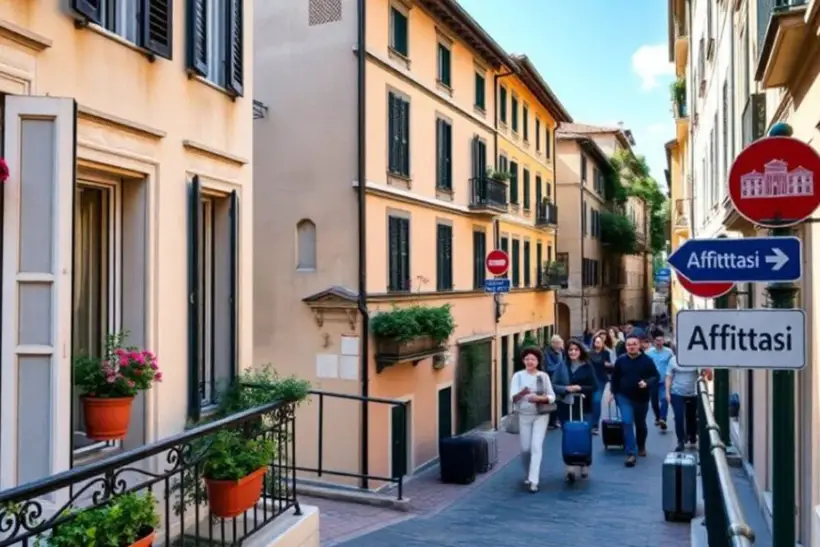
Italy’s short-term rental market in 2026 is being discussed not only as part of the tourism economy but increasingly as a housing-policy issue. In a February 16 article published by Wanted in Rome, the president of Property Managers Italia argues that the core problem is not regulation itself, but fragmented rules, frequent legal changes and the lack of a coherent industrial vision for the sector. In that interview, he says the market is not being destroyed, but filtered and professionalised under heavier regulatory pressure.
CIN, taxes and compliance are reshaping Italy’s rental market
Part of that shift is already visible in official policy. Italy’s tourism ministry has activated the BDSR national database, through which accommodation facilities and properties used for short-term or tourist rentals receive a CIN national identification code. Italy’s revenue agency also says that from January 1, 2024, the cedolare secca flat-tax rate is 21% for one selected short-term rental property and 26% for the second property. Separately, the State Police require guest data to be transmitted through Alloggiati Web within 24 hours of arrival, or immediately if the stay is shorter than 24 hours. Against that backdrop, the industry argument that compliance costs and managerial complexity are rising is grounded in rules that are already in force.
Short-term rentals remain a material part of Italy’s tourism economy
The sector itself is far from marginal. Istat said Italy recorded a historic high in 2024 with 139.6 million arrivals and 466.2 million overnight stays in accommodation establishments. Eurostat has also shown that platform-based short-term accommodation across the EU has reached record volumes. That makes the interview’s central claim more plausible in market terms: short-term rentals are not a fringe phenomenon, but part of the country’s broader tourism infrastructure. The Property Managers Italia president explicitly describes the segment as a structural component of both tourism supply and housing supply.
The core dispute is shifting from bans to regulatory design
The article’s main argument is that overly complex regulation can end up hurting compliant professional operators more than irregular ones. The interview says that when bureaucracy becomes excessive, transparent businesses continue to comply while some improvised operators move underground. It also stresses the costs of fragmentation between national, regional and municipal rules, which in this telling produce legal uncertainty, higher compliance expenses and operational difficulties for firms working across multiple territories. That is the association’s position rather than a formal state assessment, but it is one of the clearest business-side statements of how Italy’s short-term rental debate is evolving.
The EU is tightening transparency rather than banning the sector
The wider European framework makes the Italian debate more consequential. EU Regulation 2024/1028 on data collection and sharing for short-term accommodation rentals is already in force and applies from May 20, 2026. It does not create an EU-wide ban on short-term rentals. Instead, it sets rules for registration where national systems exist and for data exchange between platforms and authorities. For Italy, that matters because the CIN system and the EU data-sharing framework together push the market toward deeper formalisation. In that sense, the argument that the real issue is the quality of regulation rather than regulation itself gains broader relevance.
Hotel lobbying and competitive balance are now part of the fight
The most politically pointed part of the interview concerns competition with the traditional hotel sector. The Property Managers Italia president argues that some measures appear to reflect pressure from business models different from his own and cites tax changes, the presumption of business activity from the third property and requirements he considers disproportionate in some cases. He also suggests that one side of the accommodation market is sometimes restricted more heavily than the other. Those are advocacy claims, not government findings, but they show that in Italy the short-term rental debate is increasingly about market structure and competitive balance, not only about housing supply.
The market is moving toward professionalisation, not disappearance
The interview repeatedly argues that the sector is becoming more mature and more selective. Property Managers Italia distinguishes between owners, occasional operators and professional managers, saying durable success now depends on processes, staff, technology, insurance, dynamic pricing and legal compliance. The article also says profitability still exists for structured operators even as the space narrows for improvised players. For the property market, that matters because the Italian fight over short-term rentals is turning into a debate over who is allowed to monetise tourism demand and under what standards.
Regulatory stability is becoming the decisive investment issue
The closing message of the interview is about stability. The author says rules can be strict, but they cannot keep changing if real estate investors are expected to plan over the medium and long term. He points to fragmented obligations involving Istat reporting, municipal tourist-tax reporting, Alloggiati Web notifications and tax compliance including DAC7. As both Italy and the EU deepen oversight, predictability is becoming the central issue for owners, management companies and investors exposed to urban tourism assets.
As International Investment experts report, the Italian debate over short-term rentals in 2026 is moving away from a simplistic argument about bans and toward a more practical question about regulatory quality. That suggests short-term rentals are unlikely to disappear as an asset class in Italy, but they are becoming more formalised, more expensive to operate and more professionalised. The real divide now lies between a system built on transparency and unified digital rules, and one built on overlapping restrictions that keep raising uncertainty for investors and operators.
FAQ: short-term rentals in Italy in 2026
What is the CIN code in Italy?
CIN is the national identification code assigned to accommodation facilities and short-term or tourist rental properties through Italy’s BDSR system.
What tax rate applies to short-term rentals in Italy?
According to the Italian revenue agency, the cedolare secca rate is 21% for one selected short-term rental property and 26% for the second property.
Do hosts have to send guest data to the police?
Yes. Through Alloggiati Web, guest details must be reported within 24 hours of arrival, or immediately if the stay is shorter than 24 hours.
Does the EU ban short-term rentals from 2026?
No. EU Regulation 2024/1028 is about registration frameworks and data sharing where national systems exist, not an EU-wide ban on the sector.
Why is the short-term rental sector seen as structural in Italy?
Because Italy continues to post very large tourism numbers and short-term accommodation has become a meaningful part of that ecosystem. Istat recorded 466.2 million overnight stays in 2024.
What worries professional managers most in Italy right now?
Based on the Wanted in Rome interview, the main cTitle: Italy Debates the Limits of Short-Term Rentals in 2026