












Scotland Proposes Higher Council Tax for Million-Pound Homes

Редакционная иллюстрация жилых каменных домов в Шотландии осенью; это условные объекты, а не адреса, включенные в налоговую оценку.
Scotland has set out proposed Council Tax bands for homes worth more than £1 million. The government bill was introduced on 18 November 2026, followed by an announcement of its terms the next day. Ministers intend the bands to take effect on 1 April 2028. As of 23 November, however, the proposal has only been introduced in Parliament and has not changed existing bills.
Two new bands at the top of the market
Band I would cover homes worth more than £1 million and no more than £2 million. Band J would apply above £2 million. The government announcement says fewer than 1% of Scotland’s domestic properties are expected to be affected. Independent Scottish Assessors would determine valuations; an asking price or the amount paid in a recent transaction would not by itself establish the band.
The existing eight bands, A to H, use open-market values from 1 April 1991. The two additional bands would instead use market conditions on 1 April 2026. This would create a separate basis for the most expensive homes while leaving the remaining stock within the existing framework. It is a targeted exercise rather than a complete revaluation of every Scottish home.
Local Band D charges determine the bill
The proposed multipliers are 2.886 times the local Band D charge for Band I and 4.628 for Band J. The bill expresses the legal ratios as 1039/360 and 1666/360. These figures are multiples of a council’s charge, not percentages of a property’s market value. Homes with equivalent valuations in different council areas would therefore not necessarily face the same bill.
| Proposed parameter | Band I | Band J |
|---|---|---|
| Value at 1 April 2026 market conditions | Above £1m, up to and including £2m | Above £2m |
| Multiple of local Band D charge | 2.886 (1039/360) | 4.628 (1666/360) |
| Intended start | 1 April 2028 | 1 April 2028 |
| Transitional protection | Qualifying sole/main residences | Qualifying sole/main residences |
Source: Scottish Government / Scottish Parliament.
The financial memorandum examines revenue and implementation costs, including uncertainty around valuations, reliefs and collection. Assessing an individual property requires its valuation band, the council’s base charge and any applicable reductions. A purchase price above £1 million is consequently insufficient to calculate the annual liability. Local decisions remain part of the calculation.
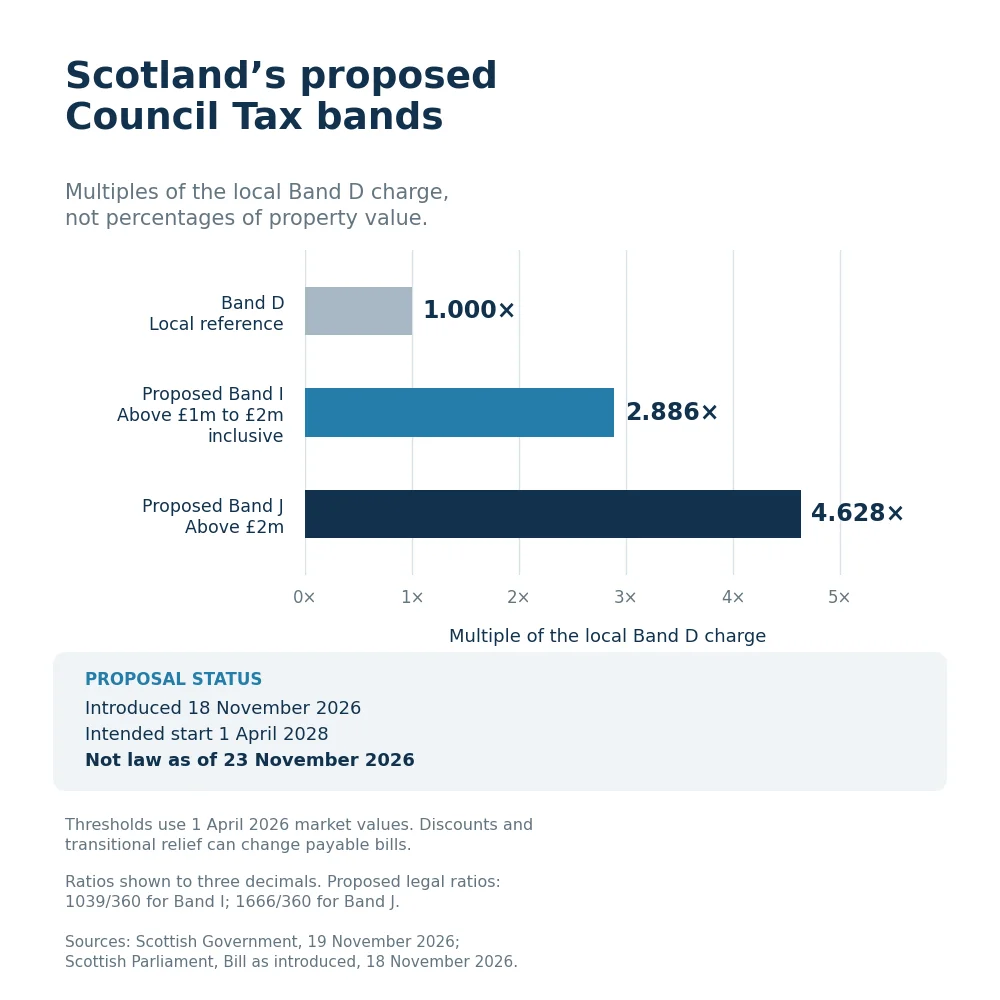
Proposed Council Tax multipliers. Bill introduced on 18 November 2026; intended start 1 April 2028. Status checked on 23 November.
Main residences would receive transitional protection
Eligible sole or main residences moving from bands A–H into I or J would receive automatic transitional relief. The annual increase would be limited to the lower of £1,500 or 50% of the relevant previous-year liability. This limits the pace at which the charge rises; it does not permanently cancel the difference between the previous band and the full new charge.
The calculation uses gross Council Tax before ordinary discounts and reductions, with earlier transitional relief reflected in subsequent years. Protection would continue until the full new liability is reached. A dwelling that is not a sole or main residence would not qualify. Existing discounts, including the single-person discount, would continue, so treatment should not be assumed to be identical for a main home and a second property.
Valuation dates serve different purposes
The policy memorandum separates the market reference date from the date used to establish a home’s physical condition. The initial exercise would assess the property as it stands on 1 January 2028 against market conditions on 1 April 2026. An extension completed by the former date could therefore be reflected, without moving the market reference forward to capture subsequent price changes.
That distinction matters more for individual properties than the broad “mansion tax” label. Physical characteristics and the assessment process determine whether a home crosses the threshold. The announcement alone cannot identify every affected address. Nor does the proposal create a separate rate specifically for overseas buyers: its stated criteria concern a dwelling’s value and the circumstances relevant to relief.
Housing policy extends beyond the tax bands
The proposal follows a wider debate over Scottish housing reforms, covered by International Investment before the 2026 election. Consultation responses discussed both proportionality at the top of the market and households whose valuable homes are not matched by high current incomes. Those responses show the views of participating individuals and organisations; they are not a representative opinion poll of Scotland’s population.
Council Tax would remain within the existing occupier-based framework. For a rental property, understanding who is liable is therefore necessary before attributing the entire charge to the landlord. Rental rules also differ across the UK. A Scottish proposal cannot be applied to an English investment simply because both are described as British property.
Parliamentary scrutiny still lies ahead
Parliament’s bill page records introduction, with the subsequent stages still to come. Rates, transitional arrangements and council powers can be scrutinised during that process. An intended commencement date is not evidence that the measure is already law. For now, these are proposed conditions for a future tax framework.
The announcement provides parameters for examining running costs. It does not establish how sale prices, transaction volumes or rents will respond. Forecasting those outcomes would require evidence about buyers, sellers and occupiers, as well as the final legislation. The verified development is the design of the proposed reform, not a measured market reaction to it.
FAQ
When would the new Council Tax bands begin?
The intended start date is 1 April 2028. As of 23 November 2026, the bill has been introduced but has not become law.
Would a home worth exactly £1 million enter Band I?
No. The proposed threshold is above £1 million. Band I includes homes worth exactly £2 million, while Band J begins above that value.
Does 2.886 mean a tax of 2.886% of the property value?
No. It is the rounded multiplier of the council’s Band D charge. Discounts, reductions and transitional relief may also affect the payable amount.
Would every high-value home receive transitional relief?
No. The mechanism is intended for qualifying sole or main residences. A dwelling outside that definition would not automatically receive this protection.