







 Georgia Accommodation Producer Prices Rise 5.2%
 InterContinental Plans Its First Montenegro Resort in Tivat
 Portugal Reconsiders Its 10% Rental Income Tax Relief
 Scotland Proposes Higher Council Tax for Million-Pound Homes
 Spain Hotel RevPAR Rises 9% in October
 Europe Property Investment Reaches €171.9bn
DXB Passenger Traffic Falls 28.1% in Nine Months

Редакционная иллюстрация пассажирского самолета и современного аэропортового терминала в Дубае.
Dubai International Airport handled 50.4 million passengers in January–September 2026, down 28.1% from the same period a year earlier. Results published by Dubai Airports on 17 November show an expanding airline network alongside a shortfall against last year’s traffic. For tourism and hotel businesses, the release tracks the return of air connections to the emirate.
The comparable period shows the size of the decline
DXB recorded 18.8 million passengers in the third quarter, a 22.1% annual decline. August was the quarter's busiest month, with 6.6 million. The nine-month total includes both winter traffic and the severe spring disruption, so its annual comparison differs from the July–September result. The quarterly decline was shallower than the cumulative shortfall, although traffic remained below the 2025 level.
| Indicator | 2026 result | Comparison |
|---|---|---|
| Passengers, January–September | 50.4m | −28.1% year on year |
| Passengers, Q3 | 18.8m | −22.1% year on year |
| Aircraft movements, January–September | 243,000 | −27.6% year on year |
| Load factor, January–September | 74% | −3 percentage points |
| Direct / connecting traffic, September | 49% / 51% | Single-month shares |
Source: Dubai Airports, 17.11.2026.
The operator’s 2025 report recorded 70.1 million passengers in January–September. This year’s 50.4 million represents approximately 19.7 million fewer movements, calculated from rounded totals. Both observations cover nine months. The full-year 2025 result of 95.2 million covers a different interval.
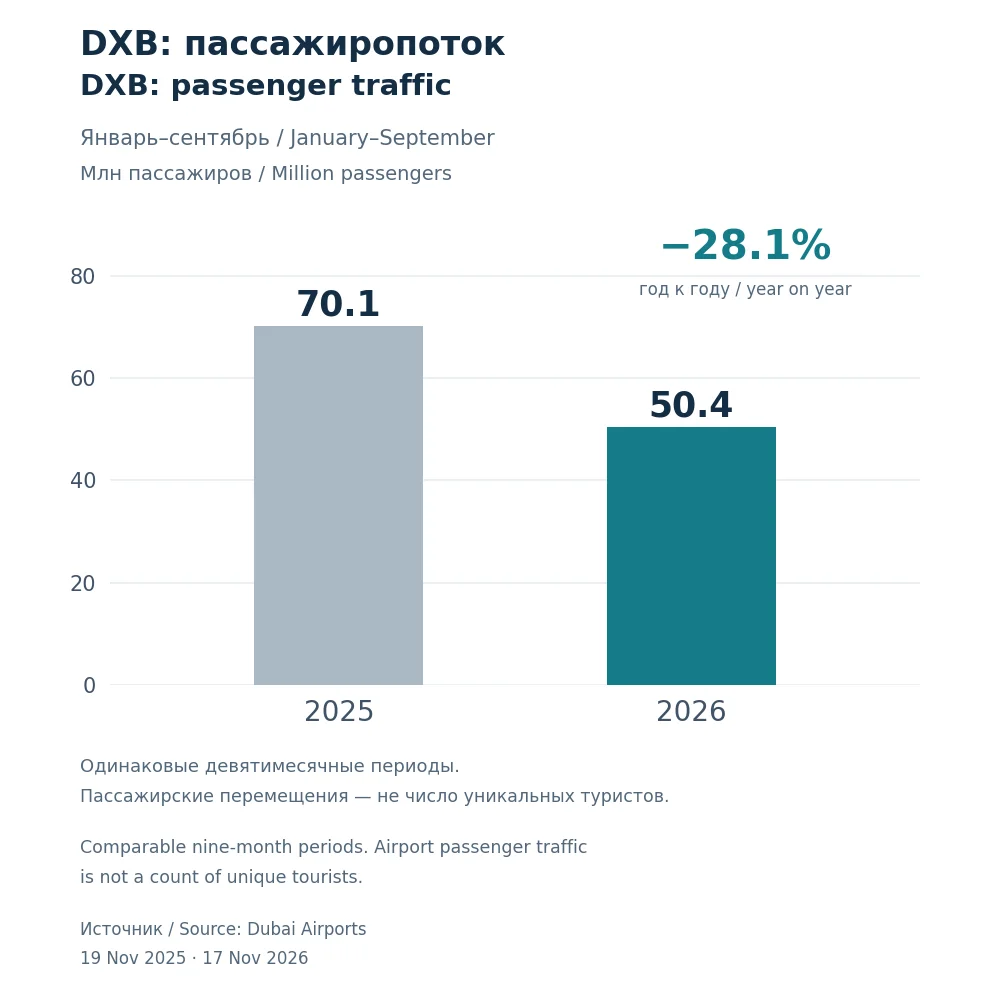
DXB passengers over comparable nine-month periods. Source: Dubai Airports, 19 November 2025 and 17 November 2026.
Spring airspace restrictions still shape the annual result
Earlier capacity constraints help explain the scale of the shortfall. In its May update, Dubai Airports described disruption beginning on 28 February and intensifying during March. March passenger traffic fell 65.7% year on year to 2.5 million. Restoring access to UAE airspace allowed operations to increase, but available routes through surrounding airspace continued to determine how quickly airlines could rebuild their schedules.
The August release recorded 13 million passengers in the second quarter and 31.5 million in the first half, down 31.3% annually. Higher third-quarter traffic also reflects seasonality. International Investment previously examined March flight suspensions and the redistribution of operations between Dubai’s airports, which helped preserve transport connections.
Connecting passengers are a separate demand segment
In September, direct journeys to and from Dubai represented 49% of DXB traffic, with connections accounting for 51%. The operator says direct traffic generally becomes more prominent during winter as tourism and events attract visitors. The published split describes September specifically.
Direct traffic includes residents, business travellers and tourists; an individual creates separate passenger movements when arriving and departing. Hotel demand also depends on overnight visitor arrivals, length of stay and accommodation use. A change in passenger composition may therefore have different commercial effects for short-stay properties and hotels serving longer holidays.
Airlines return, but utilisation remains below last year
At the November release, 57 airlines connected DXB with 235 airport destinations in 101 countries. British Airways resumed services earlier that month, following Royal Air Maroc, SunExpress and Cebu Pacific. For hotels targeting specific source markets, restored routes show which customer groups are gaining additional travel options.
Aircraft movements fell 27.6% in January–September to 243,000. The average passenger load factor was 74%, three percentage points below the previous year. Recovery involves both operating frequencies and the utilisation of available seats. The earlier role of Al Maktoum in easing disruption also showed how alternative infrastructure helped preserve connections across the network.
The operator expects to exceed 70 million passengers
Dubai Airports chief executive Paul Griffiths expects more than 70 million passengers in 2026. Achieving that forecast depends on the final months, when direct travel to Dubai traditionally becomes more prominent. Returning airlines and expanded winter schedules support access to the destination. For hotels, the next commercial step is converting additional airline capacity into bookings from particular source markets.
An assessment can connect the airport outlook with a property’s main markets through restored flight frequencies, forward bookings and length of stay. That provides a more direct link to actual hotel sales. November’s report shows both a rebuilding transport network and a substantial accumulated gap against 2025; together, they describe the conditions facing tourism businesses as the year closes.
FAQ
What period does the 28.1% decline cover?
It compares January–September 2026 with the same months of 2025. DXB handled 50.4 million passengers this year, against 70.1 million in the comparable previous period.
Is traffic recovering?
Third-quarter traffic reached 18.8 million, compared with 13 million in the second quarter. It was still 22.1% below the previous third quarter, and sequential comparisons are not seasonally adjusted.
Does the airport decline equal a decline in tourism?
No. DXB handles connecting traffic and residents' journeys as well as visitors. Assessing tourism requires separate overnight-arrival, accommodation and visitor-spending measures.
What is the full-year outlook?
The operator expects more than 70 million passengers in 2026. This was the management outlook published on 17 November, rather than an achieved annual result.