







 Georgia Accommodation Producer Prices Rise 5.2%
 DXB Passenger Traffic Falls 28.1% in Nine Months
 InterContinental Plans Its First Montenegro Resort in Tivat
 Scotland Proposes Higher Council Tax for Million-Pound Homes
 Spain Hotel RevPAR Rises 9% in October
 Europe Property Investment Reaches €171.9bn
Portugal Reconsiders Its 10% Rental Income Tax Relief

Редакционная иллюстрация жилой улицы Лиссабона и ключа от квартиры на подоконнике.
Portugal is debating an early end to a relief that taxes qualifying residential rental income at 10%. On 20 November, the Socialist Party, PS, reported approval of its initiative during detailed consideration of the 2027 budget. The budget process was still incomplete on 23 November, with the final vote scheduled for 24 November. The relief should therefore not yet be described as repealed.
The relief currently in force
Article 45-C of the Tax Benefits Statute sets a 10% rate for qualifying property income from contracts exclusively for residential letting. Monthly rent must fall within the prescribed limit, and a more favourable applicable rate takes precedence. The provision covers income through 31 December 2029, with effect from 1 January 2026. It is a temporary tax arrangement, not a guaranteed investment return.
A separate provision benefits corporate income taxpayers and individuals with organised accounts under IRS category B: only half of qualifying rental income is taken into account. The proposed repeal consequently extends beyond the familiar shorthand of a 10% rate for an individual landlord. Its practical effect depends on the tax category through which the income is assessed.
What the €2,300 monthly threshold means
Decree-Law 97/2026, published on 20 May, defines moderate rent by reference to 2.5 times the minimum monthly wage specified for 2026. For that year, the threshold is €2,300 a month. The legislation allows the limit to be updated through a separate order. This is an eligibility threshold for particular support measures, not a nationwide ceiling on the rent a landlord can charge.
The eligibility calculation takes account of the total payment for the property, including specified associated items and services. Splitting amounts between agreements does not by itself place a dwelling within the threshold. Residential letting also cannot simply be treated as interchangeable with hotel accommodation or every other use of a property. The relevant tax treatment follows the legal structure of the arrangement.
The amendment targets two provisions
Amendment 1852C to the OE2027 budget bill proposes repealing Article 45-C and the corresponding 10% withholding provision in Article 101 of the IRS code. Its specified start point is income received from 1 January 2027. Income earned during 2026 would remain outside the repeal. The text therefore concerns future tax periods rather than a recalculation of all rent already received.
| Parameter | Current Article 45-C | Amendment 1852C |
|---|---|---|
| Status on 23 November 2026 | In force | Proposal within the budget process |
| Income received in 2026 | Relief if conditions are met | Not affected by the proposed repeal |
| Income from 2027 | Relief currently runs through 2029 | Repeal of Article 45-C proposed |
| Withholding provision | Corresponding preferential IRS rule | Repeal of IRS 101(1)(f) proposed |
Source: Autoridade Tributária / Parlamento.
Removing a particular relief does not produce one tax rate for every landlord and lease. Other available regimes, general tax rules and the taxpayer’s circumstances still matter. Saying that every landlord would automatically move from 10% to 25% would go beyond what the amendment establishes. It identifies provisions for repeal rather than supplying a universal calculation for each property.
A reported amendment vote is not the final law
The PS statement records the sponsor’s account of the intermediate decision. Parliament’s timetable separately schedules the final global budget vote for 24 November. Approval of an amendment during detailed scrutiny and a new tax rule entering into force are distinct stages. The final legislation remains the document that will establish the operative outcome.
This distinction matters for contracts expected to generate income over several years. Current law describes a relief lasting through 2029, while the proposal would interrupt it from 2027. Both statements are relevant: the relief exists today, and its continuation is under challenge. The date at which the legal position was checked is consequently as important as the headline rate.
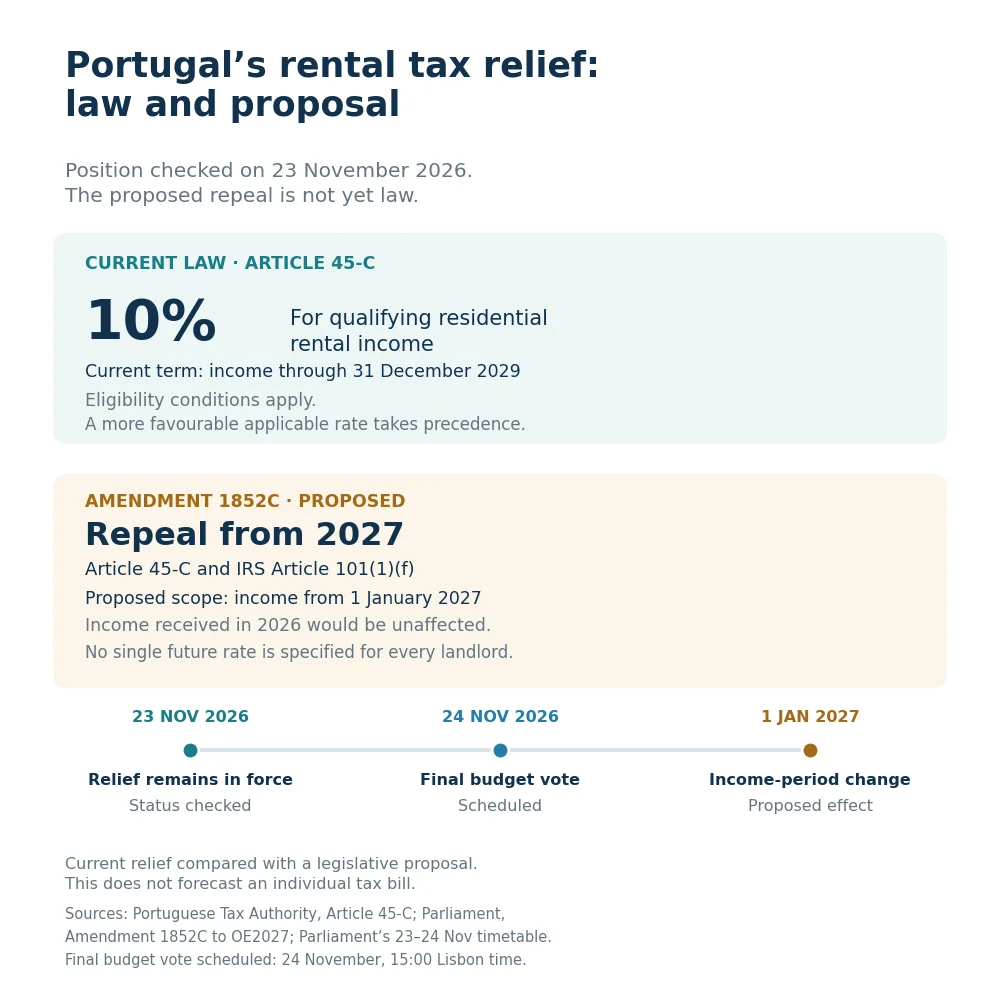
The relief remains in force as of 23 November 2026. Amendment 1852C proposes repeal for income from 2027; the final budget decision is pending.
The dispute is over how housing support works
The government introduced tax concessions within a wider package intended to support housing supply. PS challenges the broad rent threshold and the absence of an obligation to reduce rent. That is a disagreement over the targeting of public support. The party’s criticism of the measure’s effectiveness is not, by itself, statistical evidence of what the relief has done to rental prices.
Portugal is also financing social housing and operating separate affordable-rental mechanisms. The RSAA framework has its own implementing rules. Repealing Article 45-C would not by itself repeal the entire housing package. Treating these instruments as a single scheme would obscure their different eligibility requirements and intended beneficiaries.
What the proposal means for property analysis
Rising house prices make the tax debate relevant to buyers and rental-property owners. Sale prices, however, are a different measure from rents and cannot demonstrate the effect of a particular rental tax concession. Nor does changing a landlord’s tax automatically set a new monthly payment for the tenant. Contract terms and market conditions stand between those two figures.
The immediate uncertainty concerns the duration of the regime. A relief introduced for several years may end before its original expiry date. Comparing future scenarios requires the final budget wording, the date it applies and any other tax treatment still available. Until the legislative outcome is settled, a precise claim about a property’s future after-tax return would be premature.
FAQ
Has the 10% rate already been abolished?
As of 23 November 2026, Article 45-C remains in the current law. PS has reported approval of its amendment, but the final budget vote is scheduled for 24 November.
Would the amendment affect rental income received in 2026?
The published text applies the repeal to income received from 1 January 2027. It does not change the treatment of income received during 2026.
Is €2,300 the maximum rent legally permitted?
No. It is the 2026 eligibility threshold relevant to the relief under discussion. It is not the same thing as a general rent cap.
Would all housing tax incentives disappear?
No. The amendment identifies specific provisions. Other arrangements, including separate affordable-rental mechanisms, have their own legal bases and eligibility conditions.