













InterContinental Plans Its First Montenegro Resort in Tivat
Редакционная иллюстрация побережья Которского залива с горами, каменными зданиями и мариной; будущий отель на изображении не показан.
IHG Hotels & Resorts announced the signing of InterContinental Resort Tivat in Montenegro on 19 November 2026. The proposed 169-room property, including 18 suites, is expected to open in 2029 with Devolli Corporation as the development partner. It would introduce the InterContinental brand to the country.
The proposed development will compete with hotels and a substantial private accommodation sector. Official statistics show a market heavily dependent on coastal destinations and international visitors.
Opening is planned for 2029
A signed brand agreement establishes the planned relationship around a project. It does not establish that construction is complete, bookings have begun or the hotel group has purchased the building. The announcement identifies Devolli as development partner but does not disclose the investment budget, financing package or the precise contractual model for this property.
| Indicator | Disclosed position | Interpretation |
|---|---|---|
| Stage | Agreement signed | Hotel not yet open |
| Partner | Devolli Corporation | Development partner |
| Room inventory | 169, including 18 suites | Suites included in the total |
| Opening | Expected in 2029 | Projected date |
| IHG country portfolio | 9 open and pipeline hotels | Not 9 operating properties |
| Financing | Budget and terms undisclosed | No return calculable from release |
Source: IHG, 19.11.2026.
IHG says the addition brings its Montenegro portfolio to nine open and planned hotels. An operating hotel can sell rooms today, while a pipeline project represents future supply. Competitive analysis therefore needs each property’s delivery schedule and target audience.
Tivat already has a substantial visitor market
The resort is planned as part of a seafront mixed-use development connected to the Porto Montenegro waterfront. The hotel would share a wider district’s tourism infrastructure and services.
MONSTAT’s annual data show that Tivat recorded 1.43 million tourist overnight stays in 2025, representing 9.3% of Montenegro’s total. It establishes the scale of an existing visitor market, but does not identify how many guests would choose a new internationally branded resort at its eventual room rates.
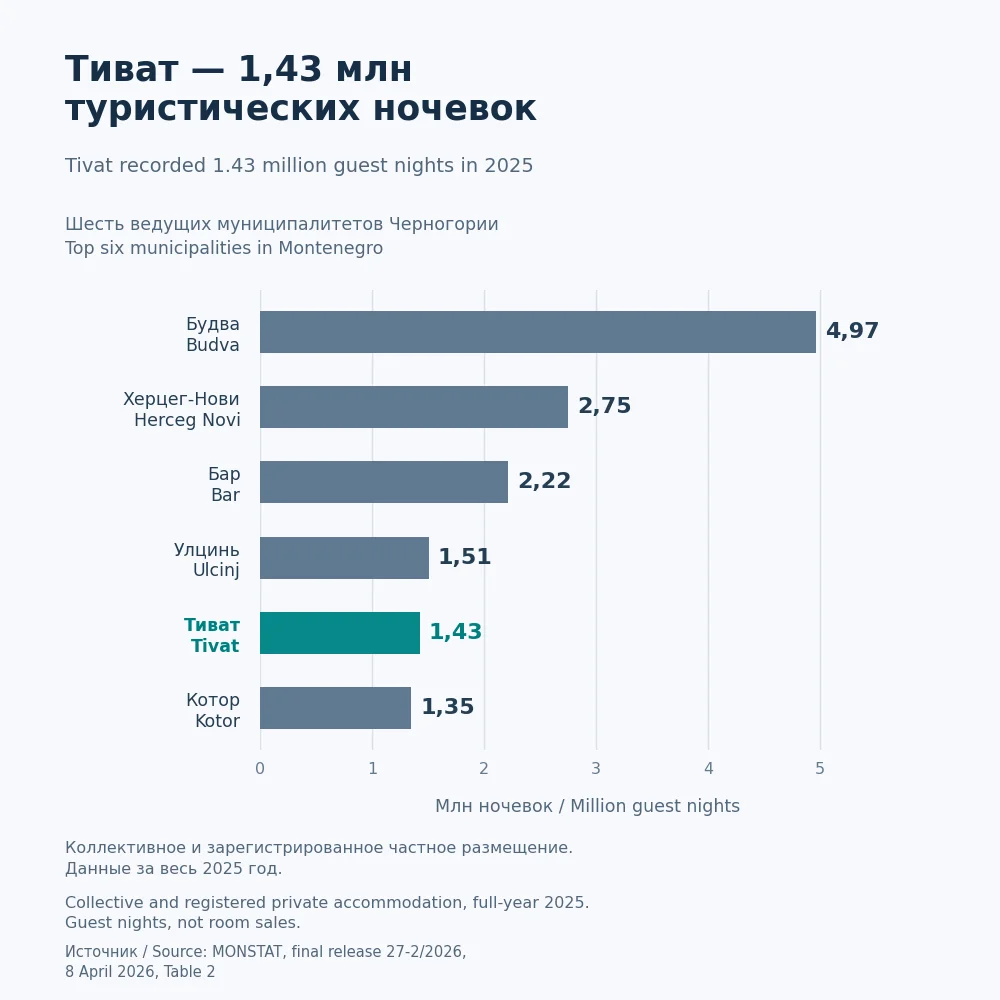
Guest nights in registered collective and private accommodation in 2025. These are guest nights, not hotel room sales. Source: MONSTAT final release, 8 April 2026.
The local second-home market adds another dimension. Holiday properties, seasonal rentals and hotels draw on the same surroundings, but their economics differ. An apartment buyer may value personal use and resale prospects, while a hotel operator needs repeat guests and manageable service costs. Strong interest in property ownership cannot simply be inserted into a hotel revenue forecast.
Private accommodation changes the competitive picture
Montenegro’s annual tourism statistics combine collective establishments with registered private accommodation. Private properties generated 66.2% of overnight stays in 2025; collective accommodation accounted for 33.8%. The latter includes hotels, resorts, boarding houses and other establishments. A new premium hotel is therefore competing within a wider range of holiday formats, rather than only against other branded hotels.
A guest night is one person staying for one night. A hotel room can accommodate several guests, while an apartment may serve a family or group. Montenegro’s tourism demand provides useful market context, but calculating hotel occupancy requires available and sold room inventory. National overnight totals cannot supply that denominator.
The commercial question is which travellers will pay for the proposed service package. Some prefer the space and independence of an apartment; others value resort facilities and consistent service. A higher room rate must offer value to the guest while covering the owner’s additional cost of delivering it.
September highlights the challenge beyond peak summer
MONSTAT’s September release records 207,118 arrivals and 757,128 overnight stays in collective accommodation in September 2026. International visitors supplied 91.3% of nights, while seaside destinations accounted for 90.3%. Published on 29 October, the figures show that the first autumn month remained heavily dependent on international demand and coastal destinations.
One month cannot establish the seasonal curve, but it raises the question of what attracts guests beyond beach holidays: business meetings, wellness stays and events can support different travel dates. Their contribution to a specific hotel would need to be demonstrated through bookings, acquisition costs and the resources needed to host them.
Operating during quieter periods also has a cost. Technical maintenance, management and a core service team remain necessary when fewer rooms are occupied. A handful of high-priced summer weeks therefore says little about annual cash generation without a realistic account of the remaining months.
Tivat Airport handled 815,000 passengers in Q3
Transport statistics offer another demand indicator. Tivat Airport handled 815,020 passengers in the third quarter of 2026, or 45.4% of Montenegro’s airport traffic. Across the country, airports handled about 1.79 million passengers, up 28.4% year on year, according to MONSTAT’s 11 November release.
Airport passenger figures count both arrivals and departures, so it is not a count of prospective hotel customers in one municipality. Its value for a resort depends on route geography, arrival times and flights outside the busiest months. Practical flight schedules also matter for short breaks.
Brand reach must translate into operating results
IHG’s operating model includes franchised and managed third-party hotels, alongside a small owned or leased business. In the first two formats, the group can supply a brand, booking channels and services while the real estate belongs to another party. These distinctions explain why branding does not establish a property’s ownership or financing.
The Tivat project’s economics will ultimately depend on development costs, financing terms, staffing, fees and reinvestment after opening. International distribution can help a property reach guests, but its financial contribution still needs to be measured. Revenue remaining after operating costs and contractual obligations will provide a more useful investment signal than the number of projects a brand has signed.
FAQ
Is InterContinental Resort Tivat already open?
No. The announcement concerns a new development expected to open in 2029. That is a projected opening date, not confirmation that the hotel is ready.
Are the 18 suites included in the 169 rooms?
Yes. Suites form part of the announced total. Adding the two numbers to produce 187 rooms would double count them.
Has a return for private investors been announced?
No. The announcement contains no offer to sell hotel units, disclosed investment budget or promised investor return. Its figures describe the planned hotel.
Can national visitor numbers predict the hotel’s occupancy?
Arrivals, guest nights and airport traffic provide demand context. An occupancy forecast needs evidence on the target market, competitors, rates and available rooms through the year.