







 Russian and Belarusian Owners List More Latvian Property
 Georgian Law Enforcement Busts Scammers Posing as Real Estate Brokers
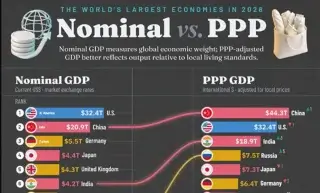 World’s Largest Economies in 2026: GDP and Purchasing Power Rankings
 Turkish Airlines Cancel Flights to Moscow
 Escalation in the Middle East: New US and Iranian Strikes
 Hong Kong Property Rebounds as Momentum Slows
Israel Cuts Rate to 3.25% for Third Meeting

The Bank of Israel cut its benchmark interest rate by 25 basis points to 3.25% on Sept. 1, its third consecutive reduction following the May and July meetings and the fifth cut since November 2025. Policymakers have gained room to ease as annual inflation slowed to 1.5%, although further reductions are not assured: energy prices have risen, the labor market remains tight and fiscal uncertainty persists. For real estate, financing conditions are improving, but home prices remain 1.5% below their year-earlier level and the stock of unsold housing is still high.
The decision was not universally expected. Bloomberg reported that economists had been divided over another reduction and highlighted pressure from exporters seeking relief from the effects of a strong shekel on their competitiveness.
Bank of Israel Cuts the Policy Rate to 3.25%
The Monetary Committee reduced the benchmark rate by a quarter percentage point. The new 3.25% rate takes effect on Sept. 3.
The current uninterrupted easing sequence began in May. The policy rate was lowered from 4% to 3.75% on May 25 and to 3.5% on July 6. The September move therefore brings the cumulative reduction over the past three meetings to 75 basis points.
Looking at the broader cycle, this is the fifth reduction since November 2025. The central bank first cut the rate from 4.5% to 4.25% on Nov. 24 and lowered it again to 4% on Jan. 5 before pausing in February.
The next interest-rate decision is scheduled for Oct. 21.
Inflation Has Slowed to 1.5%
Lower inflation provided the main justification for additional easing.
Israel's Consumer Price Index was unchanged in June and increased 0.3% in July. Annual inflation stood at 1.5%, below the midpoint of the Bank of Israel's 1%–3% target range.
Inflation excluding energy, fruit and vegetables was also 1.5%.
The central bank nevertheless continues to highlight risks that could push prices higher again. These include energy costs, the exchange rate, fiscal developments and the balance between demand and supply constraints.
Brent crude rose about 25% during the period reviewed by the Monetary Committee to around $90 a barrel. Government bond yields also increased in line with global markets.
The labor market remains tight. The job-vacancy rate edged up to 4.5% in July, while nominal wages in April–June were 6.2% higher than a year earlier.
Those indicators, together with the housing and growth data, are set out in the Bank of Israel's Sept. 1 monetary-policy decision.
The Shekel Is Helping Contain Inflation
The exchange rate is another factor supporting monetary easing.
Short-term and quarterly moves need to be separated. Since the July rate decision, the shekel appreciated just 0.6% against the US dollar and weakened 1% against the euro. On a nominal effective basis against Israel's main trading partners, it was almost unchanged, depreciating by about 0.1%.
The second-quarter move was much stronger. The shekel appreciated approximately 5.9% against the dollar, 6.6% against the euro and 6.1% on a trade-weighted nominal effective basis, according to the central bank's foreign-exchange market review.
A stronger currency helps restrain inflation by reducing the shekel cost of imported goods, commodities and services.
For exporters, the effect works in the opposite direction. Foreign-currency revenue converts into fewer shekels, while Israeli products can become more expensive for overseas customers.
A strong shekel can therefore simultaneously support lower inflation and create pressure on export-oriented businesses.
Israel's 15.4% GDP Growth Needs Context
Economic activity has also given policymakers room to ease.
GDP expanded at an annualized rate of 15.4% in the second quarter compared with the first, equivalent to roughly 3.6% quarter on quarter.
The headline figure is exceptionally strong, but much of it reflects a rebound from weaker first-quarter activity.
The Bank of Israel therefore also compares the second quarter with the fourth quarter of 2025. On that basis, GDP was 6.2% higher at an annual rate.
Excluding overseas production by Israeli companies, the figure falls to 3.8%, showing that underlying domestic activity is considerably more moderate than the 15.4% headline rate implies.
Revisions to national accounts data and the second-quarter recovery also reduced the estimated gap between GDP and its long-term growth trend to about 0.8%.
Bank of Israel Forecasts a Rate Near 3%
The central bank's July forecast had already anticipated additional easing.
Its Research Department expects GDP to grow 4% in 2026 and 5.5% in 2027. Inflation during 2026 is forecast at 1.8%.
The average policy rate is projected at around 3% in the second quarter of 2027. After the September cut, the current rate is only 25 basis points above that level.
The baseline forecast puts the budget deficit at 4.9% of GDP in 2026 and 4.2% in 2027, while the debt-to-GDP ratio is expected to stabilize at around 69%.
Those projections depend on fiscal assumptions. Additional government spending beyond the forecast baseline could increase both the deficit and inflationary pressure. The estimates are detailed in the Bank of Israel Research Department's July forecast.
Israeli Home Prices Remain Lower Than a Year Ago
Lower interest rates are supportive for housing, but the latest price data do not yet show a strong market reversal.
Home prices increased 0.1% in May–June compared with the previous two-month period, but were still 1.5% below their year-earlier level.
The central bank says the inventory of unsold homes remains high and broadly stable. Transaction volumes increased moderately in May and June, mainly in new housing.
Seasonally adjusted mortgage borrowing totaled about NIS 10 billion in July.
A lower policy rate can gradually reduce financing costs, particularly for mortgages with variable-rate components. It does not mean every mortgage automatically becomes 25 basis points cheaper, however. Actual pricing depends on loan structure, maturity, bank funding costs and borrower risk.
Rents Are Rising Faster Than Home Prices
Rental indicators are considerably stronger than sale prices.
The housing component of the Consumer Price Index was rising at an annual rate of 3.9% in July.
Rents on renewed contracts were about 2.6% higher than a year earlier. Contracts involving a change of tenant recorded a 4.7% annual increase, although that was down from 6.6% in June.
The result is an unusual divergence: purchase prices are lower than a year ago while rents continue to rise.
For property investors, that combination can improve gross rental yields relative to acquisition prices. For tenants, the picture is less favorable because lower property values do little for households that cannot yet qualify for a mortgage or accumulate a sufficient deposit.
Lower Rates May First Help Absorb Housing Inventory
The elevated stock of new homes distinguishes the current cycle from periods when lower rates quickly translated into accelerating prices.
At the end of the spring, the central bank was already reporting a high volume of new homes available for sale, and its September assessment continues to describe the inventory as elevated.
That means any demand brought back by cheaper credit may initially help developers reduce existing stock rather than immediately push market prices sharply higher.
Only a sustained decline in unsold inventory would remove one of the main constraints on sellers' pricing power.
The move to 3.25% should therefore not be translated directly into a forecast for equally rapid house-price appreciation.
Further Interest-Rate Cuts Are Not Guaranteed
Israeli monetary policy is currently being pulled in two directions.
Inflation at 1.5%, a strong shekel and negative annual house-price growth give policymakers room to support activity.
At the same time, wage growth remains high, the labor market is tight, energy prices have risen sharply and additional fiscal spending could create renewed inflation pressure.
The Bank of Israel has therefore not committed to a preset easing path. Future decisions will depend on actual inflation, economic activity, the exchange rate and fiscal developments.
As International Investment experts report, a third consecutive rate cut meaningfully improves financing conditions for Israeli real estate, but the 3.25% policy rate should not be treated as evidence that a new property-price cycle has already begun. Cheaper financing supports buyers and rising rents strengthen the investment case, but home prices are still down year on year and unsold inventories remain elevated. The more important signal will be whether transaction volumes rise while the stock of available new homes declines. If that happens before borrowing costs fall much further, today's relatively favorable negotiating conditions for buyers could disappear before a full low-rate mortgage cycle develops.
FAQ on Israel's Interest Rate and Housing Market
What is Israel's current interest rate?
The Bank of Israel cut its policy rate to 3.25% on Sept. 1, 2026. The new rate takes effect on Sept. 3.
How much did the Bank of Israel cut rates?
The reduction was 0.25 percentage point, or 25 basis points.
How many consecutive rate cuts has Israel made?
Three. The rate was reduced to 3.75% in May, 3.5% in July and 3.25% in September.
How many cuts have there been in the current easing cycle?
There have been five reductions since November 2025: in November, January, May, July and September.
Why is the Bank of Israel cutting rates?
The main reason is lower inflation. Annual inflation was 1.5% in July, below the midpoint of the central bank's 1%–3% target range.
Will Israeli interest rates fall further?
The central bank's July forecast projects an average policy rate of around 3% in the second quarter of 2027. That is a forecast rather than a predetermined policy path.
What is happening to Israeli house prices?
Prices increased 0.1% in May–June from the preceding period but remained 1.5% lower than a year earlier.
Will mortgages become cheaper?
A lower policy rate supports cheaper financing, particularly on variable-rate borrowing, but actual mortgage offers also depend on longer-term market rates, funding costs and borrower characteristics.
What is happening to Israeli rents?
Rents on renewed contracts were rising about 2.6% annually in July, while contracts involving a new tenant increased 4.7%.
When is the next Bank of Israel rate decision?
The next monetary-policy decision is scheduled for Oct. 21, 2026.