







 Turkey Is Losing Its Cheap-Holiday Advantage
 Development Is Rewriting Southeast Asia’s Historic Districts
 How Ukraine’s New-Build Housing Market Has Changed Over Four Years
 European Prime Rents Rise as Property Yields Turn Higher
 The Most Expensive Airlines in Europe in 2026
 Housing Prices in Italy Reach a Two-Year High
Thailand Signals Steady Rates to Aid Growth
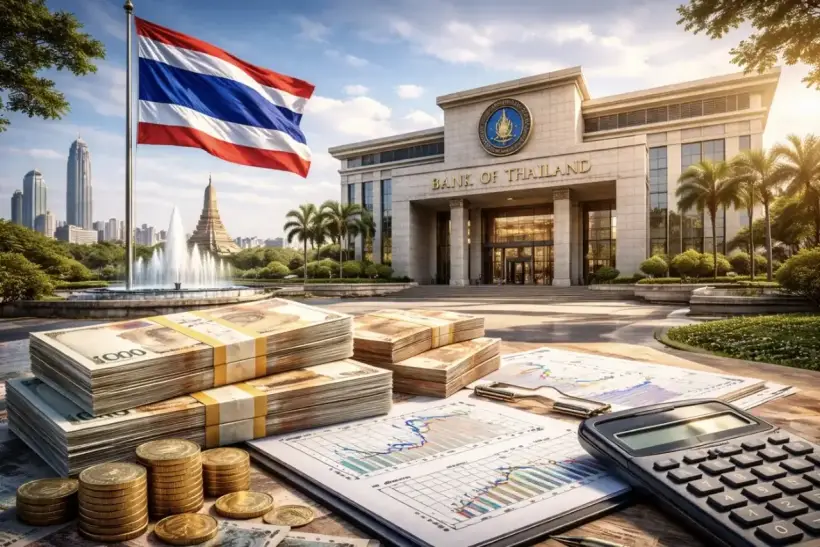
Thailand keeps an accommodative monetary stance
Thailand’s central bank is signaling that it will keep interest rates steady after February’s cut, seeking to support an economy that continues to grow below potential. Bloomberg reported on April 9 that the Bank of Thailand is effectively committing to hold rates at current levels after lowering its benchmark in February to 1.00%, as policymakers confront weak inflation, soft credit conditions and rising external risks.
Thailand’s policy rate stands at 1% after the February cut
Official Bank of Thailand data show that the policy rate, defined as the one-day bilateral repurchase rate, stood at 1.00% as of February 25, 2026. At that meeting, the Monetary Policy Committee voted 4 to 2 to reduce the rate by 25 basis points from 1.25% to 1.00%. The central bank said the move was intended to keep financial conditions supportive of the recovery and to ease debt burdens for small businesses and households.
Why the Bank of Thailand is not rushing into another move
After the February reduction, the central bank said the current level already reflects a sufficiently accommodative monetary stance. In its official statement, it argued that the present policy setting is aligned with the economic outlook. Two committee members preferred to leave the rate unchanged at 1.25%, stressing that the transmission of earlier cuts was still working its way through the economy. That makes the latest signal one of patience rather than an immediate push for another round of easing.
Thailand’s 2026 growth outlook remains weak
The Bank of Thailand’s published outlook shows the economy expanding by 1.5% in 2026 after 2.2% growth in 2025. Growth is expected to improve to 2.3% in 2027, but the bank still says output will remain below potential. According to the central bank, 2026 will be marked by slower private consumption, weaker merchandise export income due to U.S. tariffs, and only a gradual recovery in tourism.
Subdued inflation supports the case for steady rates
Price pressures remain weak. Thailand’s Trade Policy and Strategy Office said the consumer price index in March 2026 was 100.27, with headline inflation at minus 0.08% year on year. That was an improvement from February’s minus 0.88%, but still far below the Bank of Thailand’s 1% to 3% inflation target range. The central bank’s own homepage also shows February headline inflation at minus 0.88% and core inflation, which excludes more volatile items, at 0.56%.
What worries the central bank beyond inflation
The bank is focused not just on prices, but also on credit conditions, the currency and financial stress among borrowers. In February, it said overall credit continued to contract, the baht had appreciated, and liquidity remained tight for small and medium-sized enterprises as well as households. That means parts of the economy are still struggling to access financing even with low interest rates, while a stronger baht adds pressure to exports and tourism competitiveness.
External risks are shaping Thailand’s policy outlook
The Bank of Thailand has flagged U.S. trade policy, delays in the 2027 budget process and weak business adaptation, especially among smaller firms, as key risks. Energy is another concern. Thailand remains exposed to swings in global commodity prices, and in early April the government urged people to conserve energy and work from home more often as fears over oil and gas costs intensified amid Middle East tensions.
What the policy signal means for markets and borrowers
A steady rate at 1.00% suggests the Bank of Thailand does not see a need to tighten policy soon, even with some external inflation risks on the horizon. For borrowers, that points to more predictable financing costs in the near term. For markets, it reinforces that the central bank’s main priority is supporting growth in an economy that is not overheating. At the same time, room for further cuts looks limited because policymakers have also stressed the need to preserve monetary policy space in a more uncertain global environment.
As International Investment experts note, the Bank of Thailand’s stance shows a preference for stability and targeted support at a time of weak growth, low inflation and persistent debt stress. For investors and businesses, that means the key variables to watch in 2026 are likely to be exports, the baht, consumer demand and the durability of the tourism recovery rather than frequent changes in interest rates.
FAQ: Thailand interest rates in 2026
What is Thailand’s policy rate in April 2026?
Based on the latest official decision, Thailand’s policy rate stands at 1.00%.
When did the Bank of Thailand last change rates?
The latest confirmed move came on February 25, 2026, when the rate was cut from 1.25% to 1.00%.
Why is the central bank keeping rates steady?
Because growth remains below potential, inflation is subdued, and credit and debt conditions still require policy support.
What growth does the Bank of Thailand expect in 2026?
The central bank forecasts gross domestic product growth of 1.5% in 2026.
What is happening to inflation in Thailand?
Headline inflation was minus 0.08% year on year in March 2026 after minus 0.88% in February.
What are the biggest risks for Thailand’s monetary policy?
Weak domestic demand, contracting credit, the baht, export risks and external trade uncertainty are among the main concerns.