







read also
 Border Delays Are Changing Some British Holiday Plans
 US Housing Becomes a Buyer’s Market Without Buyers
 Reykjavik Airbnb Supply Falls Nearly 20% as Revenue Slips
 Mexico Sets New Tourism Record in First Half
 Indonesia Plans to Double Visa on Arrival Fee
 Australia’s Housing Downturn Tests Its Biggest Banks
Tourism & hospitality / News / Reviews / Germany / Tourism Germany / France / Tourism France / Spain / Tourism Spain / Ireland / Tourism Ireland / United Kingdom / Tourism Britain 09.12.2025
Europe flight chaos hits key holiday hubs
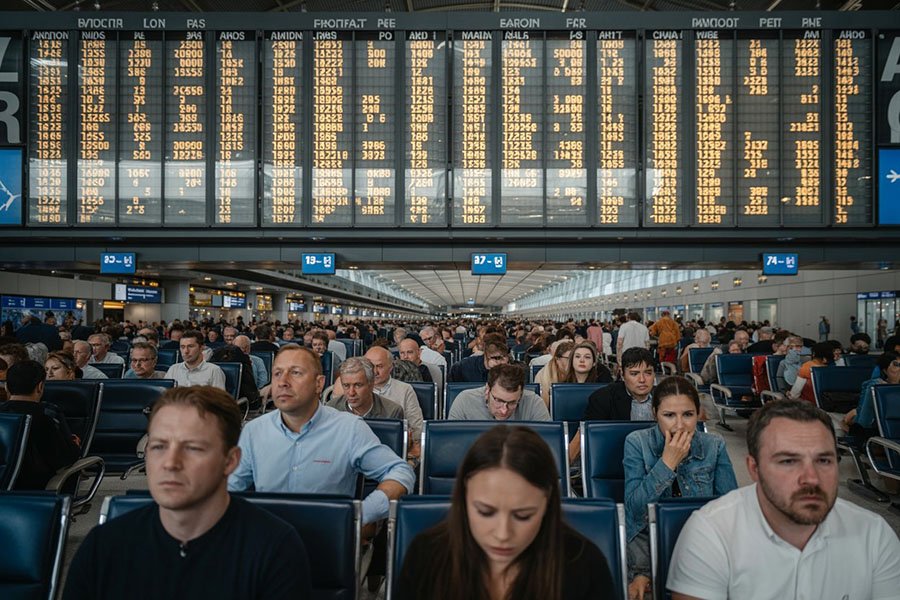
Europe’s air travel system has entered the peak holiday season in a state of acute stress. Over just 24 hours, 74 flights were cancelled across major carriers including EasyJet, Vueling, British Airways, Emerald Airlines, Pegasus Airlines and Air France. The disruption has rippled through strategic hubs such as London Heathrow, Paris Charles de Gaulle, Barcelona El Prat, Dublin and Zurich, leaving thousands of passengers stranded or rebooked on heavily delayed services. Long queues at check-in counters and service desks have become a familiar scene as travellers search for any available seat to salvage their trips.
Heathrow, Barcelona, Paris and Belfast at the centre of disruption
London Heathrow, British Airways’ primary hub, has been hit hardest. The airline cancelled 20 flights, wiping out a series of early-morning departures to Belfast, Edinburgh, Glasgow, Dublin, Zurich, Manchester, Barcelona, Basel and Athens. The return legs from these cities to Heathrow were также grounded, breaking carefully constructed connection chains for both business and leisure travellers. When a hub like Heathrow is disrupted at the start of the day, the knock-on effect is felt across the entire network well into the evening.
In Spain, Barcelona’s role as a gateway for both domestic and international traffic has been undermined by Vueling’s cancellations. Routes linking the Catalan capital to Bilbao, Granada and Asturias were suspended, cutting off regional airports from one of Europe’s busiest Mediterranean hubs. EasyJet’s problems stretched from London Gatwick and Edinburgh to Amsterdam Schiphol and Paris Orly, where a string of cancellations erased dense patterns of short-haul flights that normally underpin Europe’s low-cost connectivity.
Belfast City Airport has become another flashpoint. Emerald Airlines, operating many of the regional links between Northern Ireland and mainland Britain, cancelled 20 services connecting Belfast with Birmingham, Manchester, Leeds Bradford, Edinburgh, Southampton and Cardiff. For passengers and local businesses this translates into a full day of lost connectivity and scarce alternative options.
Pegasus and Air France weaken links between Europe and Turkey
On the eastern side of the continent, Pegasus Airlines has cancelled 12 flights from its Istanbul Sabiha Gökçen base. Domestic services to Konya, Kayseri, Antalya and Gazipaşa have been cut alongside international routes to Bristol and Geneva. The decisions affect both holidaymakers heading for Turkish resorts and members of the diaspora travelling between Turkey and Western Europe.
Air France, meanwhile, has trimmed its schedule from Paris Charles de Gaulle, cancelling flights to Dublin, Budapest, the Moroccan city of Salé and Dr. Antonio Agostinho Neto International Airport in Africa. For CDG, a key long-haul and transfer hub, even a small cluster of cancellations can unsettle connection banks and force passengers to reroute at short notice through alternative hubs or overnight stops.
Why schedules are breaking down: weather, staff and airspace limits
Behind the long list of cancelled services lies a familiar mix of structural and seasonal pressures. Severe winter weather remains the primary trigger: fog, storms and snow reduce runway capacity and force air traffic controllers to widen separation between aircraft. Once capacity is cut at multiple hubs at the same time, aircraft fail to return to their bases on schedule, crews reach their legal duty limits and airlines are left with no choice but to cancel flights to stay within safety rules.
Staffing remains another weak point. Many airlines and airports have not fully rebuilt their workforces after the pandemic. Seasonal peaks expose this shortfall: sickness, rostering issues or local disruptions leave too few ground handlers, cabin crew or controllers to keep operations running smoothly. This intersects with heavy airspace congestion over Europe. When traffic builds up around hubs like Heathrow, Schiphol and CDG in poor weather, air traffic control restrictions create queues in the sky and on the ground, feeding further delays and cancellations.
Technical and operational constraints add a final layer of fragility. Aircraft taken out of service for unplanned maintenance cannot be easily replaced because fleets are utilised to the limit. Tight turn-around times at busy airports mean there is little buffer to absorb even small delays. In such an environment, a single cancelled sector quickly cascades into a series of missed rotations across the day.
Passengers pay the price in time, money and trust
For travellers the statistics translate into disrupted lives. Families and business passengers across London, Paris, Barcelona, Dublin, Zurich and Belfast are sleeping in terminals, queuing for vouchers and scanning booking apps for scarce alternative flights. Missed connections can mean abandoned long-haul trips, lost holidays or postponed meetings. Extra nights in hotels, rebooked tickets, ground transport and meals push up the real cost of travel far beyond the original fare, even when some of these expenses are eventually reimbursed.
Uncertainty amplifies frustration. Information screens change by the minute, call centres are overloaded and not all passengers are familiar with their rights to rerouting, refunds or compensation under EU rules. The psychological effect is significant: many travellers come away with a sense that winter flying within Europe is almost inevitably linked to disruption, which in turn undermines long-term confidence in airlines’ reliability.
Outlook and International Investment view
From an industry perspective, the latest wave of cancellations is a warning about the structural limits of Europe’s air transport system. Airlines are operating with minimal spare capacity in fleets and staffing, while hub airports run close to maximum utilisation throughout the year. As extreme weather events become more frequent and holiday peaks more intense, these thin margins leave little room for error. In response, carriers and airports are likely to invest more in operational resilience: better disruption planning, smarter crew and fleet management tools and, where possible, additional reserve capacity.
Experts at International Investment believe that the current disruption does not undermine the long-term appeal of European aviation, but it does highlight the need for a new balance between efficiency and resilience. For investors, the episode is a reminder that even mature markets carry operational and weather-related risks that must be priced in.