












Georgian Airports 2025: Record Passenger Traffic of 8.5 Million
In 2025, Georgian airports handled a record number of passengers — 8.5 million, up 14.1% compared to 2024, according to the National Statistics Office. Cargo traffic increased by 48%, reaching 38.8 thousand tons. These figures confirm the recovery of the aviation sector after the pandemic and reinforce Georgia’s status as a leading regional hub.
Passenger Traffic in Georgian Airports: 2025 Trends
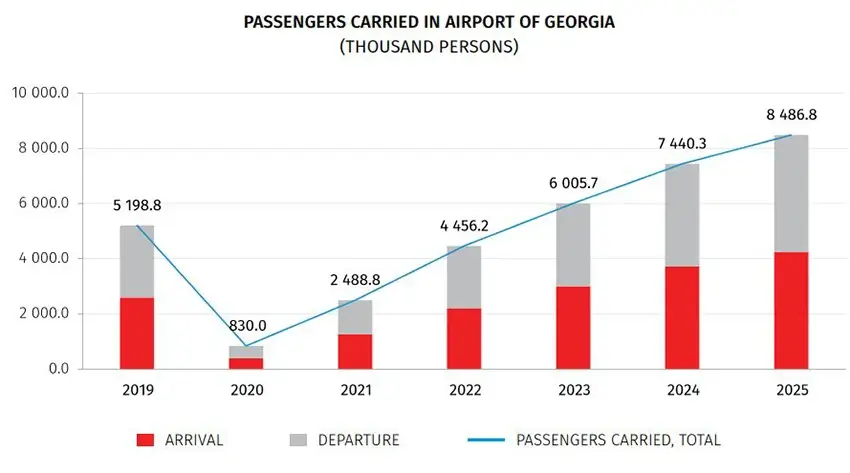
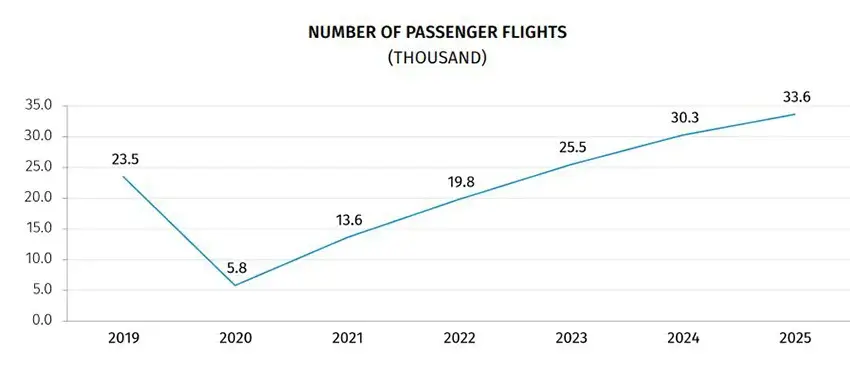
The number of passenger flights in 2025 grew by 11.1%, reaching 33.6 thousand. Georgia received 4.2 million arrivals — 14.2% more than in 2024 — while departures rose 14% to 4.3 million. The minimal difference between these numbers reflects a balanced development: both tourist and business interest in the country is growing, and residents are traveling more widely.
The seven-year trend illustrates the sector’s recovery. In 2019, passenger traffic reached 5.2 million, then considered a peak. The pandemic year of 2020 saw a collapse to 830 thousand — less than 16% of the 2019 level. Recovery began in 2021 with over 2.4 million passengers. In 2022, traffic reached 4.4 million, nearly returning to pre-pandemic levels. New records followed: 6 million in 2023, 7.4 million in 2024, and 8.48 million in 2025.
Scheduled and Charter Flights in Georgian Airports
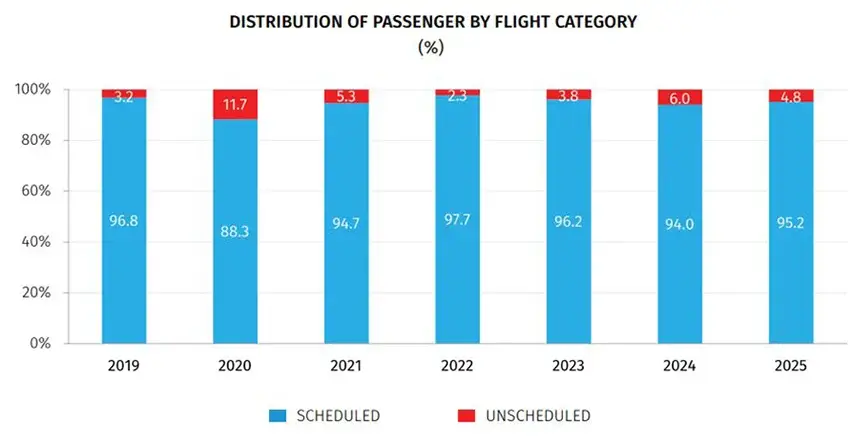
The ratio of scheduled to charter flights remains an important market maturity indicator. In 2019, scheduled flights accounted for 96.8%, while charters were only 3.2%. Pandemic-related 2020 with closed borders radically changed the picture: airlines focused on selective charter operations, and the share of non-scheduled flights jumped to 11.7% — the highest in the observed period.
As restrictions eased, the market returned to its usual pattern. Charters fell to 5.3% in 2021 and reached a minimum of 2.9% in 2022 with the recovery of scheduled flights. However, the last three years show a new trend: the share of charter flights has gradually risen again, from 3.8% in 2023 to 4.8% in 2025. This may indicate that tour operators increasingly offer package deals using charter flights to reduce travel costs, while the market becomes more flexible in testing new routes without long-term commitments.
Scheduled flights continue to dominate. In 2025, their share was 95.2%, slightly below pre-pandemic levels, confirming the stability of the core route network.
Cargo Air Transport
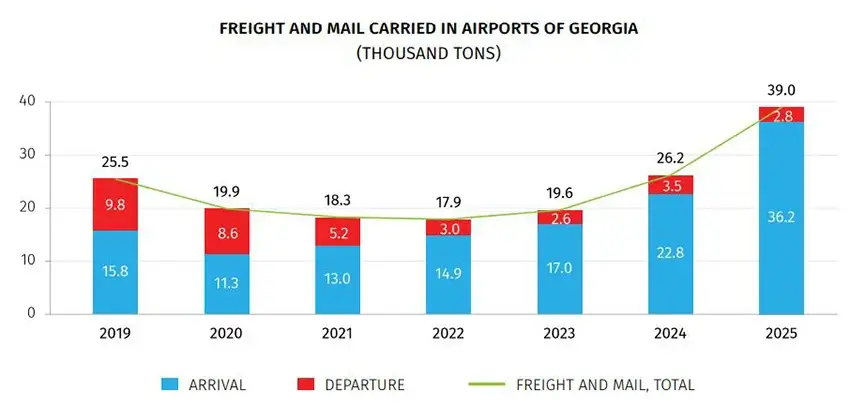
Georgian airports operated 3.9 thousand cargo flights — 77.1% more than the previous year. Total cargo and mail reached 38.8 thousand tons, up 48% compared to 2024. Incoming cargo amounted to 36.2 thousand tons (almost 1.5 times more), while outbound shipments surged from 3.5 to 39.0 thousand tons — more than elevenfold. This sharp growth reflects the expansion of export air freight, e-commerce development, and new cargo routes.
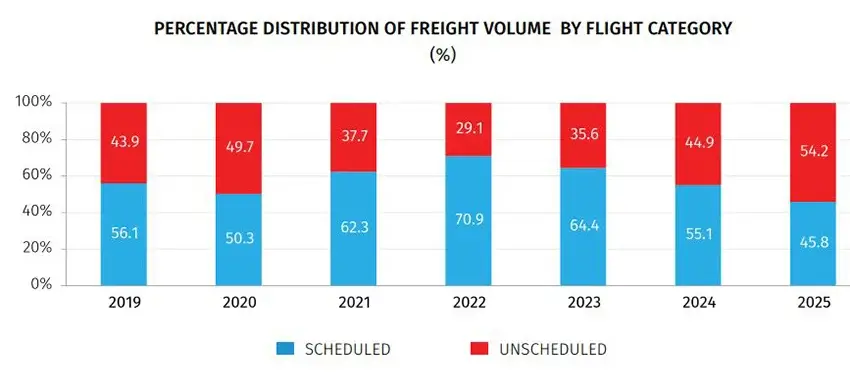
The structure of cargo transport by flight type is also changing. In 2019, regular flights accounted for 43.9% and charters 56.1%. By 2022, the regular segment fell to 29.1%, while charters rose to 70.9% due to crisis-driven unscheduled shipments. Since 2023, the trend reversed: in 2025, regular cargo flights exceeded charters for the first time, at 54.2% versus 45.8%, signaling market stabilization, the emergence of sustainable routes, and integration into scheduled airline operations.
Aircraft Fleet and Airport Infrastructure in Georgia
The Georgian civil aircraft registry lists 62 planes, 77.4% passenger and 22.6% cargo. Among passenger aircraft, small-capacity planes dominate: 72.9% have no more than 50 seats, 10.4% seat 51–150, and 16.7% seat 151–250 or more. This fleet structure suits a market focused on regional and tourist flights with flexible scheduling.
Airport infrastructure includes six runways, 59 check-in desks, 26 boarding gates, and 2,500 parking spaces for private vehicles. These facilities handled the record passenger flow in 2025 and provide capacity for further growth.
Conclusion
International Investment analysts note that Georgian aviation is steadily strengthening its position. Growth in passenger traffic and structural changes in cargo transport reflect the sector’s maturity and ability to adapt quickly to new demands. The balance between scheduled and charter flights, along with expanding stable cargo routes, provides a platform for service diversification.
Active tourism development stimulates demand for air travel, enhancing Georgia’s strategic importance as an aviation hub and making the sector a key driver of regional economic growth. In 2025, Georgia earned approximately $4.7 billion from international travelers, with visitors from Russia spending the most — $697.3 million. The top five also included citizens of EU countries, Turkey, Azerbaijan, and Israel. Maya Omiadze, Head of the National Tourism Administration, emphasized that 2026 will be even more successful: “We have large-scale marketing plans targeting both existing and new markets.”