












TOP 10 best countries for “stargazers” in 2026
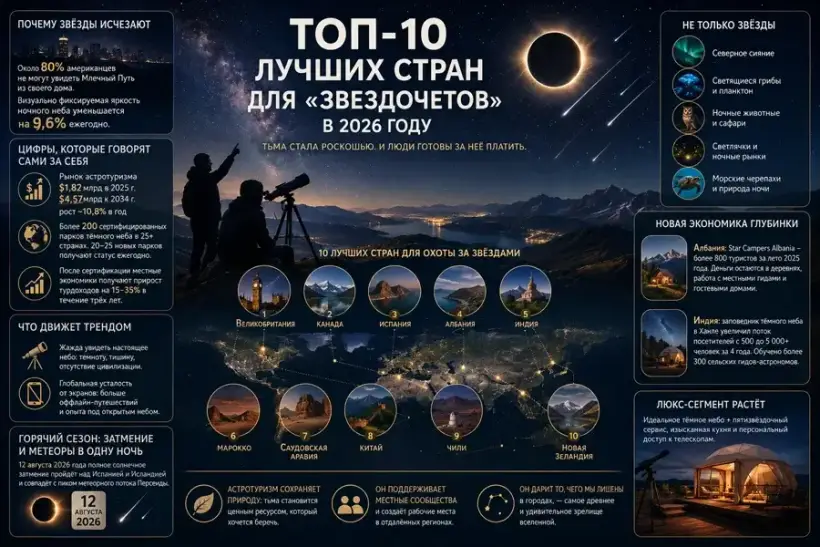
Astrotourism around the world has turned into a multibillion-dollar industry in just a few years. People are willing to fly to the other side of the world for something they can no longer see at home – the starry sky. The top ten global destinations for “stargazing” include the United Kingdom, Canada, Spain, Albania, India, Morocco, Saudi Arabia, China, Chile, and New Zealand, while Iceland also makes it into this year’s top thanks to a solar eclipse and the Perseid meteor shower, which will coincide in 2026.
Why the stars are disappearing
Before understanding the phenomenon of astrotourism, it is necessary to grasp the scale of the problem. About 80% of Americans cannot see the Milky Way from their homes. Many live under such strong “light pollution” that they can distinguish no more than a dozen stars per night.
Since 2011, the visually measurable brightness of the night sky has been decreasing by an average of 9.6% per year, according to DarkSky International. This means that a clear night sky has become a rare “natural resource”. And this shortage has created unusual demand.
Figures that speak for themselves
The global astrotourism market was valued at $1.82 billion in 2025 and is projected to reach $4.57 billion by 2034, showing an average annual growth of about 10.8%.
Today, more than 200 certified International Dark Sky Parks exist in over 25 countries, with 20–25 new sites gaining status each year. Each new park typically leads to a noticeable increase in tourist flow: studies show that within three years after certification, local economies record tourism revenue growth of 15–35%.
What drives the trend: space plus screens
In astrotourism, what is sold is not a place but visibility itself. This is a fundamentally new logic of travel: people do not travel to a specific attraction, but to conditions – darkness, silence, and the absence of civilization overhead.
Another important factor is global fatigue from screens. In 2026, more and more travelers are “putting down their phones and looking up at the sky”. Searches for offline travel increased significantly during the winter of 2025–2026, and interest in the northern lights and outdoor retreats continues to grow.
Peak season: eclipse and meteors in one night
The year 2026 promises to be special for sky enthusiasts. On August 12, 2026, a total solar eclipse will pass over Spain and Iceland, and accommodation searches in these regions have already increased more than fourfold for those dates.
A special coincidence: the 2026 eclipse aligns with the peak of the Perseid meteor shower, creating a unique “celestial duet”. The cities of La Coruña and Bilbao are in the right place at the right time, while across Europe a partial eclipse will be visible.
Conditions for observing the Perseids this year are almost ideal: the new moon falls exactly on August 12–13, meaning moonlight will not interfere. Observers in peak periods expect meteor rates of more than 100 meteors per hour.
Best places on Earth for stargazing
The Atacama Desert in Chile remains a global leader in astrotourism, alongside the Canary Islands in Spain and New Zealand’s South Island. These destinations have turned pristine night skies into a measurable tourism asset.
Other top locations include Aoraki / Mount Cook National Park in New Zealand, Jasper National Park in Canada (the world’s largest “dark sky preserve” with an area of over 11,000 km²), and the NamibRand Nature Reserve in Namibia.
Rising astrotourism destinations include India’s Spiti and Ladakh valleys, Morocco’s Merzouga Desert, the AlUla region in Saudi Arabia, and the Tibetan Plateau in China. Each of these regions is actively investing in infrastructure for stargazing.
The United Kingdom is an unexpected European leader. It has 14 certified dark sky parks and reserves across Scotland, Wales, England, and Northern Ireland – a network developed over decades that now attracts astrotourists from all over the world.
The new rural economy
Perhaps the most unexpected aspect of astrotourism is its social impact. The trend is actively transforming rural economies: remote sparsely populated regions are increasingly positioning themselves as “dark sky destinations”, extracting economic value directly from environmental conditions.
A striking example is Albania. Since 2021, the Star Campers Albania project has grown from a small group of friends into a community of more than 1,200 participants. During the 2025 summer season, more than 800 tourists joined multi-day hikes under the country’s untouched night sky, one of the clearest in Europe. Money stays in villages: the project works with local guides and small guesthouses.
In India, the Hanle dark sky reserve has increased visitor numbers from 500 to more than 5,000 in four years, boosting local homestays and small businesses. Private companies have trained more than 300 rural young people as astronomy guides.
Not just stars
Modern astrotourism is a gateway to the nocturnal world in all its diversity. Night is full of surprising phenomena: glowing fungi, bioluminescent plankton, night markets, fireflies. Nearly three-quarters of all mammals are most active at night. Tour operators already offer night wildlife safaris, twilight canoe tours, indigenous “northern lights hunts”, and sea turtle tracking excursions.
The luxury segment is growing the fastest: wealthy travelers increasingly seek a combination of perfect dark skies with five-star accommodation, fine dining, and private telescope access.
Astrotourism is a rare case where tourism actually supports nature conservation: to attract visitors, regions are incentivized to reduce light pollution. Darkness has become a luxury, and people are willing to pay for it, according to experts from International Investment.