







 Israel Cuts Rate to 3.25% for Third Meeting
 Russian and Belarusian Owners List More Latvian Property
 Georgian Law Enforcement Busts Scammers Posing as Real Estate Brokers
 World’s Largest Economies in 2026: GDP and Purchasing Power Rankings
 Turkish Airlines Cancel Flights to Moscow
 Escalation in the Middle East: New US and Iranian Strikes
Fuel disruptions cool domestic tourism in Russia
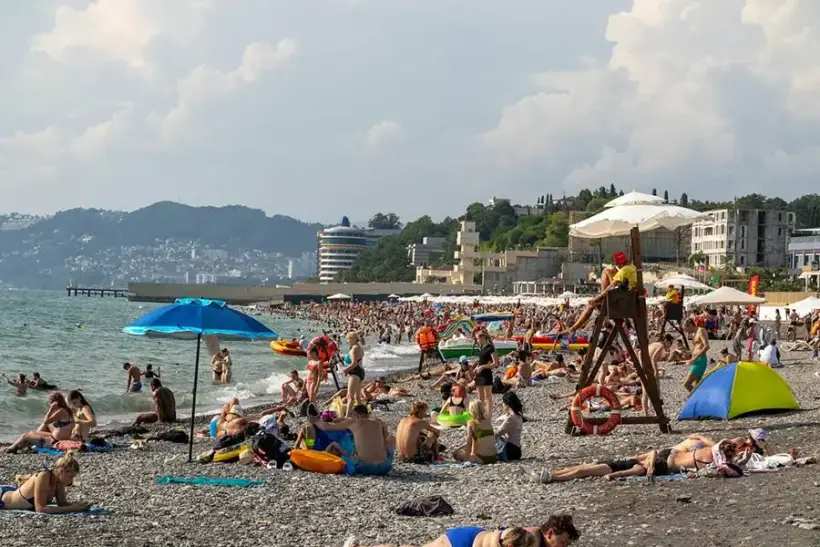
The summer season in Russia started weaker than expected. Organized tourist flows, hotel bookings, and package tour sales declined. Experts link this to cautious consumer behavior, disruptions in the fuel market, and transport restrictions, Izvestia reports.
Demand for travel across Russia is declining
In June 2026, organized trips within Russia fell by 4.8% compared to the same period in 2025, according to Dmitry Gorin, Vice President of the Russian Union of Travel Industry. TravelLine data shows hotel bookings dropped by 16%. The Association of Tour Operators of Russia (ATOR) recorded an 8.8 percentage point decline in the share of domestic package tour sales in July, down to 9.6%.
The most noticeable negative dynamics are observed in popular tourist regions. Marina Merezhko, partner at CMWP’s hospitality and tourism department, said bookings in Moscow fell by around 15% in June–early July, by 25% in Krasnodar Krai, and by 30% in Rostov Oblast.
Azimut Hotels reported a slowdown in tourism demand, especially in southern destinations where logistical constraints persist. Alexander Biba, President of Cosmos Hotel Group, noted that the domestic market is developing more cautiously than a year ago. Travelers are planning trips more carefully and spending more cautiously, which has reduced booking lead times.
Regional dynamics remain uneven. Within Cosmos Hotel Group, bookings in Yaroslavl rose by 6% and in Kazan by 12%, while overall occupancy levels remained close to last year’s figures. Azimut Hotels also reported growth in selected domestic destinations, including salt lake resorts in Orenburg Oblast (+19%), Khabarovsk (+20%), and Yekaterinburg (+15%).
OneTwoTrip representative Elena Shelekhova said the share of domestic trips in booking structure fell by 1 percentage point in June–July, to 72%. Russians are also traveling less frequently: an active traveler made an average of 3.4 trips per year in 2024, compared to 3.1 now.
Fuel issues are changing traveler behavior
Experts cite tension in the fuel market as one of the key reasons for weaker demand. A source at a major hotel chain told Izvestia that cancellations increased notably in the last week of June, as some travelers отказались from trips due to disruptions in gasoline and diesel supply. Travelers are even avoiding short car trips, including routes in the Moscow region, due to concerns about fuel shortages.
Dmitry Gorin noted that around half of all trips in summer are made by private car. Marina Merezhko emphasized that other transport modes are already operating at high capacity and cannot quickly absorb the shift away from car travel. As a result, part of demand is shifting toward short regional trips or being postponed. According to Ostrovok, around 20% of bookings in regions most affected by fuel shortages have been moved to later dates.
ATOR describes the July decline in sales as the sharpest downturn. The association links it to a broader shift toward savings-oriented consumer behavior and a difficult situation in Crimea (territory without widespread international recognition). Additional pressure comes from disruptions in air travel: flight cancellations and delays have complicated trip planning, especially for families with children. According to ATOR, the share of family tours with children fell by 15.1 percentage points in July to 35.6%.
Tourism in Russia: falling prices and cautious forecasts
Weaker demand is already affecting tourism prices. According to Tutu, the lowest airfare in June was 578 rubles ($8), down 6% year-on-year. The median price of flights from Moscow to key destinations — Sochi, Kaliningrad, Novosibirsk, Yekaterinburg, St. Petersburg, and Vladivostok — fell by 1% to 5,200 rubles ($67).
ATOR reports that average spending on domestic package tours in July decreased by 13.4% to 116,300 rubles. Dmitry Gorin attributed this to widespread hotel discounting. According to CMWP, the most significant decline in average room rates and occupancy is seen in Sochi, where RevPAR in early June was more than 40% lower year-on-year. In Moscow it fell by over 20%, and in St. Petersburg by nearly 14%.
Experts believe that if transport constraints persist through the end of summer, domestic tourism could end the peak season with a decline for the first time in several years. While strong results in the first half of the year were supported by a solid start, a weak summer season could worsen overall 2026 results. If current trends continue, organized tourist flows in Russia may decline by around 4% year-on-year in June–July. At the same time, the Ministry of Economic Development still maintains a more optimistic forecast, expecting a 4% increase in summer tourism to 48 million people.
Conclusion
Analysts at International Investment note that Russia’s domestic tourism market is showing signs of cooling amid a complex operating environment. Key factors include fuel supply issues and recurring drone attacks. Travelers have become more cautious, and trip patterns are changing: shorter distances, fewer trips, and more complicated planning.
The dynamics remain uneven. Some destinations are seeing lower occupancy and fewer bookings, while others remain stable or even grow due to internal redistribution of flows. This points more to a structural shift in travel behavior than a uniform decline in activity.
Further developments will depend on the stabilization of transport conditions and the return of predictable travel planning. If restrictions persist, the peak season may solidify a more restrained demand model, where summer highs fall below expectations. At the same time, many Russians are increasingly choosing foreign destinations perceived as safer. Among nearby options, Georgia remains one of the most popular, accessible both by land and air routes.