







 Covivio Hotels Revenue Grows 4.7% as European Markets Split
 Lithuanian Apartment Prices Accelerate Across Major Cities
 Georgia's Tourism Revenue Hits Record High
 Norway's Sovereign Fund Commits €1.5bn to European Warehouses
 Market Rout of October 2026: Can Branded Hotels Protect Capital?
 Residential Property Prices in Tbilisi Rise by 5.9% Year-on-Year
Plane Drops 5 km After Pilots Fight on Dubai–Tel Aviv Flight
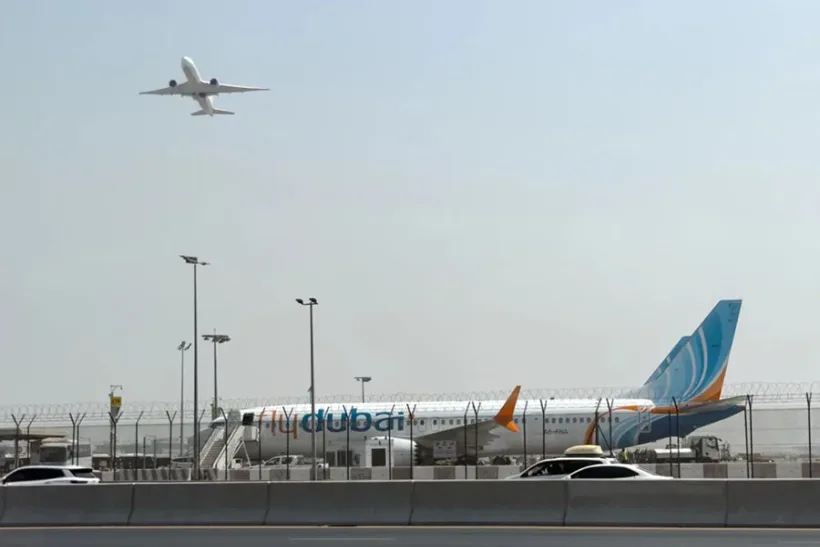
Associated Press
A passenger plane lost nearly 5 km of altitude in one minute after a fight between pilots on a Dubai–Tel Aviv flight. The sharp descent and emergency signals raised alarm in several countries, with initial concerns that the Boeing may have been hijacked. Israel scrambled fighter jets, while the aircraft eventually made an emergency landing in Saudi Arabia, according to the Associated Press.
What Happened on Board the flydubai Flight
flydubai flight FZ1073 departed Dubai for Tel Aviv on the morning of September 30. About two and a half hours later, a fight broke out between the captain and the first officer. Israeli officials told Reuters that the suspected attacker was the first officer, an Omani national. The captain suffered a stab wound. Both pilots were hospitalized after the emergency landing. The captain’s nationality has not yet been definitively established, with Israeli media identifying him as either an Indian or UAE national.
During the fight, the aircraft began rapidly losing altitude, descending from about 10 km to 5.2 km in just one minute. Panic broke out in the cabin, and passengers heard screams coming from the cockpit. Shortly afterward, the Boeing made a circular maneuver near the Jordanian border.
Two other pilots were on board, traveling as passengers. Israel Hayom reports that they were Russian and Ukrainian nationals. They managed to enter the cockpit, take control of the aircraft and land it in Tabuk in northwestern Saudi Arabia. Initial reports linked the Russian and Ukrainian directly to the fight, but that version was later denied.
Hijacking Signal: Israel’s Response
During the incident, flight FZ1073 changed its transponder emergency code several times. At 08:28 UAE time, code 7700 appeared, indicating a general emergency. Six minutes later, it was replaced by 7500, the code for unlawful interference with an aircraft. The crew subsequently switched back to the previous emergency code.
The signals initially raised concerns that the Boeing might have been hijacked. Israel scrambled military aircraft, while security services worked to establish what was happening on board. Prime Minister Benjamin Netanyahu held an urgent meeting over the situation.
The possibility of a conventional hijacking was later ruled out. Israeli authorities began investigating the incident as a possible deliberate attack by the first officer. Investigators are examining whether he attempted to seize control of the aircraft and intentionally force it downward. No final conclusions about his motives have yet been announced.
Aftermath of the Emergency Landing
There were 174 people on board, including 27 children. Following the emergency landing, they were accommodated in the terminal at Tabuk Airport. The situation was complicated by the absence of diplomatic relations between Israel and Saudi Arabia, where Israeli citizens are not normally permitted unrestricted entry. A replacement aircraft was sent from Dubai to return the passengers to Tel Aviv. El Al also offered to provide an aircraft. Some passengers refused to fly with flydubai again and sought alternative ways to return home.
Conflicts between pilots during flights are extremely rare. In June 2022, an Air France captain and first officer fought in the cockpit on a Geneva–Paris flight. Flight attendants intervened, and one of them remained in the cockpit with the pilots for the rest of the journey. The flight landed safely in Paris, and both pilots involved in the altercation were suspended. In that case, the conflict did not affect control of the aircraft or require an emergency landing.
Analysts at International Investment note that the implications of the incident may extend beyond determining responsibility among those directly involved. One of the key questions for the aviation industry is whether existing procedures can identify internal risks related to crew members’ behavior before they pose a threat to flight safety. The findings could influence airline protocols, including assessments of flight crew fitness and procedures for responding to conflicts during a flight.