










Dubai housing prices begin to cool

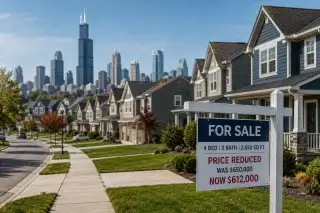
Dubai’s housing market has moved into its first price decline after years of post-pandemic expansion, marking a clear break from one of the world’s strongest residential rallies. Bloomberg reported on April 23 that home values fell for the first time since the pandemic as regional conflict weighed on demand and unsettled parts of the foreign buyer base that had fueled the emirate’s boom.
Why Dubai’s home price cycle is turning
The reversal comes after an exceptional run. Financial Times had noted earlier that Dubai’s average property prices had risen about 75% from February 2021 to spring 2025, putting the market close to its pre-2008 peak. Fitch Ratings warned in 2025 that residential prices could face a double-digit correction in 2025 and 2026 as supply surged across the market.
REIDIN’s March 2026 residential report showed Dubai’s residential sales price index slipping 0.32% month on month while remaining 9.03% higher year on year. The residential rent index also edged down 0.16% from the previous month, even as it stayed 4.13% above its level a year earlier. That combination matters because it suggests the cooling is no longer limited to sentiment alone and is beginning to appear in both sale and rental data.
New supply is reshaping the UAE property balance
The market had been heading toward this inflection point for months. Gulf News, citing Moody’s Ratings in September 2025, reported that more than 150,000 new homes were scheduled for delivery across 2025 to 2027, lifting Dubai’s housing stock by roughly 20%. Moody’s expected a modest price correction to begin in 2026. The same report highlighted that Dubai’s population grew 6% in 2024 to 3.9 million, while average household size fell to 3.9 people from 4.4 in 2019. Those forces supported demand, yet they were unlikely to offset such a large pipeline indefinitely.
Transaction data started to reflect that shift early this year. Market reports built on Dubai Land Department records showed March sales volumes in a range of roughly 13,200 to 13,500 transactions, with transaction value near AED 42.6 billion to AED 43.5 billion. Hindustan Times described the first-quarter drop in activity as nearly 24% from January levels, tying the slowdown to weaker buyer sentiment during the Iran-linked regional escalation.
Geopolitical stress is now part of the pricing equation
Bloomberg’s account is important because it links the first price decline directly to the regional conflict rather than treating it as a purely technical market pause. Dubai has spent several years attracting wealthy expatriates, international investors, and mobile capital searching for tax efficiency and political predictability. Once military risk in the wider region starts to dominate headlines, a market built on confidence becomes more sensitive to hesitation from marginal buyers.
Broader operating conditions have also become harder to ignore. British media reported large-scale disruption to Gulf air traffic and temporary airspace closures in March, including effects on Dubai and Abu Dhabi as transit hubs. That does not imply a housing crash by itself, though it does raise the risk premium attached to real estate decisions in the region at precisely the moment when supply is expanding.
This is a cooling phase, not a systemic collapse
The data still does not support a 2008-style breakdown. Annual price growth remains positive, the luxury end of the market is holding up better than the broad middle segment, and Moody’s described the 12-to-18-month outlook as stable because macroeconomic and demographic fundamentals remain supportive. What has changed is the market regime: sellers no longer control pricing with the same ease they enjoyed during the boom.
That shift is especially relevant in the segments that rose fastest after the pandemic. Moody’s argued that villas were the biggest winners of the post-pandemic cycle and should stay relatively resilient in the near term, yet apartment prices in mid-market areas may face sharper pressure once completions begin to outpace new demand.
Georgia still shows growth where Dubai is slowing
Georgia presents a different backdrop. The International Monetary Fund’s country page lists projected real GDP growth of 5.3% for 2026. The World Bank’s April 2026 monthly economic update said Georgia’s economy expanded 8.8% year on year in February, with average growth of 8.4% in January and February combined. The Asian Development Bank said last week that Georgia’s economy is expected to grow 5.5% in 2026, even while acknowledging geopolitical risks. That macro picture is materially stronger for residential demand than the one facing an overheated Dubai market now entering a correction phase.
Georgia’s national statistics office continues to publish a Residential Property Price Index for Tbilisi covering both flats and detached houses, measured against the previous quarter, the same quarter a year earlier, and the 2020 average. Official and derivative releases based on Geostat data showed double-digit annual price growth in 2025, including gains of 10.9% for flats and 13.5% for detached houses in the first quarter of 2025. The 2026 data infrastructure remains in place, with updated official releases continuing through the Geostat platform.
How Georgia compares on current safety conditions
The practical comparison for investors is straightforward. Dubai is moving from overheating into a cooling phase while geopolitical stress is adding fresh uncertainty to buyer behavior. Georgia, by contrast, still combines economic growth with an upward housing price trajectory, and most of the country continues to operate under standard travel conditions outside clearly identified high-risk zones and periods of protest in the capital.
As International Investment experts report, Dubai has entered a market phase where investors need to focus on supply absorption, segment resilience, and actual discount depth rather than the momentum of the previous rally. Georgia currently looks stronger in relative terms because prices are still rising and the regional operating environment is calmer for real estate execution, provided buyers remain selective on location and project quality.