







 Covivio Hotels Revenue Grows 4.7% as European Markets Split
 Lithuanian Apartment Prices Accelerate Across Major Cities
 Georgia's Tourism Revenue Hits Record High
 Norway's Sovereign Fund Commits €1.5bn to European Warehouses
 Market Rout of October 2026: Can Branded Hotels Protect Capital?
 Residential Property Prices in Tbilisi Rise by 5.9% Year-on-Year
Dubai Property Sales Stay High as Prices Fall
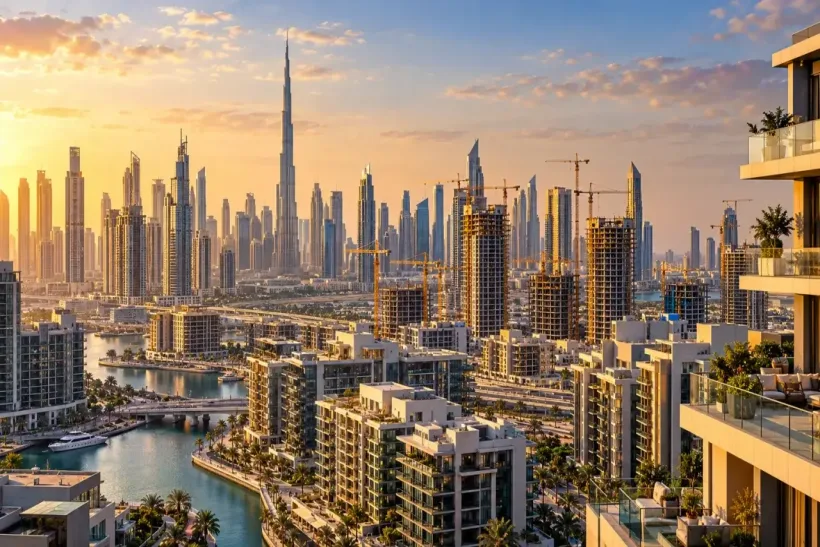
Dubai’s property market continues to generate high transaction volumes, but by autumn 2026 its main indicators are no longer moving in the same direction. Residential transactions reached about AED345 billion, or roughly $94 billion, across more than 103,900 deals between January and August. At the same time, several price indices show declines in home values and rents, while the volume of new housing entering the market is increasing. After several years of rapid appreciation, high turnover no longer automatically means higher prices.
Dubai property sales approach AED345 billion
Residential real estate transactions reached about AED345 billion across more than 103,978 deals during the first eight months of 2026. Data published by Khaleej Times on September 30 put first-half sales at AED286.43 billion across 79,229 transactions, followed by AED34.88 billion and 13,930 deals in July and AED23.26 billion and 10,819 transactions in August.
The figures require some caution when comparing periods. The first-half number in the underlying reporting refers to property sales, while the July and August figures are described as residential. Market databases can also differ in their treatment of apartments, villas, buildings and land. The AED345 billion figure is therefore best understood as the aggregate used in the September report rather than a perfectly uniform residential series.
The comparison base is also unusually high. Residential and commercial property sales reached AED441.22 billion across 137,013 transactions during January-August 2025. Gulf News described that figure as an eight-month record. The two figures are not directly comparable because their coverage differs, but they show how strong the 2025 benchmark was.
Residential sales are below last year
A narrower residential dataset shows the slowdown more clearly. REIDIN’s first-half analysis puts residential sales at AED225.7 billion in H1 2026, down 16% year on year. Transaction volume fell 14% to 81,861.
Properties under construction accounted for AED168.2 billion of the total, while completed homes generated AED57.5 billion. Transaction volumes fell 8% in the pre-completion segment and 26% for ready homes. By August, residential sales stood at AED24.43 billion across 11,440 transactions, with value down 7.8% from July and volume down 14.6%.
The dominance of properties under construction helps explain why transaction turnover can remain high as prices weaken. A purchase is registered when the contract is signed even when completion is several years away. Long instalment schedules and post-handover payment plans can also support primary-market demand despite softer conditions in the completed-home market.
Dubai home prices have started to fall
The latest price indices confirm that the market has entered a correction. ValuStrat’s August Price Index fell to 218.8 points, with residential capital values down 0.2% month on month and 3.1% year on year.
Apartment values were 5.3% lower than in August 2025. Villa prices declined 1.7% annually, their first year-on-year contraction since 2021.
The adjustment remains highly uneven. Around 73% of freehold villa communities and 61% of apartment communities recorded no monthly change. Villas on Jumeirah Islands were still up 12.2% year on year, while Emirates Hills gained 7.4%.
This widening gap between districts is becoming one of the defining characteristics of the current cycle. Scarce properties in established locations can continue to appreciate while the broader city index falls.
The correction was visible before August
Signs of the shift had already appeared during the spring. Cushman & Wakefield Core found that citywide residential sale prices fell 4% quarter on quarter in Q2, while rents declined 6%.
Apartment values on Palm Jumeirah fell 9% over the quarter, while Downtown Dubai and Business Bay declined 7%. Villa prices in The Springs and The Meadows fell 9%, with Dubai Hills Estate down 5%.
Rental adjustments were sharper in several major apartment districts. Downtown Dubai rents fell 14% quarter on quarter, while Dubai Hills Estate and Dubai Marina declined 10% and Palm Jumeirah 9%.
Average residential sale prices still stood at AED1,855 per square foot. The correction also follows five years of strong appreciation, meaning values in many communities remain substantially above levels seen at the beginning of the current cycle.
New housing supply is accelerating
Supply is emerging as one of the most important variables for the market. Dubai Land Department reported that 104 property projects with an investment value exceeding AED111 billion were completed during the first half of 2026.
Those projects added 24,537 units. The number of completed developments rose 38.7% from a year earlier, their investment value increased 52% and new unit deliveries grew by more than 36%.
Owner-occupier demand is also expanding. Dubai’s First-Time Home Buyer Programme, launched in July 2025, had helped more than 3,200 residents buy their first homes by June 2026, generating transactions worth more than AED5 billion.
Dubai could deliver 55,600 homes this year
Around 55,600 residential units are expected to be handed over during 2026, potentially the highest annual delivery total since 2008. More than 23,600 units were completed in the first half, with another 32,000 expected during the second.
The increase in supply is already changing negotiating conditions. Tenants have more choice, landlords face greater competition and buyers can compare a growing pool of completed properties with new developments.
Not all announced supply will necessarily arrive on schedule. Contractor capacity and supply-chain constraints can delay completions, so actual handovers remain more important than the headline development pipeline.
Developers have built a large 2028–2029 pipeline
Dubai launched 141 residential projects comprising 50,935 units in the first half of 2026. The average launch price was AED1,972 per square foot, while the median was AED1,725.
Mid-market and upper-mid-market projects represented 92.7% of all announced units. Meydan led new supply with 13,231 units, followed by Jumeirah Village Circle with 2,753 and Majan with 2,564.
Some 36,103 units, or 70.9% of the first-half launch pipeline, are scheduled for delivery in 2028 and 2029. That reduces the immediate impact on physical supply but creates a substantial stock of future homes that may eventually compete for tenants and resale buyers.
Luxury property is following a different path
Dubai’s ultra-prime segment remains considerably more resilient. Knight Frank recorded 296 home sales above $10 million during the first half of 2026, including 165 in Q1 and 131 in Q2.
The number of transactions above $10 million increased 16% from H1 2025, while their combined value rose 14% to $5.1 billion. Twenty-six homes changed hands for more than $25 million.
The most expensive individual transaction in the first half was a six-bedroom apartment at Aman Residences in Jumeirah Second, sold for $114.9 million, or about AED422 million.
The figures illustrate why citywide averages increasingly fail to describe the whole market. Global demand for scarce prime assets can remain strong while standard apartments in districts with expanding supply experience price pressure.
Dubai is moving from broad growth to project competition
Dubai now has several indicators moving in different directions. Transaction turnover remains high, properties under construction dominate primary sales and the top end of the market continues to attract global wealth. At the same time, citywide prices are declining, rents have softened, residential transaction volumes are below last year and new supply is increasing.
This does not yet amount to a uniform downturn across the emirate. It points instead to a more selective market in which entry price, location, completion date, construction quality, payment structure and competing supply increasingly determine performance.
As International Investment experts report, the main risk for Dubai is not the size of the construction pipeline alone, but whether future demand can absorb incoming supply without further pressure on prices and rents. Pre-completion sales can sustain headline turnover well after the completed-home market begins to soften because years may pass between registration and handover. If a large share of the 2026–2029 pipeline arrives on schedule, standardised projects in high-supply districts are likely to face the greatest competition. Scarce locations, high-quality family housing and unique ultra-prime assets may continue to behave differently. The current data therefore point to a transition from broad-based appreciation towards a more selective market rather than an extension of the previous price rally.
FAQ: Dubai real estate market
Are Dubai property prices falling?
Average indices now show declines. ValuStrat recorded a 0.2% monthly and 3.1% annual decrease in August, although performance varies significantly between communities and property types.
How much property was sold in Dubai in 2026?
The series published on September 30 puts January-August activity at around AED345 billion across more than 103,900 transactions. Totals can differ depending on whether land, buildings and commercial property are included.
Did Dubai set another record in 2026?
It would be inaccurate to describe the first eight months of 2026 as a new absolute record. A broader market measure reached AED441.22 billion during January-August 2025, and the datasets do not have identical coverage.
Why are transactions high while prices are falling?
A large proportion of sales involve properties under construction. These transactions are registered now even though the homes may not be completed for several years. Developer instalment plans also support primary-market activity.
How much new housing is coming to Dubai?
Around 55,600 residential units are expected to be delivered in 2026, while a large additional development pipeline is scheduled for 2028 and 2029.
What is happening to Dubai rents?
Average rents have begun to decline. Citywide rents fell 6% quarter on quarter in Q2, although changes vary considerably between districts.
Is demand for luxury property still strong?
Yes. Dubai recorded 296 home sales above $10 million in the first half of 2026, with their combined value reaching $5.1 billion.