







 Vietnam Mortgage Surge Pushes Homes Out of Reach
 Lithuanian Apartment Prices Accelerate Across Major Cities
 London Flats Lose Value Ahead of Leasehold Reform
 Construction of the Batumi–Sarpi Highway Begins in Georgia
 Baltic Property Investment Accelerates in 2026
 Hong Kong and Singapore Renew Their Expat Rivalry
US Keeps Tourism Lead
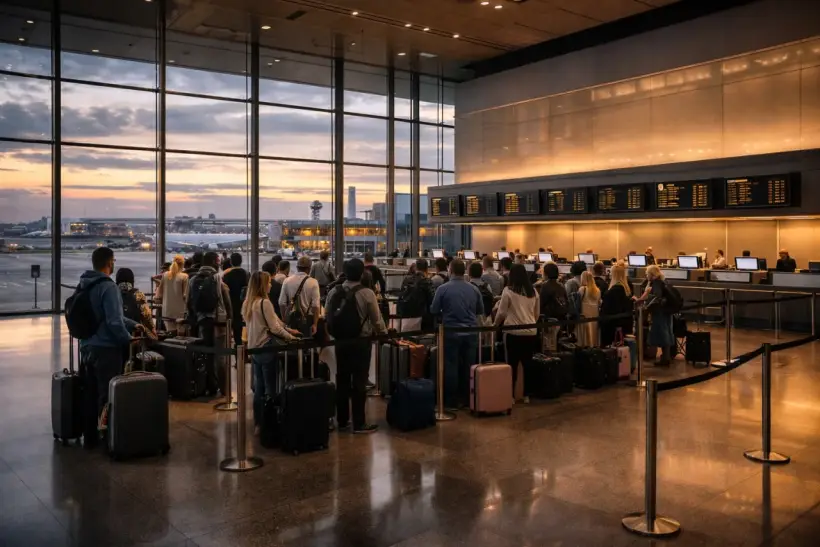
The United States remained the world’s largest travel and tourism market in 2025, but sector growth slowed sharply and inbound demand weakened even as global international travel continued to recover. Hospitality Net, citing World Travel & Tourism Council research, said US travel and tourism GDP grew just 0.9%, while Asia-Pacific expanded 8.1% and international visitor spending in the US fell 4.6% to $176 billion.
The US stayed number one by scale
Even with slower momentum, the US remained the largest market in absolute economic terms. According to the council’s latest estimates, the sector contributed $2.63 trillion to the US economy in 2025 and supported 20.4 million jobs, up 1.2% year on year. Domestic demand continued to provide the main cushion, with domestic visitor spending reaching $1.54 trillion, 14.3% above pre-pandemic levels.
Set against the global backdrop, that performance looks more mixed. Worldwide, travel and tourism had its strongest year on record, with total GDP contribution reaching $11.6 trillion, equivalent to 9.8% of the global economy. But North America was the slowest-growing major region at 1.0%, highlighting a widening gap between the US and faster-growing Asian destinations.
Inbound travel became the weak point
The main warning sign came from international demand rather than domestic travel. In 2025, international visitor numbers to the US declined 5.5% from 2024, even though global cross-border travel volumes kept expanding. The drop in foreign visitor spending to $176 billion points to direct pressure on tourism exports, hotels, airlines, retail and urban visitor economies across major US destinations.
That trend stands in contrast to earlier official expectations. The National Travel and Tourism Office had forecast international arrivals to the US would rise to 77.1 million in 2025 from 72.4 million in 2024, then increase to 85 million in 2026 and move above the 2019 level of 79.4 million. The weaker outcome shows how far actual inbound performance has diverged from the earlier recovery path.
The market has reached a strategic crossroads
Industry groups increasingly describe the current phase as a strategic turning point. The U.S. Travel Association warned in its 2025 forecast that international visits could fall from 72.4 million in 2024 to 67.9 million in 2025, the first decline since 2020, while foreign visitor spending could come in at $173 billion. The group linked the risk to outdated entry infrastructure, long visa wait times and new travel deterrents, arguing that the US could lose share to more competitive destinations without policy and operational changes.
That is why the description of the country being “at a crossroads” is more than rhetoric. The vast domestic market still keeps the US in first place globally, but slower recovery in inbound demand is limiting growth and raising the risk that the country could lose ground over time as Asia expands faster in visitor spending, jobs and tourism capacity.
Asia is increasing competitive pressure
China, the world’s second-largest travel and tourism market, lifted the sector’s economic contribution to $1.75 trillion in 2025, with growth of 9.9%. International visitor spending in China rose 10.5% to $135 billion, domestic spending increased 10.7% to $890 billion, and the sector supported 84.6 million jobs. For the US, that matters because it shows not just a strong competitor, but a broader shift in global travel momentum toward markets that are recovering international demand more quickly.
Across Asia-Pacific as a whole, travel and tourism GDP reached $3.29 trillion, with Malaysia and the Philippines among the fastest-growing markets. For investors and operators, that suggests a sharper competition for routes, capital, brand investment and visitor attention at the same moment the US needs to rebuild its international appeal.
Why 2026 could still change the picture
The US still has a strong opportunity to improve performance in 2026. The council said major football events to be co-hosted by the country next year could bring around 1.24 million international visitors during the tournament period. Combined with the government’s expectation of stronger inbound flows in 2026, those events could serve not only as a short-term demand boost, but as a platform to reposition the US as a more attractive destination for leisure, business and stopover travel.
But the opportunity is not automatic. Without smoother visa processing, stronger transport capacity and a clearer perception of the country as an easy place to visit, major events alone may not be enough to create a durable turnaround. The sector needs not just a spike in arrivals, but a sustained recovery in international visitor spending.
As International Investment experts report, the US travel market preserved its global scale in 2025 thanks to domestic demand, but inbound travel became the sector’s key vulnerability. Unless international visitor spending returns to a stronger growth path, the US may remain the largest market by size while losing part of its global influence in growth, competitiveness and long-term investment appeal.
FAQ on the US travel market
Why is the US still considered the world’s largest travel market?
Because travel and tourism contributed $2.63 trillion to the US economy in 2025, the highest figure globally.
What was the main weakness in 2025?
The main weakness was inbound travel, with international visitor numbers down 5.5% and international visitor spending down 4.6%.
Why doesn’t strong domestic travel solve the whole problem?
Because domestic spending supports overall scale, but foreign visitors are a crucial source of tourism exports and demand for hotels, air travel and destination services.
What had the US government expected for international arrivals?
The official forecast had projected 77.1 million arrivals in 2025 and 85 million in 2026, but actual performance weakened instead.
Why is Asia becoming a stronger competitive threat?
Because the region is growing much faster, and China is already much closer to the US in scale while recovering inbound and domestic demand more strongly.
Can 2026 events help the US market recover?
Yes, major football tournaments could attract about 1.24 million international visitors, but a lasting benefit will depend on better entry processes and stronger visitor experience.